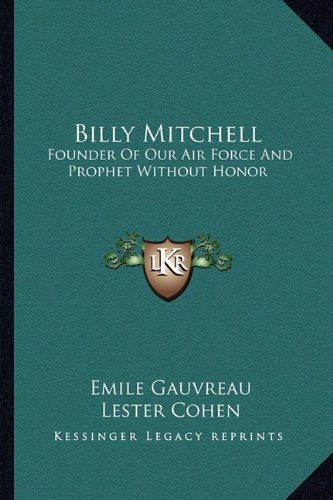
Billy Mitchell: Founder Of Our Air Force And Prophet Without Honor
(This scarce antiquarian book is a facsimile reprint of th...)
This scarce antiquarian book is a facsimile reprint of the original. Due to its age, it may contain imperfections such as marks, notations, marginalia and flawed pages. Because we believe this work is culturally important, we have made it available as part of our commitment for protecting, preserving, and promoting the world's literature in affordable, high quality, modern editions that are true to the original work.
(First edition bound in black cloth with gold lettering & ...)
First edition bound in black cloth with gold lettering & design. This is a special Screen edition with 4 b&w stills from the Universal Picture (Retitled "Scandal For Sale"). A VG copy, has tiny frays at the head of the spine a little bit of rubbing at the corners. Inside is clean, tight and unmarked. Solid copy.
Emile Henry Gauvreau was an American newspaper editor.
Background
Gauvreau was born on February 4, 1891 in Centerville, Connecticut, the son of French-Canadian immigrants, Alphonse Gauvreau, who worked in an arms factory, and Malvina Perron. When Gauvreau was six, his right leg was crippled in a traumatic incident. He later credited the handicap with turning his interests toward literature and music.
Education
For a time the family returned to Canada and Gauvreau was educated at the Jesuit-run Provencher Academy in Montreal. When the Gauvreaus returned to the United States, he entered public schools. At the age of eighteen, Gauvreau abandoned both high school and study as a flutist to work on the New Haven Journal-Courier.
Career
As a cub reporter Gauvreau evinced tenacity and a talent for developing sensational news. He exposed officials who were taking graft from prostitutes, and later solved a murder that had baffled the police. The latter achievement won him a standing offer from Clifton L. Sherman, managing editor of the Hartford Courant; and in August 1916, Gauvreau moved to that city. Gauvreau's tenure at the Courant was spotted with controversy. With many exclusives to his credit, he rose to assistant managing editor and, following Sherman's resignation in September 1919, to managing editor. His vigorous, somewhat sensational news policies placed him in conflict with Charles Hopkins Clark, majority stockholder and editor in chief. When Gauvreau refused to terminate a series of stories about a traffic in fake medical diplomas, Clark forced him to resign. Gauvreau then went to New York and, almost by chance, was hired by physical culturist and publisher Bernarr Macfadden to organize a daily newspaper, which appeared on September 15, 1924, as the New York Evening Graphic. The Graphic was bizarre even in the "jazz journalism" era; its tone was lurid and it employed such techniques as the "composograph, " a manufactured illustration that looked like a photograph. Gauvreau struggled for five years to put the Graphic on a high-circulation, profitable basis, but it was a losing battle. He left the Graphic long before its 1932 closing, hired away by William Randolph Hearst in 1929 to work on the New York Mirror. As managing editor, Gauvreau found himself again in a circulation contest against the more successful New York Daily News. As a result, the Mirror paid less attention to news than to scandal, racing information, and promotional contests; its star was the Broadway columnist Walter Winchell, with whom Gauvreau was not on speaking terms, and about whom he wrote a novel, The Scandal Monger. Nor did he work smoothly with Arthur Brisbane, whom Hearst installed as editor in 1934. In 1935 Gauvreau published What So Proudly We Hailed, which contrasted the Soviet Union, as he had seen it as an observer on a congressional mission in 1933, and America. Hearst mistakenly believed the work to be procommunist, and Gauvreau was fired. A friend, Representative William I. Sirovich of New York, then obtained Gauvreau a position as staff investigator for the House Committee on Patents. One assignment dealt with patent pooling in the aircraft industry; this inquiry led to his acquaintance with and admiration of General William Mitchell, the advocate of air power who had been court-martialed for expressing his opinions. Gauvreau was coauthor of a biography of Mitchell (1942), who died in 1936. Late in 1936, Gauvreau went to work at the Philadelphia Inquirer, which had been acquired by the racing-news magnate Moses Annenberg. Placed in charge of the rotogravure section, Gauvreau produced features in the gaudiest Sunday-supplement tradition. In 1938 Annenberg named Gauvreau editor of Click, one of many picture magazines founded in the late 1930's. Underpaid and overloaded with assignments, he resigned in 1940, following a conflict with management over his secretary's wages. In his later years he was handicapped by a deteriorative brain condition. He died in Suffolk, Virginia.
Achievements
Gauvreau was a newspaper editor, who established a reputation as a skilled practitioner of a flawed trade.
Before leaving New Haven Gauvreau married Sarah Welles Joyner, the Journal-Courier society editor. They had three children and were divorced in 1936. After his divorce from his first wife, Gauvreau married Winifred C. Rollins, who had been his secretary at the Mirror, on December 5, 1936.