

Background
Bauer, Henry Hermann was born on November 16, 1931 in Vienna, Austria. Son of Martin Josef and Anne (Rafael) Bauer. came to the United States, 1965, naturalized, 1969.
http://www.amazon.com/gp/product/B00Y2S02G8/?tag=2022091-20
http://www.amazon.com/gp/product/0470059206/?tag=2022091-20
http://www.amazon.com/gp/product/0252012844/?tag=2022091-20
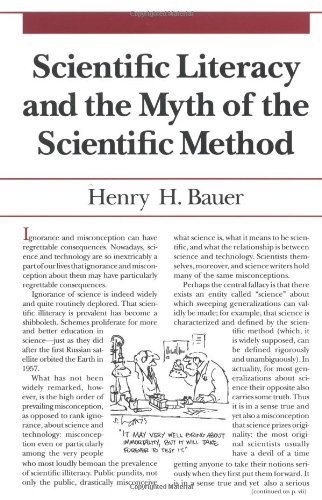
(Scientific Literacy and the Myth of the Scientific Method...)
Scientific Literacy and the Myth of the Scientific Method (View amazon detail page) ASIN: 0252064364
http://www.amazon.com/gp/product/0252064364/?tag=2022091-20
http://www.amazon.com/gp/product/B010WFMYHO/?tag=2022091-20
http://www.amazon.com/gp/product/B010WEO0V8/?tag=2022091-20
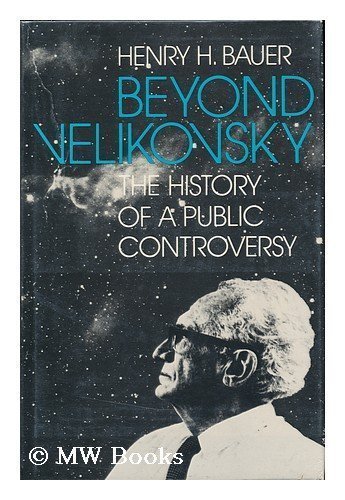
(Since the appearance in 1950 of Worlds in Collision, Imma...)
Since the appearance in 1950 of Worlds in Collision, Immanuel Velikovsky's radical theories of planetary physics have been the center of controversy. "Beyond Velikovky" presents a detailed analysis of the entire Velikovsky affair, conclusively resolves the major misunderstandings and primary arguments between opposing camps, and leads us beyond to a more complete understanding of the scientific process itself.
http://www.amazon.com/gp/product/025201104X/?tag=2022091-20
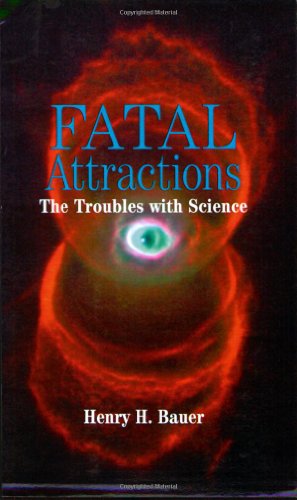
(The modern world has become fatally addicted to science. ...)
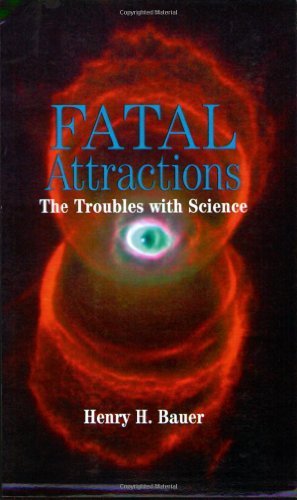
The modern world has become fatally addicted to science. In the beginning, the natural sciences were simply humankind's storehouse of knowledge about the mechanics of the world. But increasingly, since the late 19th century, science has become a universal role model for how to acquire knowledge. Science-based metaphors pervade our words and thoughts. Science is now our very arbiter of truth, and has even become a surrogate religion. Science now occupies an impossibly demanding cultural role and, inevitably, misconceptions about it are rampant. Therein lies the root of the troubles with science. Curing those troubles requires that we understand what science's manifold faces are and allow each to have only as much influence as it really deserves.
http://www.amazon.com/gp/product/1931044287/?tag=2022091-20
http://www.amazon.com/gp/product/B011W9MSDY/?tag=2022091-20
(This is a book that all scientists should read, and a boo...)
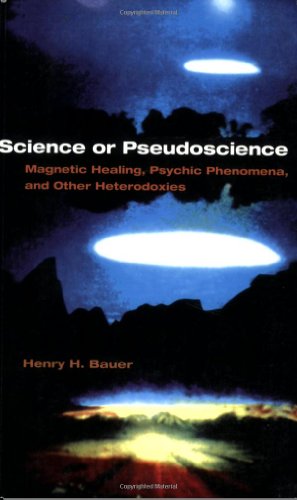
This is a book that all scientists should read, and a book that all who are interested in the unexplainable will want to read. Bauer explores how examining anomalies have profited humankind and restores the respectability - and necessity - of such pursuits in a fascinating overview of science and the pursuit of the unknown. Although science attempts to draw a clear line separating its endeavours from those of "pseudoscience", Henry Bauer reveals that the distinction is both equivocal and misleading. Setting aside science's snowy mantle of truth, Bauer presents pseudoscience - or anomalistics - not as the opposite of science but as something that develops parallel to it. Science assumes anomalies - that is, phenomena that contradict the existing store of knowledge - result from error, contamination, or even deception: in short, from bad research technique, at best, and deliberate hoax, at worst. Anomalists, by contrast, accept such occurrences, often on the basis of eyewitness claims, as important in themselves and worthy of further study, even if they contradict prevailing theories and offer a minimal degree of reproducibility. "Science or Pseudoscience" explores the diffuse and porous borders between mainstream and unorthodoxy. A scientist himself, Bauer points out that some phenomena that have turned out to be spurious, such as polywater and cold fusion, were for a time taken quite seriously by respected members of the scientific community. Other anomalies, such as ball lightning and meteorites, were dismissed by many scientists but turned out to be legitimate discoveries. Meanwhile, science has failed to prove that phenomena encompassed by the "big three" subjects in anomalistics - parapsychology, ufology, and cryptozoology (e.g., the Loch Ness monster) - do not exist. Rather, science theorizes that these phenomena cannot exist, since today's scientific laws seem to hold them to be impossible. Bauer discusses anomalies such as archaeoastronomy (e.g., Stonehenge) and bioelectromagnetics and looks at how institutional, commercial, and political interests influence borderline research in mainstream laboratories. He also draws a distinction between fraud and commercial huckstering, on the one hand, and genuine knowledge-seeking about matters ignored by the established intellectual disciplines, on the other. Bauer notes that the more closely anomalistic research approaches science, the more strenuously it is criticized by the establishment, often in terms of heresy. Reminding us that geniuses are cranks who happen to be right while cranks may be geniuses who happen to be wrong, "Science or Pseudoscience" offers a measured and thoughtful assessment of this volatile debate.
http://www.amazon.com/gp/product/0252072162/?tag=2022091-20
Chemistry and science educator
Bauer, Henry Hermann was born on November 16, 1931 in Vienna, Austria. Son of Martin Josef and Anne (Rafael) Bauer. came to the United States, 1965, naturalized, 1969.
Bachelor of Science, University Sydney, 1952. Master of Science, University Sydney, 1953. Doctor of Philosophy, University Sydney, 1956.
Research associate, University of Michigan, 1956-1958; visiting scientist, University of Michigan, 1965-1966; lecturer, senior lecturer, U. Sydney, 1958-1966; associate professor, professor, U. Kentucky, 1966-1978; visiting professor, Southampton (England) University, 1972-1973; dean College Arts and Sciences, Virginia Polytechnic Institute and State University, Blacksburg, 1978-1986; professor of chemistry and science studies College Arts and Sciences, Virginia Polytechnic Institute and State University, Blacksburg, since 1986.
(Since the appearance in 1950 of Worlds in Collision, Imma...)
(This is a book that all scientists should read, and a boo...)
(Scientific Literacy and the Myth of the Scientific Method...)
(The modern world has become fatally addicted to science. ...)
Member Society Science Exploration (founding member, councillor), International Society Cryptozoology.
Married Barbara Bush, August 25, 1986. Children from previous marriage: Helen Suzanne, Judith Annual.
