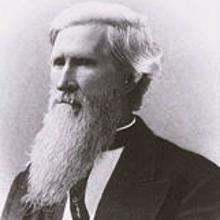
Henry Massie Rector was an American lawyer and politician. He served as Governor of Arkansas from 1860 to 1862.
Background
Henry Massey Rector was born on May 1, 1816 in Louisville, Kentucky, United States. He was the son of Elias and Fannie Bardella Thruston Rector. He was a descendant of John Jacob Rector who emigrated from Saxony and settled in Fauquier County, Virginia, in 1714. Elias moved to St. Louis and died when Henry was six.
His mother remarried after his father's death, and from age thirteen to nineteen, Henry had an unhappy childhood at the salt-works of his stepfather, Stephen Trigg, cutting and hauling wood.
Education
Henry received the rudiments of an education from his mother, but his formal schooling was limited to two years spent at Francis Goddard's school in Louisville.
Career
At the age of nineteen Henry Rector went to Arkansas to look after the extensive land claims his father had held in and around Hot Springs. Several individuals and the United States claimed these lands and Rector spent many years and thousands of dollars in litigation.
In 1842 Rector was appointed marshal by President Tyler. From 1848 to 1852 he served in the state Senate.
In 1854 he began to practice law in Little Rock and the next year was elected to the House of Representatives. The "Johnson Dynasty," desiring to shelve him, elected him a judge of the supreme court in 1859, and the following year, by clever manipulation of the state convention, nominated Richard H. Johnson for governor. In order to break the hold of the "dynasty, " Rector resigned from the supreme court and made a successful contest for the governorship. Two years later, however, the "dynasty" had its revenge when the secession convention so altered the constitution as to terminate Rector's term of office at the end of two years, although the four-year term for other officials was not shortened. Rector unsuccessfully fought this action in the courts. He ran for reelection but was defeated. A secessionist from the beginning, he persuaded a reluctant legislature to call a secession convention. To Secretary Cameron's request for Arkansas troops, he replied: "None will be furnished. The demand is only adding insult to injury," and he was delighted when the convention reassembled and voted secession with only one negative vote. The Johnson faction was ready to embarrass him at every turn. General T. C. Hindman, who had supported him in 1860, turned against him, largely because of differences over martial law and conscription. Rector differed with the Richmond government over taking Arkansas troops out of the state, even threatening to secede from the Confederacy, but at heart he was loyal.
On November 4, 1862, he resigned the governorship in the face of political pressure against his resistance to the Confederate government. Rector held no other office in the Confederacy. Rector served as a private in the state militia for the rest of the war.
After the war, he was a planter in Pulaski County, Arkansas. He was elected as a delegate to the state constitutional conventions of 1868 and 1874, but he held no political office.
In 1875 the claim of the United States was sustained by the Supreme Court, but Congress later created a commission with authority to sell lots at a nominal price to the claimants who had made improvements thereon. Rector had thirty-two houses occupied by renters, but the commission awarded them to the occupants. Although the decision of the commission was to be final he appealed, in most of the cases successfully. For years afterward, when a shot was heard in town, someone would exclaim, "Look out, old Governor Rector is collecting his rent."
Achievements
Henry Massey Rector distinguished himself as 6th Governor of Arkansas. During his term, Arkansas was admitted to the Southern Confederacy after the convention passed the Ordinance of Secession. He also served in the Arkansas Senate and in the Arkansas House of Representatives.
Politics
A member of the Democratic Party, ideologically Rector was pro-slavery.
Connections
In October 1838 Henry married Jane Elizabeth Field. She died in 1857, and in February 1860 he married Ernestine Flora Linde, of Memphis. By his first wife he was the father of four sons and two daughters; by his second, of one daughter.