Background
Goldstine, Herman Heine was born on September 13, 1913 in Chicago, Illinois, United States. Son of Isaac Oscar and Bessie (Lipsey) Goldstine.

(The calculus of variations is a subject whose beginning c...)
The calculus of variations is a subject whose beginning can be precisely dated. It might be said to begin at the moment that Euler coined the name calculus of variations but this is, of course, not the true moment of inception of the subject. It would not have been unreasonable if I had gone back to the set of isoperimetric problems considered by Greek mathemati cians such as Zenodorus (c. 200 B. C. ) and preserved by Pappus (c. 300 A. D. ). I have not done this since these problems were solved by geometric means. Instead I have arbitrarily chosen to begin with Fermat's elegant principle of least time. He used this principle in 1662 to show how a light ray was refracted at the interface between two optical media of different densities. This analysis of Fermat seems to me especially appropriate as a starting point: He used the methods of the calculus to minimize the time of passage cif a light ray through the two media, and his method was adapted by John Bernoulli to solve the brachystochrone problem. There have been several other histories of the subject, but they are now hopelessly archaic. One by Robert Woodhouse appeared in 1810 and another by Isaac Todhunter in 1861.
http://www.amazon.com/gp/product/0387905219/?tag=2022091-20

(In this book I have attempted to trace the development of...)
In this book I have attempted to trace the development of numerical analysis during the period in which the foundations of the modern theory were being laid. To do this I have had to exercise a certain amount of selectivity in choosing and in rejecting both authors and papers. I have rather arbitrarily chosen, in the main, the most famous mathematicians of the period in question and have concentrated on their major works in numerical analysis at the expense, perhaps, of other lesser known but capable analysts. This selectivity results from the need to choose from a large body of literature, and from my feeling that almost by definition the great masters of mathematics were the ones responsible for the most significant accomplishments. In any event I must accept full responsibility for the choices. I would particularly like to acknowledge my thanks to Professor Otto Neugebauer for his help and inspiration in the preparation of this book. This consisted of many friendly discussions that I will always value. I should also like to express my deep appreciation to the International Business Machines Corporation of which I have the honor of being a Fellow and in particular to Dr. Ralph E. Gomory, its Vice-President for Research, for permitting me to undertake the writing of this book and for helping make it possible by his continuing encouragement and support.
http://www.amazon.com/gp/product/1468494740/?tag=2022091-20
(In this book I have attempted to trace the development of...)
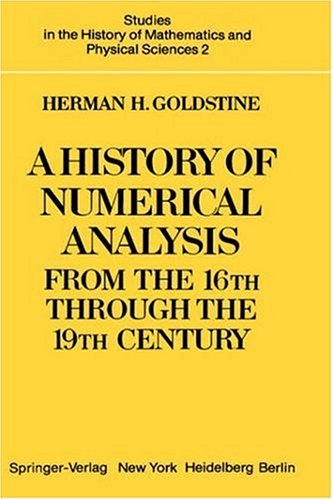
In this book I have attempted to trace the development of numerical analysis during the period in which the foundations of the modern theory were being laid. To do this I have had to exercise a certain amount of selectivity in choosing and in rejecting both authors and papers. I have rather arbitrarily chosen, in the main, the most famous mathematicians of the period in question and have concentrated on their major works in numerical analysis at the expense, perhaps, of other lesser known but capable analysts. This selectivity results from the need to choose from a large body of literature, and from my feeling that almost by definition the great masters of mathematics were the ones responsible for the most significant accomplishments. In any event I must accept full responsibility for the choices. I would particularly like to acknowledge my thanks to Professor Otto Neugebauer for his help and inspiration in the preparation of this book. This consisted of many friendly discussions that I will always value. I should also like to express my deep appreciation to the International Business Machines Corporation of which I have the honor of being a Fellow and in particular to Dr. Ralph E. Gomory, its Vice-President for Research, for permitting me to undertake the writing of this book and for helping make it possible by his continuing encouragement and support.
http://www.amazon.com/gp/product/0387902775/?tag=2022091-20
mathematician association executive
Goldstine, Herman Heine was born on September 13, 1913 in Chicago, Illinois, United States. Son of Isaac Oscar and Bessie (Lipsey) Goldstine.
Bachelor of Science, University Chicago, 1933. Master of Science, University Chicago, 1934. Doctor of Philosophy, University Chicago, 1936.
Doctor of Philosophy honoris causa (honorary), University Lund, Sweden, 1974. Doctor of Science (honorary), Amherst College, 1978. Doctor of Science (honorary), Adelphi University, 1978.
Doctor of Science (honorary), Rutgers University, 1994.
Research assistant, University of Chicago, 1936-1937; instructor, University of Chicago, 1937-1939; instructor, University of Michigan, Ann Arbor, 1939-1942; assistant professor, University of Michigan, Ann Arbor, 1942-1950; associate project director electronic computer project, Institute Advanced Study, Princeton, New Jersey, 1946-1955; acting project director, Institute Advanced Study, Princeton, New Jersey, 1954-1957; permanent member, Institute Advanced Study, Princeton, New Jersey, since 1952; director mathematics science department, International Business Machines Corporation Research, 1960-1965; director science development, International Business Machines Corporation Data Processing Headquarters, White Plains, New York, 1965-1967; consultant to director research, International Business Machines Corporation, 1967-1969; fellow, International Business Machines Corporation, since 1969; Executive officer, American Philosophical Society, Philadelphia, 1984-1997. Head Electronic Numerical Integrator and Computer Project United States Army, officer in charge of sub-station, Aberdeen Proving Grounds, University of Pennsylvania, 1942-1946. Consultant various government and military agys., 1946-1984.
(In this book I have attempted to trace the development of...)
(In this book I have attempted to trace the development of...)
(The calculus of variations is a subject whose beginning c...)
(Reprinted in 1994. This vol. presents tables giving the d...)
Trustee University of Pennsylvania Press, since 1985. Member of advisory county history of science program Princeton University, 1982-1987. Member visiting committee physical science division University of Chicago, 1976-1986.
Member committee Annenberg Research Institute, 1987-1991. Board directors National Constitution Center, 1987-1990, Glaucoma Svc. Foundation to Prevent Blindness, since 1989.
Member of advisory board Parkinson's Disease and Movement Disorders Center, since 1996. Lieutenant colonel Army of the United States, World World War World War II. Member NAS, American Mathematics Society, American Philosophical Society (Ben Franklin medal), American Academy Arts and Sciences, Mathematics Association American, College Physicians Philadelphia, Century Association, Union League (Philadelphia), Phi Beta Kappa (book award in science 1973), Sigma Xi.
Married Adele Katz, September 15, 1941 (deceased 1964). Children: Madlen, Jonathan. Married Ellen Watson, January 8, 1966.