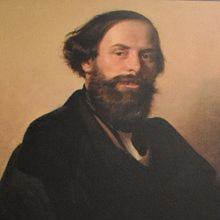
Background
Ippolito Caffi was born on October 16, 1809 in Belluno, Italy, to Giacomo and Maria Castellani.


Ippolito Caffi was born on October 16, 1809 in Belluno, Italy, to Giacomo and Maria Castellani.
Caffi studied in Belluno, then in Padua with his cousin, painter Pietro Paoletti, and finally at the Venice Academy.
Caffi's first works were produced at the Academy of Fine Arts of Venice. In January 1832, he moved to Rome and made some reputation by his treatise on perspective, as well as by his investigations on Roman archaeology.
At the beginning of 1833 Caffi opened his own studio in Rome, devoting himself to painting. He often moved to other cities to exhibit his works.
In 1841 Caffi decorated the Roman hall of the Caffè Pedrocchi of Padua. In 1843 he visited Greece and the East (Athens, Constantinople, Syria, Egypt, and Malta) and returned to Italy in 1844, full of sketches and works. The first work of his that created a sensation was "Carnival at Venice". This was exhibited at Paris in 1846, and was admired for its brilliant effects of light. Other works were his "Panorama of Rome from Monte Mario, Isthmus of Suez", and "Close of the Carnival at Rome".
In 1849 he settled in Genoa, Switzerland and in 1850 in Turin. After a series of trips to France, Spain and the United Kingdom, where he exhibited at the Universal Exposition in London, in 1855 he returned to Rome and in 1858 again to Venice.
Throughout his life he managed to keep a fairly high standard of living, selling his paintings, some replicated many times, to European nobles, including the Prince of Austria himself.
However, his aim of commemorating in paint the first Italian naval engagement was frustrated when the Re d' Italia, on which he traveled was destroyed on July 20, 1866, by Austro-Venetian fleet at the battle of Lissa, drowning him along with his comrades.
Caffi was an outstanding Italian painter of the 19th century. By 1830, he had won awards for his vedute "Il ponte di Rialto" at the Academy of Fine Arts of Venice.
Only a few his works, including "Night party in San Pietro di Castello", "Health and the Grand Canal with snow", "Caravan in the desert", "Belluno and Mount Serva", and "Piazza San Marco with fog", are preserved at the Civic Museum of Belluno. Other canvases are part of private collections, and many other works are kept in museums, villas and palaces of many Italian and European cities, including Vatican City, Copenhagen, Rome, Turin, Treviso, Trieste, Venice.
Benedizione Di Pio Ix Dal Quirinale Di Notte
Snow and Fog on the Grand Canal
Florence, a View of the Piazza Della Signoria with the Loggia Dei Lanzi at Left
The Parthenon
Aqueducts in the Roman Campagna
Venedig, Nachtfest Auf Der Via Eugenia (heute Via Garibaldi)
Autoritratto
Nocturnal Celebrations in Via Eugenia at Venice
Die Ankunft Von Kaiser Franz Joseph Und Kaiserin Elisabeth Von Österreich in Venedig Im Jahr 1856
Bucht von Neapel
Nizza, Strandansicht Vom Quai Du Midi Aus
Vittorio Emanuele a Napoli 7.11.1860
Bombardment of Marghera Made by the Austrian Army on the Night of May 24, 1849
Blick Auf Die Kirchen Maria Dei Miracole Und Santa Maria Nova in Venedig
Markusplatz in Venedig Im Mondlicht
La Piazza Di Monte Cavallo
Venedig, Die Piazzetta Bei Nacht
View of the Pantheon, Rome
It is known that Caffi joined revolutionary movements in Venice in 1848. In 1860 he was a political prisoner in the prison of San Severo for three months, due to his frequent visits to Turin and Milan, which aroused the suspicions of the Austrian authorities.