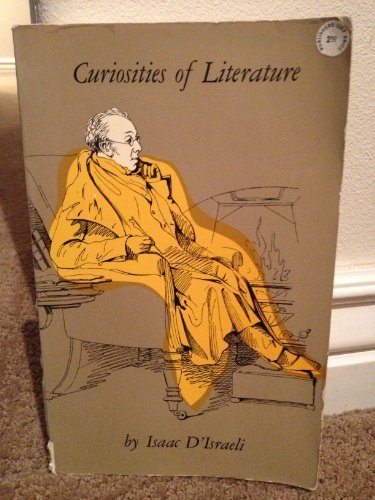
(A collection of literary and historical anecdotes, observ...)
A collection of literary and historical anecdotes, observations about unusual books, and accounts of book collectors; expanded through successive editions.
(A study of the hardships and circumstances of authors, in...)
A study of the hardships and circumstances of authors, including inquiries into their moral and literary character. The Project Gutenberg edition is combined with Quarrels of Authors.
https://www.gutenberg.org/ebooks/30745
1812
Quarrels of Authors
(A study of disputes among writers and their place in lite...)
A study of disputes among writers and their place in literary history, issued as a continuation of Calamities of Authors. The Project Gutenberg edition is combined with that work.
https://www.gutenberg.org/ebooks/30745
1814
literary history
Amenities of Literature, Consisting of Ketches and Characters of English Literature
(A study of English literary history, published near the e...)
A study of English literary history, published near the end of D’Israeli’s life.
Isaac D’Israeli was an English writer, scholar, and man of letters best known for Curiosities of Literature, a popular series of essays and anecdotes on books, history, and authors. His historical studies included Commentaries on the Life and Reign of Charles I; he was also the father of Benjamin Disraeli, the future British prime minister.
Background
Ethnicity:
Of Jewish, particularly Sephardic, family background.
D’Israeli was born in Enfield, Middlesex, to Benjamin D’Israeli, a Jewish merchant who had emigrated from Cento, Italy, to England in 1748, and Sarah Syprut de Gabay Villa Real. His mother came from a Sephardic Jewish family with Spanish and Portuguese connections. Isaac was their only child.
Education
D’Israeli received much of his education in Leiden, in the Dutch Republic, where he studied at Leiden University. His education there is recorded without a specified degree or field of study.
D’Israeli began writing as a teenager: at sixteen he composed verses addressed to Samuel Johnson. He developed into a writer of essays, poetry, historical biography, literary criticism, and adaptations of traditional Middle Eastern tales. His Curiosities of Literature, first published in 1791 and expanded in later editions, brought together anecdotes about historical figures and events, unusual books, and the practices of book collectors. Its popularity made D’Israeli known for his wide-ranging literary and historical learning. He also published Miscellanies, or Literary Recreations (1796), Calamities of Authors (1812–1813), and Quarrels of Authors (1814), works examining literary lives, disputes, and the circumstances of authorship.
D’Israeli became a frequent guest at the table of publisher John Murray and was recognized as a bibliophile. His historical writing included An Enquiry into the Literary and Political Character of James I (1816) and Commentaries on the Life and Reign of Charles I, published in five volumes between 1828 and 1830. In the latter work he drew on diaries, letters, and manuscript sources, contributing to historical research on the reign. He later answered Lord Nugent’s challenge to his royalist interpretation in Eliot, Hampden, and Pym (1832). Oxford University awarded him the honorary degree of Doctor of Civil Law in 1832 in recognition of his work on Charles I.
In 1833 D’Israeli published The Genius of Judaism, initially anonymously. By 1841 he had become blind, following paralysis of the optic nerve; an operation did not restore his sight. With assistance from his daughter, he continued his literary work and completed Amenities of Literature, a study of English literary history. He died at Bradenham, Buckinghamshire, on January 19, 1848.
Achievements
Curiosities of Literature became a widely read collection of literary and historical anecdotes, helping bring book history and the lives of authors to a broad readership.
Commentaries on the Life and Reign of Charles I drew on manuscript diaries and correspondence, representing a substantial contribution to historical research on the reign.
(A work reflecting on Jewish history and contemporary Jewi...)
1833
Religion
D’Israeli was born into a Jewish family and remained unbaptized, though his relationship with organized Jewish practice became increasingly distant. After a dispute with the leadership of London’s Spanish and Portuguese Jewish congregation, Bevis Marks, he withdrew from the community; his children were baptized into the Church of England in 1817. He did not himself convert to Christianity. His 1833 book, The Genius of Judaism, praised Jewish history while criticizing aspects of contemporary communal exclusiveness and religious practice. His position is commonly described as that of a religious skeptic or free-thinker rather than an adherent of another faith.
Views
In The Genius of Judaism, D’Israeli combined admiration for Jewish history and the endurance of the Jewish people with criticism of what he regarded as social exclusiveness and rigid adherence to religious practices. His writing reflects a skeptical, rationalist outlook, while his own refusal to convert to Christianity distinguished his personal position from the decision he made to have his children baptized.
Membership
D’Israeli was a Fellow of the Society of Antiquaries of London, a learned society devoted to the study of the past and the material and documentary remains of history.
Fellow
Society of Antiquaries of London
,
United Kingdom
Personality
D’Israeli was known as a raconteur, a characterization associated with the anecdotal style of his collections. His sustained interest in books and literary history was also reflected in his reputation as a bibliophile.
Physical Characteristics:
D’Israeli became blind in 1841 after paralysis of the optic nerve. An operation did not restore his sight.
Interests
D’Israeli was a bibliophile with a sustained interest in the history, collecting, and circulation of books.
Connections
On February 10, 1802, D’Israeli married Maria Basevi, who came from a London merchant family of Italian-Jewish background. They had five children: Sarah, Benjamin, Naphtali, Raphael, and Jacobus. Naphtali died in infancy; Benjamin became a leading Conservative politician and served as prime minister of the United Kingdom. D’Israeli’s daughter assisted him in his literary work after he lost his sight.
Father:
Benjamin D'Israeli
A Jewish merchant who emigrated from Cento, Italy, to England in 1748.
Mother:
Sarah Syprut de Gabay Villa Real
She came from a Sephardic Jewish family with Spanish and Portuguese connections.
Wife:
Maria Basevi
She came from a London merchant family of Italian-Jewish background.
Daughter:
Sarah D'Israeli
Lived from 1802 to 1859.
Son:
Benjamin Disraeli
Lived from 1804 to 1881 and became prime minister of the United Kingdom.
Jewish Encyclopedia, “D'Israeli, Isaac”
Biographical account of D’Israeli’s writing, family, relationship with Judaism and the Bevis Marks congregation, and blindness.