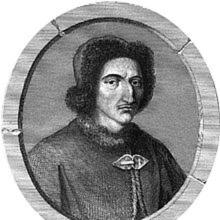
Jacob Spon, a French doctor and archaeologist, was a pioneer in the exploration of the monuments of Greece and a scholar of international reputation in the developing "Republic of Letters".
Background
He was born in Lyon, France, in 1647. His father was Charles Spon, a doctor and Hellenist, of a wealthy and cultured Calvinist banking family from Ulm that had been established since 1551 at Lyon, where they were members of the bourgeois élite.
Education
Following medical studies at Strasburg, the younger Spon first met the son of a friend of his father, Charles Patin, who introduced him to antiquarian interests and the study of numismatics, then as now a window into the world of Classical Antiquity.
Career
He is famous as a pioneer in the exploration of the monuments of Greece, travelling there in1675-1676with the Englishman (Sir) George Wheler (1650-1723), whose collection of antiquities was afterwards bequeathed to Oxford University. Spon brought back many valuable treasures, coins, inscriptions and manuscripts, and in later years published various important works on archaeology, notably his Voyage d'Italie, de Dalmatie, de Grece et du Levant (1678), and a Histoire de la republique de Geneve (1680).
The Revocation of the Edict of Nantes, October 1685, was indirectly the cause of Spon's death. Rather than abjure his Calvinist faith he preferred to leave for Zurich, an illegal move. His money and baggage stolen from him, and in fragile health, he died of tuberculosis in the canton hospital at Vevey, Christmas Day 1685, at the age of 38.
Achievements
His works are:
Histoire de la ville et de l'Estat de Genève, Lyon, 1620, ibid. , Amaulry, 1680, 1682, Utrecht: Halma, 1685;
The history of the city and state of Geneva, London : White, 1687;
Historie van de Stad en Staat van Geneve, Amsterdam: Oossaan, 1688;
Histoire de Genève rectifiée et augmentée, Genève: Fabri et Barrillot, 1730;
De l'origine des estrenes, [Lyon], 1673, Paris : Didot et de Bure, 1781;
Recherche des antiquités et curiosités de la ville de Lyon, Lyon, 1673;
Relation de l'état présent de la ville d'Athènes, Lyon, 1674;
Réponse à la critique publiée par M. de Guillet sur le Voyage de Grèce, Lyon, 1679;
Réponse à la critique publiée par M. de Guillet sur le Voyage de Grèce, Lyon, 1679;
Voyage d'Italie, de Dalmatie, de Grèce et du Levant, Lyon: Cellier, 1678, Amsterdam : Boom, 1679;
Viaggi per la Dalmazia, Grecia, e Levante, Bologna: Monti, 1688;
Italiänische, Dalmatische, Griechische und Orientalische Reise-Beschreibung, Nürnberg: Hofmann, 1690, 1713;
Lettres sur l'antiquité de la véritable religion, Lausanne : [Gentil ?], 1681;
Lettres curieuses touchant la religion, Cologne, 1682;