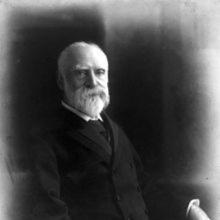
Education
He was graduated from Trinity College, Oxford, in 1862, and continued his studies at Heidelberg University.

He was graduated from Trinity College, Oxford, in 1862, and continued his studies at Heidelberg University.
He was admitted to the bar in 1867, and became regius professor of civil law at Oxford in 1870, serving until 1893. Elected to the House of Commons for the first time in 1880, he served in several Liberal party governments, as under secretary for Foreign Affairs, 1886-1892; chancellor of the Duchy of Lancaster, 1892; president of the Board of Trade, 1894; and chief secretary for Ireland, 1905-1907. Bryce made his first visit to America in 1870, and as British ambassador to the United States, 1907-1913, worked, with singular success, to promote diplomatic relations between Great Britain and Canada, and the United States. In 1913, Bryce was elevated to the peerage. He devoted his remaining years to his writings.
Combining the life of a scholar with that of a practical statesman, Bryce traveled most widely in the United States, South America, Europe, and the British Dominions, and his experiences encouraged the use of comparative and observational methods in his political and legal writings. The Holy Roman Empire (1864), his initial essay, written while he was professor at Oxford, is a valuable study in the history of political institutions. His best known work, The American Commonwealth (1888), was the first important study on the subject and remains today a classic treatise. His Modern Democracies (1921) is one of the best appraisals of the leading democracies of the early 20th century. Among his other works, Studies in History and Jurisprudence (1901) is recognized for its importance in the field of comparative jurisprudence.