

Background
BUCHANAN, James M. was born in 1919 in Murfreesboro, Tennessee, United States of America.
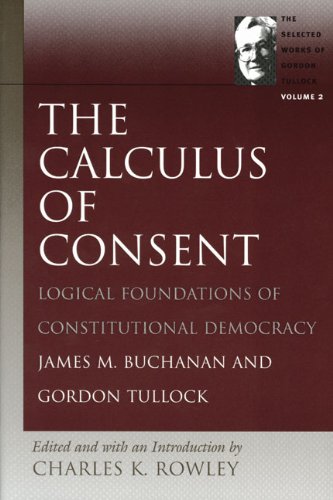
(The Calculus of Consent, the second volume of Liberty Fun...)
The Calculus of Consent, the second volume of Liberty Fund s The Selected Works of Gordon Tullock, is a reprint edition of the ground-breaking economic classic written by two of the world s preeminent economists--Gordon Tullock and Nobel Laureate James M. Buchanan. This book is a unique blend of economics and political science that helped create significant new subfields in each discipline respectively, namely, the public choice school and constitutional political economy. Charles K. Rowley, Duncan Black Professor of Economics at George Mason University, points out in his introduction, “The Calculus of Consent is, by a wide margin, the most widely cited publication of each coauthor and, by general agreement, their most important scientific contribution. The Calculus of Consent is divided into four parts, each consisting of several chapters. The introduction by Professor Rowley provides a short overview of the book and identifies key insights that permeated the bounds of economics and political science and created an enduring nexus between the two sciences. Part I of The Calculus of Consent establishes the conceptual framework of the book s subject; part II defines the realm of social choice; part III applies the logic developed in part II to describe a range of decision-making rules, most notably, the rule of simple majority; while part IV explores the economics and ethics of democracy. Charles K. Rowley is Duncan Black Professor of Economics at George Mason University and a Senior Fellow of the James M. Buchanan Center for Political Economy at George Mason University. He is also General Director of the Locke Institute. The entire series includes: Volume 1: Virginia Political Economy Volume 2: The Calculus of Consent Volume 3: The Organization of Inquiry (November 2004) Volume 4: The Economics of Politics (February 2005) Volume 5: The Rent-Seeking Society (March 2005) Volume 6: Bureaucracy (June 2005) Volume 7: The Economics and Politics of Wealth Redistribution (July 2005) Volume 8: The Social Dilemma: Of Autocracy, Revolution, Coup d'Etat, and War (December 2005) Volume 9: Law and Economics (December 2005) Volume 10: Economics without Frontiers (January 2006)
http://www.amazon.com/gp/product/0865975329/?tag=2022091-20
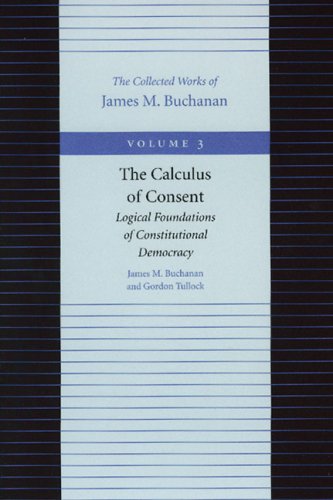
( The Calculus of Consent was co-authored by Buchanan wit...)
The Calculus of Consent was co-authored by Buchanan with Gordon Tullock, with whom Buchanan collaborated on many books and academic enterprises throughout their careers. As Robert D. Tollison states in the foreword, “[this book] is a radical departure from the way democracies conduct their business. The Calculus is already a book for the ages. This classic work analyzes the political organization of a free society through the lens of the economic organization of society. The authors acknowledge their unease as economists in analyzing the political organization, but they take the risk of forging into unfamiliar territory because they believe the benefits of their perspective will bear much fruit. As the authors state, their objective in this book is “to analyze the calculus of the rational individual when he is faced with questions of constitutional choice . . . .We examine the [choice] process extensively only with reference to the problem of decision-making rules. The authors describe their approach as “economic individualism. They believe that economists have explored individual choice extensively in the market sector while social scientists have largely ignored the dynamics of individual decision-making in the dynamics of forming group action in the public sector. Written in the early 1960s, The Calculus of Consent has become a bulwark of the public choice movement for which James M. Buchanan is so justly famous. James M. Buchanan is an eminent economist who won the Alfred Nobel Memorial Prize in Economic Sciences in 1986 and is considered one of the greatest scholars of liberty in the twentieth century. The entire series includes: Volume 1: The Logical Foundations of Constitutional Liberty Volume 2: Public Principles of Public Debt Volume 3: The Calculus of Consent Volume 4: Public Finance in Democratic Process Volume 5: The Demand and Supply of Public Goods Volume 6: Cost and Choice Volume 7: The Limits of Liberty Volume 8: Democracy in Deficit Volume 9: The Power to Tax Volume 10: The Reason of Rules Volume 11: Politics by Principle, Not Interest Volume 12: Economic Inquiry and Its Logic Volume 13: Politics as Public Choice Volume 14: Debt and Taxes Volume 15: Externalities and Public Expenditure Theory Volume 16: Choice, Contract, and Constitutions Volume 17: Moral Science and Moral Order Volume 18: Federalism, Liberty, and the Law Volume 19: Ideas, Persons, and Events Volume 20: Indexes
http://www.amazon.com/gp/product/0865972184/?tag=2022091-20
http://www.amazon.com/gp/product/B010CLVO10/?tag=2022091-20
http://www.amazon.com/gp/product/B000IAN0NQ/?tag=2022091-20

http://www.amazon.com/gp/product/B00I3MAXE0/?tag=2022091-20

http://www.amazon.com/gp/product/B010WHHS64/?tag=2022091-20
http://www.amazon.com/gp/product/B010BFHFSI/?tag=2022091-20
http://www.amazon.com/gp/product/B00I3M9WD8/?tag=2022091-20
http://www.amazon.com/gp/product/B010BFEZW2/?tag=2022091-20

http://www.amazon.com/gp/product/B010BFIHC6/?tag=2022091-20

http://www.amazon.com/gp/product/B010BFGAFM/?tag=2022091-20
( While relatively short, Cost and Choice, according to H...)
While relatively short, Cost and Choice, according to Hartmut Kliemt in the foreword, holds quite a central place in Buchanan’s work. For the fundamental economic notion of cost’, or opportunity cost’, is intimately related to the individualist and subjectivist perspective that is so essential to the Buchanan enterprise.” To be sure, the Austrian school of economists enunciated similar views of cost decades before Buchanan, but Buchanan advances his theories by attempting to integrate his views into the orthodox classical and neoclassical framework. When he published the book in 1969, Buchanan hoped that other scholars would follow him in researching the opportunity-cost concept and its applications. Unlike the theater of public policy, where Buchanan’s work is widely celebrated and influential, his important work on the issue of cost and choice, so clearly explicated in this volume, has done little to move the mainstream of economic thinking in the thirty years since its original publication. It is hoped that this new edition of Buchanan’s seminal work will place Buchanan’s groundbreaking ideas in wider circulation. Buchanan writes in the preface, My aim is to utilize the theory of opportunity cost to demonstrate basic methodological distinctions that are often overlooked and to show that a consistent usage of this theory clarifies important areas of disagreement on policy issues.” James M. Buchanan is an eminent economist who won the Alfred Nobel Memorial Prize in Economic Sciences in 1986 and is considered one of the greatest scholars of liberty in the twentieth century. The entire series will include: Volume 1: The Logical Foundations of Constitutional Liberty Volume 2: Public Principles of Public Debt Volume 3: The Calculus of Consent Volume 4: Public Finance in Democratic Process Volume 5: The Demand and Supply of Public Goods Volume 6: Cost and Choice Volume 7: The Limits of Liberty Volume 8: Democracy in Deficit Volume 9: The Power to Tax Volume 10: The Reason of Rules Volume 11: Politics by Principle, Not Interest Volume 12: Economic Inquiry and Its Logic Volume 13: Politics as Public Choice Volume 14: Debt and Taxes Volume 15: Externalities and Public Expenditure Theory Volume 16: Choice, Contract, and Constitutions Volume 17: Moral Science and Moral Order Volume 18: Federalism, Liberty, and the Law Volume 19: Ideas, Persons, and Events Volume 20: Indexes
http://www.amazon.com/gp/product/0865972249/?tag=2022091-20

(In this sequel to Brain Tumors: Leaving the Garden of Ede...)
In this sequel to Brain Tumors: Leaving the Garden of Eden, Dr. Paul continues to guide you through the brain tumor minefield so you have the best chances for quality survival. Here are the key answers to questions about medications, side effects and late effects of treatment, insurance, Medicare & HMOs, clinical trials, heredity, brain tumors in children, Complementary and Alternative Medicines & Lists of 250 major brain tumor treatment centers worldwide (30 blk-and-white illustrations , 350 websites and other resources to contact.)
http://www.amazon.com/gp/product/0976017113/?tag=2022091-20

( "As he usually does, Professor Buchanan has produced an...)
"As he usually does, Professor Buchanan has produced an interesting and provocative piece of work. [Cost and Choice] starts off as an essay in the history of cost theory; the central ideas of the book are traced to Davenport and Knight in the United States, and to a series of distinguished writers associated at various times with the London School of Economics. The author emerges from this discussion with what can be described as the ultimate in subjectivist cost doctrines. . . . Economists should learn the lessons offered to us in this little book—and learn them well. It can save them from serious errors."—William J. Baumol, Journal of Economic Literature
http://www.amazon.com/gp/product/0226078183/?tag=2022091-20

http://www.amazon.com/gp/product/B00ZT1WLHU/?tag=2022091-20
( This work has been selected by scholars as being cultur...)
This work has been selected by scholars as being culturally important, and is part of the knowledge base of civilization as we know it. This work was reproduced from the original artifact, and remains as true to the original work as possible. Therefore, you will see the original copyright references, library stamps (as most of these works have been housed in our most important libraries around the world), and other notations in the work. This work is in the public domain in the United States of America, and possibly other nations. Within the United States, you may freely copy and distribute this work, as no entity (individual or corporate) has a copyright on the body of the work. As a reproduction of a historical artifact, this work may contain missing or blurred pages, poor pictures, errant marks, etc. Scholars believe, and we concur, that this work is important enough to be preserved, reproduced, and made generally available to the public. We appreciate your support of the preservation process, and thank you for being an important part of keeping this knowledge alive and relevant.
http://www.amazon.com/gp/product/1298037611/?tag=2022091-20

(This report seeks to inform the debate over the extent of...)
This report seeks to inform the debate over the extent of U.S. military presence overseas by providing a rigorous estimate of the costs associated with maintaining U.S. Air Force installations and units overseas rather than in the United States.
http://www.amazon.com/gp/product/0833080377/?tag=2022091-20
http://www.amazon.com/gp/product/B010CLA59C/?tag=2022091-20
( This work has been selected by scholars as being cultur...)
This work has been selected by scholars as being culturally important, and is part of the knowledge base of civilization as we know it. This work was reproduced from the original artifact, and remains as true to the original work as possible. Therefore, you will see the original copyright references, library stamps (as most of these works have been housed in our most important libraries around the world), and other notations in the work. This work is in the public domain in the United States of America, and possibly other nations. Within the United States, you may freely copy and distribute this work, as no entity (individual or corporate) has a copyright on the body of the work. As a reproduction of a historical artifact, this work may contain missing or blurred pages, poor pictures, errant marks, etc. Scholars believe, and we concur, that this work is important enough to be preserved, reproduced, and made generally available to the public. We appreciate your support of the preservation process, and thank you for being an important part of keeping this knowledge alive and relevant.
http://www.amazon.com/gp/product/1296464458/?tag=2022091-20

( This work has been selected by scholars as being cultur...)
This work has been selected by scholars as being culturally important, and is part of the knowledge base of civilization as we know it. This work was reproduced from the original artifact, and remains as true to the original work as possible. Therefore, you will see the original copyright references, library stamps (as most of these works have been housed in our most important libraries around the world), and other notations in the work. This work is in the public domain in the United States of America, and possibly other nations. Within the United States, you may freely copy and distribute this work, as no entity (individual or corporate) has a copyright on the body of the work. As a reproduction of a historical artifact, this work may contain missing or blurred pages, poor pictures, errant marks, etc. Scholars believe, and we concur, that this work is important enough to be preserved, reproduced, and made generally available to the public. We appreciate your support of the preservation process, and thank you for being an important part of keeping this knowledge alive and relevant.
http://www.amazon.com/gp/product/1294943677/?tag=2022091-20

http://www.amazon.com/gp/product/0833005928/?tag=2022091-20

( Published originally in 1975, The Limits of Liberty mad...)
Published originally in 1975, The Limits of Liberty made James Buchanan’s name more widely known than ever before among political philosophers and theorists and established Buchanan, along with John Rawls and Robert Nozick, as one of the three new contractarians, standing on the shoulders of Hobbes, Locke, and Kant. While The Limits of Liberty is strongly related to Buchanan’s Calculus of Consent (Vol. 3 in Liberty Fund’s Collected Works of James M. Buchanan), it is logically prior to the Calculus, according to Hartmut Kliemt in the foreword, even though it was published later. As Kliemt states, [The Limits of Liberty] characterizes the status quo from the point where Paretian politics starts and at the same time describes conceivable processes of interindividual agreement that might lead from a natural equilibrium to a political one.” Buchanan frames the central idea most cogently in the opening of his preface: Precepts for living together are not going to be handed down from on high. Men must use their own intelligence in imposing order on chaos, intelligence not in scientific problem-solving but in the more difficult sense of finding and maintaining agreement among themselves. Anarchy is ideal for ideal men; passionate men must be reasonable. Like so many men have done before me, I examine the bases for a society of men and women who want to be free but who recognize the inherent limits that social interdependence places on them.” James M. Buchanan is an eminent economist who won the Alfred Nobel Memorial Prize in Economic Sciences in 1986 and one of the greatest scholars of liberty in the twentieth century. The entire series will include: Volume 1: The Logical Foundations of Constitutional Liberty Volume 2: Public Principles of Public Debt Volume 3: The Calculus of Consent Volume 4: Public Finance in Democratic Process Volume 5: The Demand and Supply of Public Goods Volume 6: Cost and Choice Volume 7: The Limits of Liberty Volume 8: Democracy in Deficit Volume 9: The Power to Tax Volume 10: The Reason of Rules Volume 11: Politics by Principle, Not Interest Volume 12: Economic Inquiry and Its Logic Volume 13: Politics as Public Choice Volume 14: Debt and Taxes Volume 15: Externalities and Public Expenditure Theory Volume 16: Choice, Contract, and Constitutions Volume 17: Moral Science and Moral Order Volume 18: Federalism, Liberty, and the Law Volume 19: Ideas, Persons, and Events Volume 20: Indexes
http://www.amazon.com/gp/product/0865972265/?tag=2022091-20
http://www.amazon.com/gp/product/B008WDEAN0/?tag=2022091-20
http://www.amazon.com/gp/product/B011824UXQ/?tag=2022091-20

http://www.amazon.com/gp/product/B011DC0IBE/?tag=2022091-20

(Freedom has limits. In this book, the author James Buchan...)
Freedom has limits. In this book, the author James Buchanan rebukes the anarchic utopia and points out that a good society allows people to get what they want and the restriction set on them have to base on the principle of mutual agreement. And this book will talk about how to reach the agreement of the basic rules and the result if a common ground is not reached.
http://www.amazon.com/gp/product/7308105733/?tag=2022091-20

http://www.amazon.com/gp/product/B010BFJJEG/?tag=2022091-20
http://www.amazon.com/gp/product/B010BFGNA4/?tag=2022091-20
http://www.amazon.com/gp/product/B010BFER16/?tag=2022091-20
http://www.amazon.com/gp/product/B00N1B6D0G/?tag=2022091-20
http://www.amazon.com/gp/product/B00AVGOX1K/?tag=2022091-20
( Commenting on his collaboration with Geoffrey Brennan o...)
Commenting on his collaboration with Geoffrey Brennan on The Power to Tax, James M. Buchanan says that the book is demonstrable proof of the value of genuine research collaboration across national-cultural boundaries.” Buchanan goes on to say that The Power to Tax is informed by a single ideathe implications of a revenue-maximizing government.” Originally published in 1980, The Power to Tax was a much-needed answer to the tax revolts sweeping across the United States. It was a much-needed answer as well in the academic circles of tax theory, where orthodox public finance models were clearly inadequate to the needs at hand. The public-choice approach to taxation which Buchanan had earlier elaborated stood in direct opposition to public-finance orthodoxy. What Buchanan and Brennan constructed in The Power to Tax was a middle ground between the two. As Brennan writes in the foreword, The underlying motivating question was simple: Why not borrow the motivational assumptions standard in public-choice theory and put them together with assumptions about policy-maker discretion taken from public-finance orthodoxy?” The result was a controversial bookand a much misunderstood one as well. Looking back twenty years later, Brennan feels confirmed in the rightness of the theories he and Buchanan espoused, particularly in their unity with the public-choice tradition: The insistence on motivational symmetry is a characteristic feature of the public choice approach, and it is in this dimension that The Power to Tax and the orthodox public- finance approach diverge.” James M. Buchanan is an eminent economist who won the Alfred Nobel Memorial Prize in Economic Sciences in 1986 and is considered one of the greatest scholars of liberty in the twentieth century. The entire series will include: Volume 1: The Logical Foundations of Constitutional Liberty Volume 2: Public Principles of Public Debt Volume 3: The Calculus of Consent Volume 4: Public Finance in Democratic Process Volume 5: The Demand and Supply of Public Goods Volume 6: Cost and Choice Volume 7: The Limits of Liberty Volume 8: Democracy in Deficit Volume 9: The Power to Tax Volume 10: The Reason of Rules Volume 11: Politics by Principle, Not Interest Volume 12: Economic Inquiry and Its Logic Volume 13: Politics as Public Choice Volume 14: Debt and Taxes Volume 15: Externalities and Public Expenditure Theory Volume 16: Choice, Contract, and Constitutions Volume 17: Moral Science and Moral Order Volume 18: Federalism, Liberty, and the Law Volume 19: Ideas, Persons, and Events Volume 20: Indexes
http://www.amazon.com/gp/product/0865972303/?tag=2022091-20

(Tax Power for the Self-Employed addresses the specific an...)
Tax Power for the Self-Employed addresses the specific and particular tax laws and regulations facing a self-employed individual. Unlike other small businesses, it focuses on the individual who either runs a single-person small business (or one with an otherwise limited number of employees) or the person who does something to make extra money that he or she may consider a hobby or side job, but from which the IRS expects tax to be paid. Discussions of specific concern to the self-employed person include Schedule C deductions, with particular emphasis on changes in Sec. 179 deductions that target self-employed individuals for increased capital investments. Additional attention is placed on strategies for taking deductions to lower income subject to the self-employed tax, a totally separate tax from income tax. An entire chapter is devoted to the self-employment tax and Schedule SE. With the latest IRS rules, regulations and decisions, as well as tax-planning strategies, any self-employed individual can feel confident that they are meeting all of their tax requirements while maximizing their tax savings.
http://www.amazon.com/gp/product/1572485760/?tag=2022091-20
(Following even a few of the tax-saving strategies found i...)
Following even a few of the tax-saving strategies found in Tax Power for Individuals can have a dramatic reduction in your tax obligation and substantially increase the size of your refund. Accessible by anyone, it provides the reader with the latest IRS rules and answers everyday tax-related questions. It explores the IRS's definition of income and how to lower yours through expense deductions, tax credits and depreciation. Its extensive glossary of financial and tax terms makes it an easy-to-understand and essential reference for every home's bookshelf.
http://www.amazon.com/gp/product/1572486406/?tag=2022091-20
http://www.amazon.com/gp/product/B010WI7BF6/?tag=2022091-20
http://www.amazon.com/gp/product/B010CLA9DE/?tag=2022091-20
http://www.amazon.com/gp/product/B010WHTTAC/?tag=2022091-20
( In his foreword, Geoffrey Brennan states, The papers i...)
In his foreword, Geoffrey Brennan states, The papers in this volume represent a coherent set of pieces focused on aspects of public-expenditure theory and constitute all of Buchanan’s papers in this area.”
Buchanan’s work on the subject of what governments should do and his insistence on Knut Wicksell’s ideal that taxation and public expenditure be integrated topics have contributed significantly to the current thinking of most economists on the topic. Geoffrey Brennan summarizes Buchanan’s central themes in this way, There are two messages that emerge from this work: one is that a proper sense of the extent of market failure, rather than its mere presence, is relevant in all cases; the other is that correcting’ for such market failure is often a complex multidimensional business not captured by direct public provision at zero price and not necessarily involving expansion of market output.”
The twenty-nine papers represented in this volume are grouped into these major subject categories:
1.Public Services and Collective Action
2.Externalities
3.Clubs and Joint Supply
4.Public Goods Theory
5.ApplicationsCity, Health, and Social Security
6.Distributive Norms and Collective Action
This volume also includes what are arguably Buchanan’s two most famous articles: Externality,” which he wrote with William Stubblebine, and Economic Theory of Clubs.”
James M. Buchanan is an eminent economist who won the Alfred Nobel Memorial Prize in Economic Sciences in 1986 and is considered one of the greatest scholars of liberty in the twentieth century.
ERRATA
Unfortunately, after this book had been printed and bound, it was discovered that, due to a production error, the index contained some erroneous page numbers. Please click on the pdf file below to obtain the corrected index that should replace the index bound into the back of the book. When this volume goes back to press for a second printing, the index will be updated with the pages in this pdf file, and we will be pleased to send all buyers of the erroneous Volume 15 a corrected copy of the book at no extra charge.
Click here for a pdf file of the corrected index.
Volume 1: The Logical Foundations of Constitutional Liberty
Volume 2: Public Principles of Public Debt
Volume 3: The Calculus of Consent
Volume 4: Public Finance in Democratic Process
Volume 5: The Demand and Supply of Public Goods
Volume 6: Cost and Choice
Volume 7: The Limits of Liberty
Volume 8: Democracy in Deficit
Volume 9: The Power to Tax
Volume 10: The Reason of Rules
Volume 11: Politics by Principle, Not Interest
Volume 12: Economic Inquiry and Its Logic
Volume 13: Politics as Public Choice
Volume 14: Debt and Taxes
Volume 15: Externalities and Public Expenditure Theory
Volume 16: Choice, Contract, and Constitutions
Volume 17: Moral Science and Moral Order
http://www.amazon.com/gp/product/0865972427/?tag=2022091-20

http://www.amazon.com/gp/product/B010CLTOQC/?tag=2022091-20
BUCHANAN, James M. was born in 1919 in Murfreesboro, Tennessee, United States of America.
Bachelor of Science University Middle Tennessee, 1940. Master of Arts University Tennessee, 1941. Doctor of Philosophy University Chicago, 1948.
Mclntire Professor of Economics,
Director, Thomas Jefferson Center Political Economics, University Virginia, 1956-1968. Professor of Economics, University of California, Los Angeles, Calif., United States of America, 1968-1969. University Distinguished Professor, General Director, Center Studies Public Choice, Virginia Polytechnic Institute, Institution, Blacksburg, Virginia, United States of America, since 1969.
Co-founder (with G. Tullock), Public Choice Society, 1962. President, Southern Economic Association, USA, 1963. Executive Committee,
1967-1969, Vice-President, American Economic Association, 1972.
Law Economics Prize, University Miami Law Economics Center, 1977. Executive Committee, Mont Pelerin Society, 1980-1981. Vice-President, Western Economic Association, USA, 1982.
( Published originally in 1975, The Limits of Liberty mad...)
(The Calculus of Consent, the second volume of Liberty Fun...)
( In his foreword, Geoffrey Brennan states, The papers i...)
(Following even a few of the tax-saving strategies found i...)
( The Calculus of Consent was co-authored by Buchanan wit...)
( This work has been selected by scholars as being cultur...)
( This work has been selected by scholars as being cultur...)
( This work has been selected by scholars as being cultur...)
( While relatively short, Cost and Choice, according to H...)
(Tax Power for the Self-Employed addresses the specific an...)
( Though written by an economist, this book's subject is ...)
( "As he usually does, Professor Buchanan has produced an...)
( Commenting on his collaboration with Geoffrey Brennan o...)
(In this sequel to Brain Tumors: Leaving the Garden of Ede...)
(This report seeks to inform the debate over the extent of...)
(Freedom has limits. In this book, the author James Buchan...)
(Blacksburg 1973. Article (14pp.) included in Public Choic...)
Integration of the analysis of political decisionmaking (public choice) into the corpus of economic theory, which is the source for what is now called ‘public sector economics’. Extension and application of economic analysis to constitutional choices among social-political rules and institutions. Critique of Keynesian macroeconomic policy based on analysis of political decision structure.
Clarification of theory of opportunity cost. Critique of post-Keynesian theory of public debt.
