Background
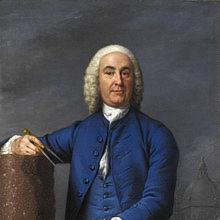
James Gibbs was born at Footdeesmire near Aberdeen, Scotland, United Kingdom, on 23 December 1682. A younger son of a Patrick Gibbs merchant and his second wife Ann née Gordon, the family was Roman Catholic; there was a half-brother William from the first marriage to Isabel née Farquhar. As a young man, he traveled on the Continent, pursuing his fondness for drawing.
Education
He was educated at Aberdeen Grammar School and Marischal College. In Rome he determined to become an architect and entered the school of Carlo Fontana. He was also taught by Pietro Francesco Garroli, professor of perspective at the Accademia di San Luca.
Career
Gibbs became acquainted with many members of the English aristocracy, for whom he made drawings and who were helpful to him in later life. He returned to England in 1709. Through the influence of Edward Harley, Earl of Oxford, Gibbs was made one of the surveyors to the commissioners for building 50 new churches in London in 1713, and in this capacity he designed St. Mary-le-Strand (1714 - 1717), his first public building. Here he expressed not only influences of Sir Christopher Wren but also ideas absorbed from Italian baroque and mannerist architecture.
Gibbs was employed by Lord Burlington in rebuilding the east block of Burlington House, Piccadilly, before that patron embraced Palladianism, but was superseded by the earl's protegé, Colen Campbell.
When the Whigs, who supported the Palladians, came to power, Gibbs as a Tory of baroque tendencies lost his official post in 1715, but his private practice among Tory patrons continued to be exclusive and remunerative. He built Cannons House, Middlesex (1716-1719; demolished 1747) for the Duke of Chandos; added a chapel and library at Wimpole Hall, Cambridgeshire (ca. 1720), for Lord Harley; built the exquisite Octagon Room at Twickenham, Middlesex (1720), with beautiful plasterwork by Italian stuccoworkers; and erected Ditchley House, Oxfordshire (1720 - 1725), probably his most splendid house, for the Earl of Lichfield, again with remarkable plasterwork by Italian craftsmen. But public commissions were not entirely lacking.
In 1720 Gibbs designed St. Martins-in-the-Fields (built 1722 - 1726), one of his outstandingly beautiful works. Like St. Mary-le-Strand and many of his houses, the interior was decorated with plasterwork by the fashionable Italian stuccoworkers, who probably came to England through his encouragement.
St. Martins was followed by another building of extreme elegance and dignity, the Senate House at Cambridge (1722 - 1730), as well as the new buildings of King's College. Many of the ornamental buildings in the park at Stowe House, Buckinghamshire, are his work, including the Temple of Diana (1726), the Temple of Friendship (1739), the Gothic Temple (1740), and the Column with a statue of Lord Cobham.
Gibbs's general influence among architects and clients was great because of his exhaustive knowledge of architecture acquired through long study in Rome, an experience rare among architects of that generation, although later more common. This influence he extended by means of his Book of Architecture (1728), a record of both his executed and unexecuted work, and especially his Rules for Drawing the Several Parts of Architecture (1732), a work used by countless architects, students, scholars, and builders up to the present day.
Of Gibbs's later works the circular Radcliffe Library at Oxford (1737 - 1749) is his most ambitious and monumental achievement; it shows much influence of Nicholas Hawksmoor. Gibbs published the designs in the large folio volume Bibliotheca Radcliviana in 1747. He designed the new decorations of Ragley Hall, Warwickshire (ca. 1750 - 1755), in the rococo taste then becoming fashionable.
A distinguished late work is the church of St. Nicholas at Aberdeen (1751 - 1755). In his last years Gibbs held the sinecure post of architect to the Office of Ordnance. He died in London on Aug. 5, 1754.
Personality
Gibbs was fond of wine and food, was described as "corpulent".
Quotes from others about the person
Horace Walpole described Gibbs as being around 1720 as "the architect most in vogue".