

Background
James Clark Ross was born in London on April 15, 1800, the son of George Ross and a nephew of Rear Admiral John Ross.

1850
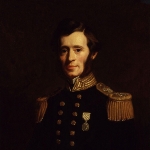
Sir James Clark Ross by Stephen Pearce

1785
A portrait of Commander James Clark Ross by Wildman, John R.

1850
Rear-Admiral Sir James Clark Ross

James Clark Ross, a British naval officer, of a number, who searched for Franklin in the High Canadian North.

Sir James Ross, a plaster cast of a medallion by Bernhard Smith, c. 1842–48 Courtesy of the National Portrait Gallery, London.

James Clark Ross

James Clark Ross. Hulton Archive/Getty Images

Stamp United Kingdom: James Clark Ross, a British naval officer who carried out important magnetic surveys in the Arctic and Antarctic.

A portrait of James Clark Ross after an original by Negelen.

1848 - 1862
Royal Society, London, England, United Kingdom
In 1848 James Ross was elected a fellow of the Royal Society.

1843
Ross was awarded the Grande Médaille d'Or des Explorations.

1844
Ross was named to the French Legion of Honor.
1785
A portrait of Commander James Clark Ross by Wildman, John R.
1843
Ross was awarded the Grande Médaille d'Or des Explorations.
1844
Ross was named to the French Legion of Honor.
1850
Rear-Admiral Sir James Clark Ross
1995
Reserve Bank of New Zealand five dollars dedicated to James Clark Ross.
James Clark Ross, a British naval officer, of a number, who searched for Franklin in the High Canadian North.
Sir James Ross, a plaster cast of a medallion by Bernhard Smith, c. 1842–48 Courtesy of the National Portrait Gallery, London.
James Clark Ross
James Clark Ross
James Clark Ross. Hulton Archive/Getty Images
Stamp United Kingdom: James Clark Ross, a British naval officer who carried out important magnetic surveys in the Arctic and Antarctic.
A portrait of James Clark Ross after an original by Negelen.
Royal Society, London, England, United Kingdom
In 1848 James Ross was elected a fellow of the Royal Society.

Sir John Ross (24 June 1777 – 30 August 1856) was a British Royal Navy officer and Polar explorer.


Francis Rawdon Moira Crozier (17 September 1796 – c. 1848) was an Irish officer of the Royal Navy and polar explorer who participated in six expeditions to the Arctic and Antarctic.


http://www.amazon.com/gp/product/1175560375/?tag=2022091-20
1834

http://www.amazon.com/gp/product/1340079534/?tag=2022091-20
1834

http://www.amazon.com/gp/product/1279462620/?tag=2022091-20
1844

http://www.amazon.com/gp/product/1910241903/?tag=2022091-20
1847

(Volume 2)
Volume 2
http://www.amazon.com/gp/product/1910241911/?tag=2022091-20
1847
explorer scientist navy geomagnetist
James Clark Ross was born in London on April 15, 1800, the son of George Ross and a nephew of Rear Admiral John Ross.
James Ross entered the Royal Navy at 11 years of age. During his first years of service, he was tutored and watched over by his uncle, Sir John Ross.
After Ross entered the Royal Navy as a midshipman in April 1812, he served under his uncle, John Ross, in the Baltic and North seas and the Downs. He subsequently accompanied him on surveys of the North Sea and the coast of the White Sea, in the course of which the longitude of Archangel was determined by observations of Jupiter’s satellites.
After service from 1815 to 1817 in Scottish waters, in 1818 Ross accompanied his uncle on the latter’s attempt, with William Edward Parry, to discover the Northwest Passage via Davis Strait.
In 1819-1820 Ross sailed with Parry when a further attempt was made to force the passage via Baffin Bay, Lancaster Sound, and Bering Strait. The partial success of this voyage in reaching Melville Island brought the expedition a reward of £5,000 from the Board of Longitude and encouraged the next expedition (1821-1823).
Promoted to lieutenant on 26 December 1822, Ross sailed with Parry on the latter’s third voyage on H.M.S. Fury, which was wrecked in Prince Regent Inlet on 30 July 1825. The Fury was abandoned, and all her crew was taken aboard H.M.S. Hecla. In 1827 Ross again sailed with Parry, this time to Spitsbergen in an effort to reach the North Pole over the ice. On the return of this venture, Ross was promoted to commander on 8 November 1827.
From 1829 to 1833 Ross accompanied his uncle, Sir John Ross, on the private expedition promoted by Felix Booth (1775-1850), a wealthy distiller who contributed £17,000 toward the cost. Sailing in a small vessel, James Ross carried out the sledging operations on the coasts of the Boothia Peninsula (named after the sponsor) and King William Island.
In June of 1831, he discovered the north magnetic pole at latitude 70°05'17" north and longitude 96 45'48" west. Promoted to post-captain on 28 October 1834, Ross commanded H.M.S. Cove on a voyage to the Baffin Bay in 1836 for the relief of iced-in whalers.
Ross’s accumulated expertise in magnetic observations led to his employment by the Admiralty in 1838 on a magnetic survey (declination and dip) of the United Kingdom. The success of these operations was followed by his appointment in 1839 to command an expedition, sponsored by the British Association for the Advancement of Science and the Royal Society, for magnetic and geographical discovery in the Antarctic.
In September 1839 Ross sailed on what was to be a four-year voyage. On January 1, 1841, he crossed the Antarctic Circle, discovering Victoria Land, the 12,000-foot volcano at latitude 77°35' south that he named Mount Erebus, and “the marvelous range of ice cliffs barring the approach to the Pole.”
Ross returned to England in 1843 with a large accumulation of observations on magnetism and other branches of natural sciences, including geology and marine life at great depths. He had carried out in his survey the greatest work of its kind yet performed - and, remarkably, with the loss of only one man through illness. This was due in no small measure to the great attention given to the selection of supplies for a mixed diet.
In 1847 Ross published a comprehensive two-volume account of his voyage. The following year he was placed in command of H.M.S. Enterprise on the first search expedition to relieve the expedition headed by Sir John Franklin. The main purpose was not achieved, but no opportunity was lost in accumulating observations.
Although Ross saw no further naval service after 1849, he was thereafter regarded as the leading authority on all aspects of Arctic navigation. His magnetic observations were reduced and published over a period of more than twenty years by the geo magnetician Sir Edward Sabine, in the Philosophical Transactions of the Royal Society.

Ross' major achievement was succeeded on the second Arctic expedition of his uncle, Sir John Ross, he located the north magnetic pole on June 1, 1831. Another Ross' achievement was in his own Antarctic expedition of 1839–43, which was undertaken to conduct magnetic observations and to reach the south magnetic pole. Commanding the Erebus and Terror, he discovered the Ross Sea in 1841 and, while sailing toward the position assigned to the magnetic pole, also discovered Victoria Land. He wintered at Hobart, Tasmania, and in November 1841 sailed again for Antarctica.
Also, Ross charted part of the coast of Graham Land and sailed around the Weddell Sea ice. He later published an important work titled A Voyage of Discovery and Research in the Southern and Antarctic Regions (1847).
Ross was elected to the Linnean Society in 1824 and to the Royal Society on 11 December 1828 and was awarded the gold medals of the geographical societies of London and Paris in 1842 for his Antarctic exploration. In 1844 he was knighted, received the degree of Doctor of Civil Laws, and was named to the French Legion of Honor. He was a corresponding member of the Paris Academy of Sciences and other foreign scientific societies for many years. He received gold medals from geographical societies in London and Paris.
The Ross seal, one of the four Antarctic phocids, first described during the Ross expedition. The James Ross Strait, Ross Bay, Ross Point, and Rossoya in the Arctic are all named after him.
The crater Ross on the Moon is named after him. Ross's gull, a small gull, the only species in its genus, that breeds in the high arctic of northernmost North America and northeast Siberia. Ross Dependency, Ross Island, Ross Ice Shelf, and Ross Sea in the Antarctic are all named after him.
(Volume 2)
1847In 1848 James Ross was elected a fellow of the Royal Society.
In 1843 James Ross was married to Lady Ann Coulman.

24 June 1777 – 30 August 1856, a British Royal Navy officer and Polar explorer. He was the uncle of Sir James Clark Ross, who explored the Arctic with him, and later led expeditions to Antarctica.


Sir Edward Sabine (14 October 1788 – 26 June 1883) was an Irish astronomer, geophysicist, ornithologist, explorer, soldier and the 30th president of the Royal Society. From 1835–1839, except for his voyage with Cove, James Ross conducted a magnetic survey of Great Britain with Sir Edward Sabine.

Between 1839 and 1847, Ross commanded HMS Erebus on his own Antarctic expedition and charted much of the continent's coastline. Captain Francis Crozier was second-in-command of the expedition, commanding HMS Terror. Support for the expedition had been arranged by Francis Beaufort, hydrographer of the Navy and a member of several scientific societies. On the expedition was Joseph Dalton Hooker, who had been invited along as an assistant ship's surgeon.
In the spring of 1848, Ross and Sir Francis McClintock explored the west coast of the island by sledge. He recognized Peel Sound but thought it too ice-choked for Franklin to have used it.

17 September 1796 – c. 1848, an Irish officer of the Royal Navy and polar explorer who participated in six expeditions to the Arctic and Antarctic. In May 1845, he was second-in-command to Sir John Franklin and captain of HMS Terror during the Franklin expedition to discover the Northwest Passage, which ended with the deaths of all 129 men.




