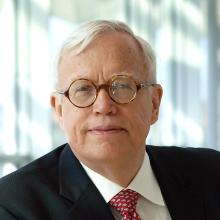
Background
HECKMAN, James J. was born in 1944 in Chicago, Illinois, United States of America.

HECKMAN, James J. was born in 1944 in Chicago, Illinois, United States of America.
Bachelor of Arts(Mathematics) Colorado College, 1965. Master of Arts, Doctor of Philosophy Princeton University, 1968,
1971.
Assistant Professor, Association Professor, Columbia University, 1970-1972,1972^1. Association Professor, University Chicago, 1974-1980. Visiting Professor, University of California, Los Angeles, Calif., United States of America, 1976, University Wisconsin, 1977, London School of Economies and Political Science, London, United Kingdom, 1977, Yale University, 1984.
Professor of Economics, University Chicago, since 1980. Co-Editor, Journal of Political Economy, since 1981. American Editor, Review of Economic Studies, 1982-1985.
Association Editor, J Labor E, since 1983.
Mr. Heckman is the author of Longitudinal Analysis of Labor Market Data, Law and Employment: Lessons from Latin America and the Caribbean, Inequality in America: What Role for Human Capital Policies?, and numerous articles on labor, education, and civil-rights policies. He has received numerous awards for his work, including the John Bates Clark Medal in 1983, the Jacob Mincer Award for Lifetime Achievement in 2005, and the Ulysses Medal from the University College Dublin in 2006. In 2000, he won the Sveriges Riksbank Prize in Economic Sciences in Memory of Alfred Nobel. He is also a member of many academic and professional socieities, including the National Academy of Sciences, the International Statistical Institute, the American Statistical Association, the Society of Labor Economics, the American Philosophical Society, and the National Academy of Education. In addition, he has been the recipient of numerous honorary degrees and professorships.
(Acclaimed for the scholarship of its prominent authors an...)
(Acclaimed for the scholarship of its prominent authors an...)
(Acclaimed for the scholarship of its prominent authors an...)
(This popular brief edition text maintains the framework o...)
(New features, up-to-date political news and analysis, and...)
(Same or next day processing! Good physical shape, light t...)
I have attempted to explore the consequences of sample design on empirical estimates obtained from those samples. Sample selection and self-selection are pervasive phenomena that critically affect the interpretation placed on social statistics. I have helped direct the attention of the profession to this topic.
In addition, I have explored the consequences of failing to account for unobservables
in dynamic models of labour supply and fertility. Such unobservables — termed ‘heterogeneity’ — seriously affect the inferences one can draw from dynamic data. The hypothesis that people are different can account for a wide variety of empirical regularities in social science.
Economic models that rationalise statistical artefacts are a pernicious waste of time. My principal goal — but perhaps not my principal contribution—is to provide a factual basis for economics, to free it of metaphysical or political bias and to sort out the empirically testable from the huge corpus of economics that is not empirically founded. All of my work is directed toward producing testable economic models and to separating the knowable (in an empirical source) from the conjecture, however fashionable or widely held.
By placing economics on an empirical basis and eliminating the subjective element which currently dominates the field, it may be possible to make progression in a subject that is widely perceived to be discredited because it has so little empirical content and cares so little about developing it.
Guggenheim Foundation Fellow, 1978-1979; Fellow, Econometric Society, 1980; Fellow, Center Advanced Studies Behavioral Sciences, Stanford, California 1982; John Bates Clark Medal, American Economic Association 1983.
Fellow: American Association for the Advancement of Science
Econometric Society
American Academy Arts. & Scis.
Society Labor Economics (Jacob Mincer award for Lifetime Achievement 2005)
American Statistical Association (Chicago chapter Statistician of Year 2002)
International Statistical Institute; National Academy of Sciences
American Economic Association (John Bates Clark medal 1983)
American Philosophical Society
National Academy Education
Irish Economic Association (life)
Phi Beta Kappa