

Background
Sundquist, James Lloyd was born on October 16, 1915 in West Point, Utah, United States. Son of Frank Victor and Freda (Carlson) Sundquist.

http://www.amazon.com/gp/product/0815782217/?tag=2022091-20

( Since the original edition of Dynamics of the Party Sys...)
Since the original edition of Dynamics of the Party System was published in 1973, American politics have continued on a tumultuous course. In the vacuum left by the decline of the Democratic and Republican parties, single-interest groups have risen and flourished. Protest movements on the left and the New Right at the opposite pole have challenged and divided the major parties, and the Reagan Revolution--in reversing a fifty-year trend toward governmental expansion--may turn out to have revolutionized the party system too. In this edition, as in the first, current political trends and events are placed in a historical and theoretical context. Focusing upon three major realignments of the past--those of the 1850s, the 1890s, and the 1930s--Sundquist traces the processes by which basic transformations of the country's two-party system occur. From the historical case studies, he fashions a theory as to the why and how of party realignment, then applies it to current and recent developments, through the first two years of the Reagan presidency and the midterm election of 1982. The theoretical sections of the first edition are refined in this one, the historical sections are revised to take account of recent scholarship, and the chapters dealing with the postwar period are almost wholly rewritten. The conclusion of the original work is, in general, confirmed: the existing party system is likely to be strengthened as public attention is again riveted on domestic economic issues, and the headlong trend of recent decades toward political independence and party disintegration reversed, at least for a time.
http://www.amazon.com/gp/product/081578225X/?tag=2022091-20

http://www.amazon.com/gp/product/B010BEW94O/?tag=2022091-20

http://www.amazon.com/gp/product/B002BARUS2/?tag=2022091-20
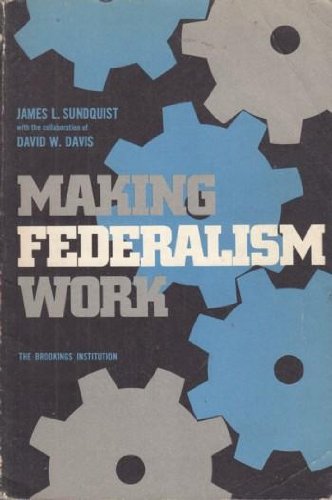
(Book by Sundquist, James L., Davis, David W.)
Book by Sundquist, James L., Davis, David W.
http://www.amazon.com/gp/product/0815782187/?tag=2022091-20

http://www.amazon.com/gp/product/B0032TXMN8/?tag=2022091-20

(In this study, James Sundquist reviews the origins and ra...)
In this study, James Sundquist reviews the origins and rationale of the Constitutional structure and the current debate about whether reform is needed, then raises practical questions about what changes might work best if a consensus should emerge that the national government is too prone to stalemate to meet its responsibilities.
http://www.amazon.com/gp/product/0815782292/?tag=2022091-20

( "Solid ground for optimism as well as cause for forebod...)
"Solid ground for optimism as well as cause for foreboding." So James L. Sundquist views the outcome of the struggle by the Congress in the 1970s to recapture powers and responsibilities that in preceding decades it had surrendered to a burgeoning presidency. The resurgence of the Congress began in 1973, in its historic constitutional clash with President Nixon. For half a century before that time, the Congress had acquiesced in its own decline vis-à-vis the presidency, or had even initiated it, by building the presidential office as the center of leadership and coordination in the U.S. government and organizing itself not to initiate and lead but to react and follow. But the angry confrontation with President Nixon in the winter of 1972-73 galvanized the Congress to seek to regain what it considered its proper place in the constitutional scheme. Within a short period, it had created a new congressional budget process, prohibited impoundment of appropriated funds, enacted the War Powers Resolution, intensified oversight of the executive, extended the legislative veto over a wide range of executive actions, and vastly expanded its staff resources. The Decline and Resurgence of Congress, after reviewing relations between president and Congress over two centuries, traces the long series of congressional decisions that created the modern presidency and relates these to certain weaknesses that the Congress recognized in itself. It then recounts the events that marked the years of resurgence and evaluates the results. Finally, it analyzes the strengths and weaknesses of the new Congress and appraises its potential for leadership and coordination.
http://www.amazon.com/gp/product/0815782233/?tag=2022091-20

(Book by Sundquist, James L.)
Book by Sundquist, James L.
http://www.amazon.com/gp/product/0815782225/?tag=2022091-20
Sundquist, James Lloyd was born on October 16, 1915 in West Point, Utah, United States. Son of Frank Victor and Freda (Carlson) Sundquist.
Student, Weber College, 1934. HHD (honorary), Weber College, 1990. Student, Northwestern University, 1935.
Bachelor of Science, University Utah, 1939. Master of Science in Public Adminstrn, Syracuse University, 1941. Doctor of Dental Surgery (honorary)., Carthage College, 1987.
Reporter Salt Lake Tribune, 1935-1939. Administrative analyst United States Bureau Budget, 1941-1947, 49-51. Reports and statistics officer Office Defense Mobilization, 1951-1953.
Director management control European Command, United States Army, Berlin, 1947-1949. Assistant to chairman Democratic National Committee, 1953-1954. Assistant secretary to governor New York, 1955-1956.
Assistant to the United States Senator Clark, 1957-1962. Deputy under secretary agriculture, 1963-1965. Senior fellow Brookings Institution, 1965-1985, emeritus, since 1985, director governmental studies, 1976-1978.
Adjunct professor Smith College, 1975-1978. Secretary platform committee Democratic National Convention, 1960, 68.
(In this study, James Sundquist reviews the origins and ra...)
( Since the original edition of Dynamics of the Party Sys...)
( "Solid ground for optimism as well as cause for forebod...)
(Book by Sundquist, James L., Davis, David W.)
(Book by Sundquist, James L.)
Member Governor's Commission on Virginia's Future, 1983-1984. Member National Academy Public Administration, American Society Public Administration, American Political Science Association (treasurer 1980, Charles E. Merriam award 1985, Eldersveld award 1994), American Academy Arts and Sciences.
Married Beth Ritchie, December 25, 1937 (deceased 1982). Children: Erik L., Mark L., James K. Married Geraldine Coote, December 3, 1983.
