

Background
Ortega, James McDonough was born on June 15, 1932 in Madison, Wisconsin, United States. Son of Joaquin and Margaret (McDonough) Ortega.

http://www.amazon.com/gp/product/B01FEK6IFQ/?tag=2022091-20

http://www.amazon.com/gp/product/B00226BDT2/?tag=2022091-20
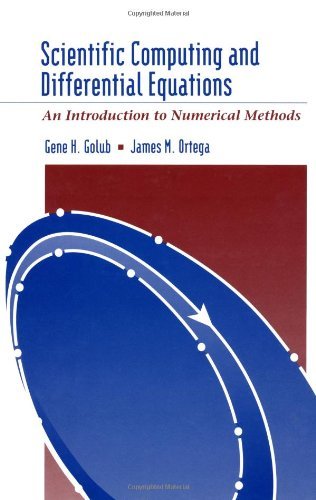
http://www.amazon.com/gp/product/B0088OZDNE/?tag=2022091-20

(Scientific Computing and Differential Equations: An Intro...)
Scientific Computing and Differential Equations: An Introduction to Numerical Methods, is an excellent complement to Introduction to Numerical Methods by Ortega and Poole. The book emphasizes the importance of solving differential equations on a computer, which comprises a large part of what has come to be called scientific computing. It reviews modern scientific computing, outlines its applications, and places the subject in a larger context. This book is appropriate for upper undergraduate courses in mathematics, electrical engineering, and computer science; it is also well-suited to serve as a textbook for numerical differential equations courses at the graduate level. • An introductory chapter gives an overview of scientific computing, indicating its important role in solving differential equations, and placing the subject in the larger environment • Contains an introduction to numerical methods for both ordinary and partial differential equations • Concentrates on ordinary differential equations, especially boundary-value problems • Contains most of the main topics for a first course in numerical methods, and can serve as a text for this course • Uses material for junior/senior level undergraduate courses in math and computer science plus material for numerical differential equations courses for engineering/science students at the graduate level
http://www.amazon.com/gp/product/0122892550/?tag=2022091-20

(Linear algebra and matrix theory are essentially synonymo...)
Linear algebra and matrix theory are essentially synonymous terms for an area of mathematics that has become one of the most useful and pervasive tools in a wide range of disciplines. It is also a subject of great mathematical beauty. In consequence of both of these facts, linear algebra has increasingly been brought into lower levels of the curriculum, either in conjunction with the calculus or separate from it but at the same level. A large and still growing number of textbooks has been written to satisfy this need, aimed at students at the junior, sophomore, or even freshman levels. Thus, most students now obtaining a bachelor's degree in the sciences or engineering have had some exposure to linear algebra. But rarely, even when solid courses are taken at the junior or senior levels, do these students have an adequate working knowledge of the subject to be useful in graduate work or in research and development activities in government and industry. In particular, most elementary courses stop at the point of canonical forms, so that while the student may have "seen" the Jordan and other canonical forms, there is usually little appreciation of their usefulness. And there is almost never time in the elementary courses to deal with more specialized topics like nonnegative matrices, inertia theorems, and so on. In consequence, many graduate courses in mathematics, applied mathe matics, or applications develop certain parts of matrix theory as needed.
http://www.amazon.com/gp/product/0306424339/?tag=2022091-20

http://www.amazon.com/gp/product/B01MY267LL/?tag=2022091-20

(Addresses some of the basic questions in numerical analys...)
Addresses some of the basic questions in numerical analysis: convergence theorems for iterative methods for both linear and nonlinear equations; discretization error, especially for ordinary differential equations; rounding error analysis; sensitivity of eigenvalues; and solutions of linear equations with respect to changes in the data.
http://www.amazon.com/gp/product/0898712505/?tag=2022091-20

http://www.amazon.com/gp/product/1483244342/?tag=2022091-20

(Iterative Solution of Nonlinear Equations in Several Vari...)
Iterative Solution of Nonlinear Equations in Several Variables provides a survey of the theoretical results on systems of nonlinear equations in finite dimension and the major iterative methods for their computational solution. Originally published in 1970, it offers a research-level presentation of the principal results known at that time. Although the field has developed since the book originally appeared, it remains a major background reference for the literature before 1970. In particular, Part II contains the only relatively complete introduction to the existence theory for finite-dimensional nonlinear equations from the viewpoint of computational mathematics. Over the years semilocal convergence results have been obtained for various methods, especially with an emphasis on error bounds for the iterates. The results and proof techniques introduced here still represent a solid basis for this topic.
http://www.amazon.com/gp/product/1483244334/?tag=2022091-20
Ortega, James McDonough was born on June 15, 1932 in Madison, Wisconsin, United States. Son of Joaquin and Margaret (McDonough) Ortega.
Bachelor of Science, U. New Mexico, 1954; Doctor of Philosophy, Stanford University, 1962.
With, U. Maryland., College Park, 1964-1973; professor mathematics and computer science, U. Maryland., 1969-1973; director, Institute Computer Applications in Science, Engineering, National Aeronautics and Space Administration Langley Research Center, Hampton, Virginia, 1973-1977; head department mathematics, North Carolina State University, Raleigh, 1977-1979; Charles Henderson professor applied mathematics and computer science, University of Virginia, Charlottesville, since 1979; department chairman, University of Virginia, 1979-1984; associate dean School Engineering and Applied Science, University of Virginia, 1980-1982; chairman applied mathematics, University of Virginia, 1984-1989; special advisor to dean, University of Virginia, 1989-1990; director Institute for Parallel Computation, University of Virginia, since 1990; department chairman Computer Science, University of Virginia, Charlottesville, since 1993.
(Addresses some of the basic questions in numerical analys...)
(Iterative Solution of Nonlinear Equations in Several Vari...)
(Linear algebra and matrix theory are essentially synonymo...)
(Scientific Computing and Differential Equations: An Intro...)
Served with United States Air Force, 1954-1956. Member Association Computing Machinery (editor transactions on Mathematics Software 1979), American Mathematics Society, Society Industrial, Applied Mathematics (editor Journal Science and Statistical Computing 1979-1984).
Married Sara Angell Martin, November 27, 1957. 1 son, Scott.
