

Background
Ely, James Wallace was born on January 20, 1938 in Rochester, New York, United States. Son of James Wallace andEdythe (Farnham) E.
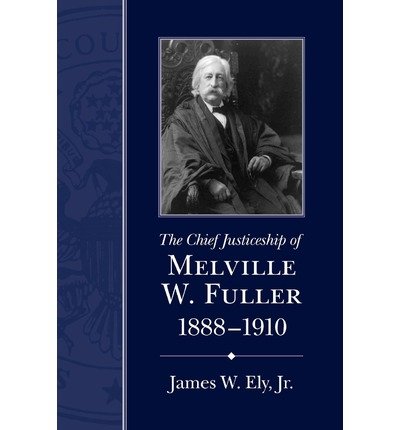
http://www.amazon.com/gp/product/B00I2JAXL2/?tag=2022091-20
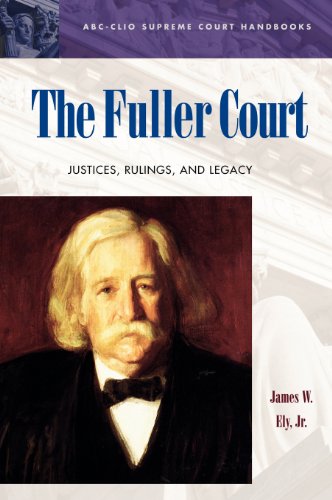
( The Fuller Court: Justices, Rulings, and Legacy present...)
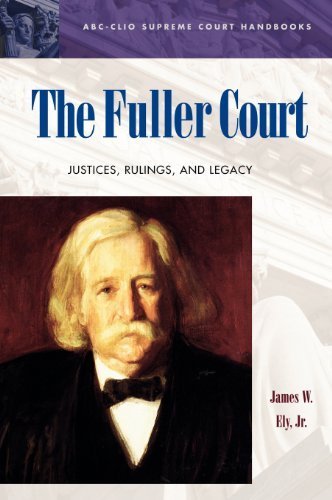
The Fuller Court: Justices, Rulings, and Legacy presents an in-depth analysis of the decisions and impact of the U.S. Supreme Court during the twenty-two year reign of Chief Justice Melville W. Fuller. An exploration of key Court decisions—ranging from railroad rate regulation and the Due Process Clause to the 1894 income tax—reveals how the Court assigned a high priority to individual liberty, which it defined largely in economic terms. A revealing discussion of the Commerce Clause and the Interstate Commerce Commission shows how the Fuller Court both limited and accepted some expansion of federal authority. Profiles of the nineteen justices who served on the Fuller Court place a special emphasis on those who made the most significant impact, including John Marshall Harlan, Samuel F. Miller, and Oliver Wendell Holmes, Jr.
http://www.amazon.com/gp/product/1576077144/?tag=2022091-20
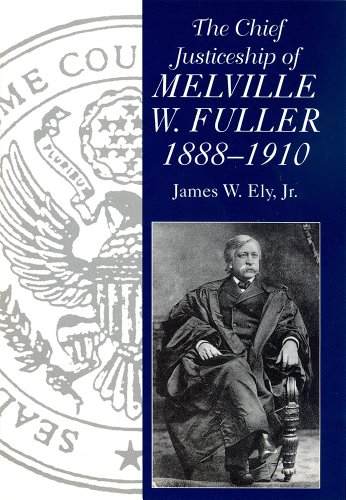
(In this comprehensive interpretation of the Supreme Court...)
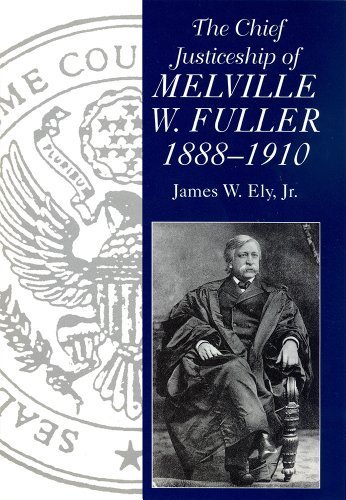
In this comprehensive interpretation of the Supreme Court during the pivotal tenure of Melville W. Fuller, James W. Ely Jr., provides a judicial biography of the man who led the Court from 1888 until 1910 as well as a comprehensive and thoughtful analysis of the jurisprudence dispensed under his leadership. Highlighting Fuller's skills as a judicial administrator, Ely argues that a commitment to economic liberty, the security of private property, limited government, and states' rights guided Fuller and his colleagues in their treatment of constitutional issues. Ely directly challenges the conventional idea that the Fuller Court adopted laissez-faire principles in order to serve the needs of business. Rather Ely presents the Supreme Court's efforts to safeguard economic rights not as a single-minded devotion to corporate interests but as a fulfillment of the property-conscious values that shaped the constitution-making process in 1787. The resulting study illuminates a range of related legal issues, including the Supreme Court's handling of race relations, criminal justice, governmental authority, and private law disputes.
http://www.amazon.com/gp/product/1611171288/?tag=2022091-20
http://www.amazon.com/gp/product/1570030189/?tag=2022091-20

http://www.amazon.com/gp/product/B006E7ZYUO/?tag=2022091-20
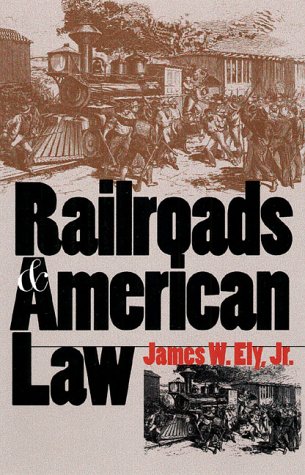
(No enterprise is so seductive as a railroad for the influ...)
No enterprise is so seductive as a railroad for the influence it exerts, the power it gives, and the hope of gain it offers.—Poor's Manual of Railroads (1900 At its peak, the railroad was the Internet of its day in its transformative impact on American life and law. A harbinger and promoter of economic empire, it was also the icon of a technological revolution that accelerated national expansion and in the process transformed our legal system. James W. Ely Jr., in the first comprehensive legal history of the rail industry, shows that the two institutions—the railroad and American law—had a profound influence on each other. Ely chronicles how "America's first big business" impelled the creation of a vast array of new laws in a country where long-distance internal transport had previously been limited to canals and turnpikes. Railroads, the first major industry to experience extensive regulation, brought about significant legal innovations governing interstate commerce, eminent domain, private property, labor relations, and much more. Much of this development was originally designed to serve the interests of the railroads themselves but gradually came to contest and control the industry's power and exploitative tendencies. As Ely reveals, despite its great promise and potential as an engine of prosperity and uniter of far-flung regions, the railroad was not universally admired. Railroads uprooted people, threatened local autonomy, and posed dangers to employees and the public alike—situations with unprecedented legal ramifications. Ely explores the complex and sometimes contradictory ways in which those ramifications played out, as railroads crossed state lines and knitted together a diverse nation with thousands of miles of iron rail. Epic in its scope, Railroads and American Law makes a complex subject accessible to a wide range of readers, from legal historians to railroad buffs, and shows the many ways in which a powerful industry brought change and innovation to America.
http://www.amazon.com/gp/product/0700611444/?tag=2022091-20
http://www.amazon.com/gp/product/B011DB86LO/?tag=2022091-20
http://www.amazon.com/gp/product/B010WHGPTK/?tag=2022091-20
Ely, James Wallace was born on January 20, 1938 in Rochester, New York, United States. Son of James Wallace andEdythe (Farnham) E.
Bachelor of Laws, Harvard University, 1962. Doctor of Philosophy, University Virginia, 1971.
Bar: New York 1962, United States District Court (western district) New York 1963. Association, Harris, Beach and Wilcox, Rochester, New York, 1962-1967. Instructor University of Virginia, 1970.
Instructor to assistant professor Virginia Commonwealth University, Richmond, 1970-1973.
Assistant professor of law Vanderbilt University, Nashville, 1973-1975, associate professor, 1975-1978, professor, since 1978. Visiting professor law U. Leeds, England, 1981-1982.
Chapman distinguished visiting professor, U. Tulsa, 1985.
(No enterprise is so seductive as a railroad for the influ...)
( The Fuller Court: Justices, Rulings, and Legacy present...)
(In this comprehensive interpretation of the Supreme Court...)
Member American Society Legal History (treasurer 1980-1981, 82-83, 84-85), Organisation American Historians, So.Hist. Association.
Married Ruth Buell MacCameron, August 27, 1960. Children: A. Elizabeth, Kimberly Farnham, Suzanne B., James West. Bachelor of Arts, Princeton University, 1959.
