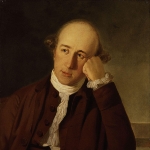
Colorized version of engraved depiction of Jane Austen. This is several steps removed from an authentic portrait (from the original Cassandra Austen drawing to the 1870 Memoir engraving to other engravings in imitation of the 1870 engraving, then add color)
Jane Austen was a British writer, one of the most important novelists of the 19th century. Although her novels received favorable reviews, she was not celebrated as an author during her lifetime.
Background
Austen was born on December 16, 1775, at Steventon, in the south of England, where her father was rector of the parish. She was the seventh of eight children in an affectionate and high-spirited family. Her parents were both descended from ancient country families of more or less prosperous squires and professional men.
In 1801 she moved to Bath with her father, her mother, and her only sister, Cassandra. After the Reverend Austen's death in 1805, the three women moved to Southampton and in 1809 to the village of Chawton, where Jane lived for the rest of her life.
Education
In 1783, Austen and her sister Cassandra were sent to Oxford to be educated by Mrs. Ann Cawley who took them with her to Southampton. In the autumn both girls were sent home when they caught typhus and Austen nearly died. She was from then home educated, until she attended Reading Abbey Girls' School in Reading with her sister from early 1785.
Career
Austen began writing as a young girl and by the age of 14 had completed Love and Friendship. This early work, an amusing parody of the melodramatic novels popular at that time, shows clear signs of her talent for humorous and satirical writing. Three volumes of her collected juvenilia were published more than a hundred years after her death.
Austen's first major novel was Sense and Sensibility, whose main characters are Elinor Dashwood and her sister Marianne. The first draft was written in 1795 and titled Elinor and Marianne. In 1797 Austen rewrote the novel. After years of polishing, it was finally published in 1811. As the original and final titles indicate, the novel contrasts the temperaments of the two sisters.
In 1796, when Austen was 21 years old, she wrote the novel First Impressions. The work was rewritten and published under the title Pride and Prejudice in 1813. It is her most popular and perhaps her greatest novel. It achieves this distinction by virtue of its perfection of form, which exactly balances and expresses its human content. As in Sense and Sensibility, the twin abstractions of the title are closely associated with the protagonists, Elizabeth Bennet and Fitzwilliam Darcy.
During 1797-1798 Austen wrote Northanger Abbey, which was published posthumously. It is a fine satirical novel, making sport of the popular Gothic novel of terror, but it does not rank among her major works. In the following years she wrote The Watsons (1803 or later), which is a fragment of a novel similar in mood to her later Mansfield Park, and Lady Susan (1804 or later), a novelette in letters.
In 1811 Jane began Mansfield Park, which was published in 1814. It is her most severe exercise in moral analysis and presents a conservative view of ethics, politics, and religion. Shortly before Mansfield Park was published, Austen began a new novel, Emma, and published it in 1816. Again the heroine, Emma Woodhouse, is difficult to love but, like Fanny Price, does engage the reader's sympathy and understanding.
Persuasion, begun in 1815 and published posthumously (together with Northanger Abbey) in 1818, is Jane Austen's last complete novel and is perhaps most directly expressive of her feelings about her own life. The heroine, Anne Elliot, is a woman growing older with a sense that life has passed her by.
The novel Sanditon was unfinished at her death in 1817. Austen died on July 18, 1817, at Winchester, where she had gone to seek medical attention, and was buried there.
Achievements
Austen is famous principally for her refinement of the English novel. In her works, she mirrored society: manners, customs, and beliefs. She worked magic with the commonplace, seemingly subtle, realities of life. Part of Austen's fame rests on the historical and literary significance that she was the first woman to write great comic novels.
For Austen, religion was a more private affair. Being brought up as a moderate 18th Century Anglican clergyman’s daughter, religion was a part of her daily life, but it was demonstrated in a discreet manner.
Views
Austen's plots often explore the dependence of women on marriage in the pursuit of favorable social standing and economic security. Her works critique the novels of sensibility of the second half of the 18th century and are part of the transition to 19th-century literary realism.
Personality
Quotes from others about the person
Mary Lascelles: "Few novelists can be more scrupulous than Jane Austen as to the phrasing and thoughts of their characters."
Critic Robert Polhemus: "To appreciate the drama and achievement of Austen, we need to realize how deep was her passion for both reverence and ridicule ... and her comic imagination reveals both the harmonies and the telling contradictions of her mind and vision as she tries to reconcile her satirical bias with her sense of the good."
Connections
Austen never married, but received at least one proposal and led an active and happy life, unmarked by dramatic incident and surrounded by her sister and brothers and their families.
Father:
George Austen
George Austen (1731–1805) was a clergyman in the Anglican Church of England and the rector of Deane and Steventon in Hampshire.
Jane Austen at Home: A Biography
A book by Lucy Worsley, who visits Austen's childhood home, her schools, her holiday accommodations, the houses - both grand and small - of the relations upon whom she was dependent, and the home she shared with her mother and sister towards the end of her life. In places like Steventon Parsonage, Godmersham Park, Chawton House and a small rented house in Winchester, Worsley discovers a Jane Austen very different from the one who famously lived a 'life without incident'.
2017
Jane Austen: A Life
An acclaimed biographer Claire Tomalin, author of A Life of My Own, has filled the gaps in the record, creating a remarkably fresh and convincing portrait of the woman and the writer.
1997
Jane Austen, the Secret Radical
In this fascinating, revelatory work, Helena Kelly - dazzling Jane Austen authority - looks past the grand houses, the pretty young women, past the demure drawing room dramas and witty commentary on the narrow social worlds of her time that became the hallmark of Austen's work to bring to light the serious, ambitious, deeply subversive nature of this beloved writer. Kelly illuminates the radical subjects - slavery, poverty, feminism, the Church, evolution, among them - considered treasonous at the time, that Austen deftly explored in the six novels that have come to embody an age. The author reveals just how in the novels we find the real Jane Austen: a clever, clear-sighted woman "of information," fully aware of what was going on in the world and sure about what she thought of it.