Background
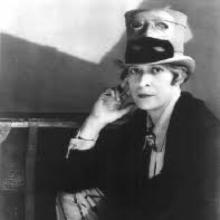
Flanner, Janet was born on March 13, 1892 in Indianapolis, Indiana, United States. Daughter of Frances and Mary-Ellen (Hockett) Flanner.


(This portrait of a city and an era is drawn from the the ...)
This portrait of a city and an era is drawn from the the author's celebrated "Letter from Paris," a series that appeared in The New Yorker from 1925 to 1975 over the signature "Genêt." Edited by William Shawn; Index. This portrait of a city and an era is drawn from the the author's celebrated "Letter from Paris," a series that appeared in The New Yorker from 1925 to 1975 over the signature "Genêt." Edited by William Shawn; Index.
http://www.amazon.com/gp/product/015670949X/?tag=2022091-20

('JANET FLANNER'S WORLD: UNCOLLECTED WRITINGS, 1932-75' [I...)
'JANET FLANNER'S WORLD: UNCOLLECTED WRITINGS, 1932-75' [Irving Flanner Janet; Drutman] on Amazon.com. *FREE* shipping on qualifying offers.
http://www.amazon.com/gp/product/0436159953/?tag=2022091-20

(In 1925 Flanner began her New Yorker “Letter from Paris,”...)
In 1925 Flanner began her New Yorker “Letter from Paris,” from which most of the pieces in this collection are drawn. They give an incomparable view of French life before World War II. Edited by Irving Drutman; Index. In 1925 Flanner began her New Yorker “Letter from Paris,” from which most of the pieces in this collection are drawn. They give an incomparable view of French life before World War II. Edited by Irving Drutman; Index.
http://www.amazon.com/gp/product/0156709902/?tag=2022091-20

(The pieces collected here include an early profile of Hit...)
The pieces collected here include an early profile of Hitler, reports on the Nuremberg trials, portraits of Thomas Mann, Bette Davis, Picasso, and concerts and art exhibits. Edited by Irving Drutman. Preface by William Shawn. The pieces collected here include an early profile of Hitler, reports on the Nuremberg trials, portraits of Thomas Mann, Bette Davis, Picasso, and concerts and art exhibits. Edited by Irving Drutman. Preface by William Shawn.
http://www.amazon.com/gp/product/015645971X/?tag=2022091-20

(The Cubical City [Janet Flanner] on Amazon.com. *FREE* sh...)
The Cubical City [Janet Flanner] on Amazon.com. *FREE* shipping on qualifying offers.
http://www.amazon.com/gp/product/B001INI6JK/?tag=2022091-20

(From 1925 to 1978, Janet Flanner was the Paris correspond...)
From 1925 to 1978, Janet Flanner was the Paris correspondent for "The New Yorkers", signing her letters "Genet". In "Men and Monuments", Flanner traces the course of four brilliant lives - those of the painters Picasso, Braque and Matisse, and the writer, politician and art critic Andre Malraux. Through anecdote, analysis, reportage, and opinion, Flanner presents a portrait of a time in Paris history - the late 1940s and 1950s - during which a nation recovered from a catastrophe, a new art was being forged and new ideas and values flourished. In addition, Flanner tells the inside story of one of the greatest art-pillaging campaign in history: Hitler's and Goering's ransack of the collections of the occupied countries during World War II.
http://www.amazon.com/gp/product/0306804174/?tag=2022091-20
Flanner, Janet was born on March 13, 1892 in Indianapolis, Indiana, United States. Daughter of Frances and Mary-Ellen (Hockett) Flanner.
Student Tudor Hall, Indpls.
In September 1925 Flanner published her first "Letter from Paris" in The New Yorker, launched the previous February, starting a professional association that lasted for five decades. She wrote under the pen-name "Genêt". Flanner had first come to the attention of editor Harold Ross through his first wife, Jane Grant, who was a friend of Flanner's from the Lucy Stone League, an organization that fought for women to preserve their maiden names after marriage, in the manner of Lucy Stone. Flanner joined the group in 1921. Ross famously thought "Genêt" was French for "Janet".
Flanner was a prominent member of the American expatriate community which included Ernest Hemingway, F. Scott Fitzgerald, John Dos Passos, e. e. cummings, Hart Crane, Djuna Barnes, Ezra Pound, and Gertrude Stein – the world of the Lost Generation and Les Deux Magots. While in Paris she became very close friends with Gertrude Stein and her lover, Alice B. Toklas.
She played a crucial role in introducing her contemporaries to new artists in Paris, including Pablo Picasso, Georges Braque, Henri Matisse, André Gide, Jean Cocteau, and the Ballets Russes, as well as crime passionel and vernissage, the triumphant crossing of the Atlantic Ocean by Charles Lindbergh and the depravities of the Stavisky Affair.
Her prose style has since come to epitomise the "New Yorker style" – its influence can be seen decades later in the prose of Bruce Chatwin. An example: "The late Jean De Koven was an average American tourist in Paris but for two exceptions: she never set foot in the Opéra, and she was murdered."
Flanner lived in New York City during World War II with Natalia Danesi Murray and her son William B. Murray, still writing for The New Yorker. She returned to Paris in 1944.
Her New Yorker work during World War II included not only her famous "Letter from Paris" columns, but also included a seminal 3-part series profiling Hitler (1936), and coverage of the Nuremberg trials (1945). Additionally, she contributed a series of little-known weekly radio broadcasts for the NBC Blue Network during the months following the liberation of Paris in late 1944.
Flanner authored one novel, The Cubical City, which achieved little success.
She covered the Suez crisis, the Soviet invasion of Hungary, and the strife in Algeria which led to the rise of Charles de Gaulle. She was a leading member of the influential coterie of mostly lesbian women that included Natalie Clifford Barney and Djuna Barnes.
For Paris Journal, 1944-1965 she won the 1966 U.S. National Book Award in category Arts and Letters. Extracts of her Paris journal were turned into a piece for chorus and orchestra by composer Ned Rorem.
In 1971, she was the third guest during the infamous scuffle between Gore Vidal and Norman Mailer on the Dick Cavett Show, getting in between the two after a drunken Mailer started insulting his fellow guests and their host.
(This portrait of a city and an era is drawn from the the ...)
('JANET FLANNER'S WORLD: UNCOLLECTED WRITINGS, 1932-75' [I...)
(The pieces collected here include an early profile of Hit...)
(In 1925 Flanner began her New Yorker “Letter from Paris,”...)
(From 1925 to 1978, Janet Flanner was the Paris correspond...)
(The Cubical City [Janet Flanner] on Amazon.com. *FREE* sh...)
Member National Institute Arts and Letters.
Her father co-owned a mortuary and ran the first crematorium in the state of Indiana.
Hildegarde Flanner (June 6, 1899-May 27, 1987) was an American poet, essayist, playwright and conservationist.
In 1918 she married William "Lane" Rehm, a friend that she had made while at the University of Chicago. He was an artist in New York City, and she later admitted that she married him to get out of Indianapolis. The marriage lasted for only a few years and they divorced amicably in 1926. Rehm was supportive of Flanner's career until his death.
Flanner was bisexual. In 1918, the same year she married her husband, she met Solita Solano (Sarah Wilkinson). They met in Greenwich Village, and the two became lifelong lovers, although both became involved with other lovers throughout their relationship. Solita Solano was drama editor for the New York Tribune and also wrote for National Geographic. The two women are portrayed as "Nip" and "Tuck" in the 1928 novel Ladies Almanack, by Djuna Barnes, who was a friend of Flanner's. While in New York, Janet Flanner moved in the circle of the Algonquin Round Table, but was not a member. She also met the couple Jane Grant and Harold Ross through painter Neysa McMein. It was this connection that Harold Ross offered her the position of French Correspondent to the New Yorker.