

Background
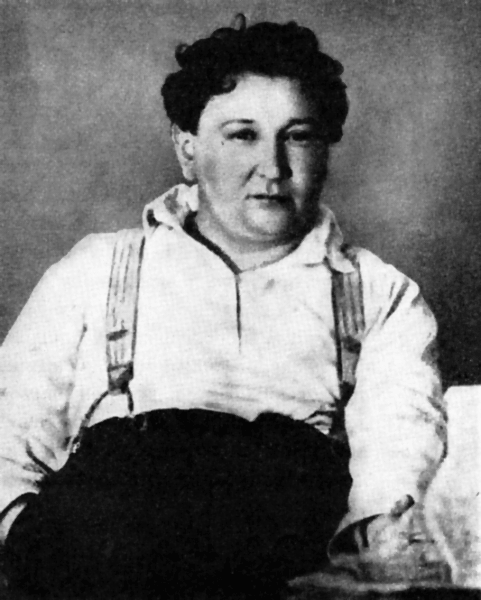
Jaroslav Hasek was born April 24, 1883, in Prague.
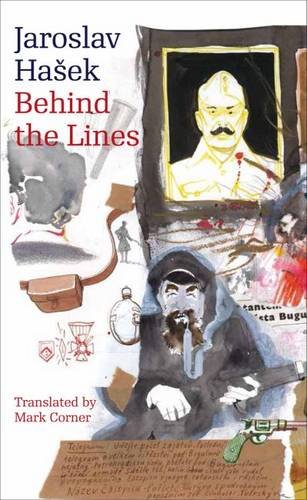
( Jaroslav Haek is a Czech writer most famous for his wi...)
Jaroslav Haek is a Czech writer most famous for his wickedly funny, widely read, yet incomplete novel The Good Soldier Schweik, a series of absurdist vignettes about a recalcitrant WWI soldier. Haekin spite of a life of buffoonery and debaucherywas remarkably prolific. He wrote hundreds of short stories that all display both his extraordinary gift for satire and his profound distrust of authority. Behind the Lines presents a series of nine short stories first published in the Prague Tribune and considered to be some of Haeks best. Based on his experiences as a Red Commissar in the Russian Civil War and his return to Czechoslovakia, Behind the Lines focuses on the Russian town of Bugulma, taking aim, with mordant wit, at the absurdities of a revolution. Providing important background and insight into The Good Soldier Schweik, this collection by a writer some call the Bolshevik Mark Twain is nevertheless much more than a tool for understanding his better-known novel; it is a significant work in its own right. A hidden gem remarkable for its modern, ribald sense of humor, Behind the Lines is an enjoyable, fast-paced anthology of great literary and historical value.
http://www.amazon.com/gp/product/802463287X/?tag=2022091-20

(The Good Soldier Svejk is the abbreviated title of an unf...)
The Good Soldier Svejk is the abbreviated title of an unfinished satirical/dark comedy novel by Jaroslav Haek. The novel is set during World War I in Austria-Hungary, a multi-ethnic empire full of long-standing tensions. Fifteen million people died in the War, one million of them Austro-Hungarian soldiers of whom around 140,000 were Czechs. Jaroslav Hasek participated in this conflict and examined it in The Good Soldier Svejk. Many of the situations and characters seem to have been inspired, at least in part, by Haek's service in the 91st Infantry Regiment of the Austro-Hungarian Army. The novel also deals with broader anti-war themes: essentially a series of absurdly comic episodes, it explores both the pointlessness and futility of conflict in general and of military discipline, Austrian military discipline, in particular. Many of its characters, especially the Czechs, are participating in a conflict they do not understand on behalf of a country to which they have no loyalty. The character of Josef Svejk is a development of this theme. Through possibly-feigned idiocy or incompetence he repeatedly manages to frustrate military authority and expose its stupidity in a form of passive resistance: the reader is left unclear, however, as to whether Svejk is genuinely incompetent, or acting quite deliberately with dumb insolence. These absurd events reach a climax when Svejk, wearing a Russian uniform, is mistakenly taken prisoner by his own troops.
http://www.amazon.com/gp/product/1909669458/?tag=2022091-20
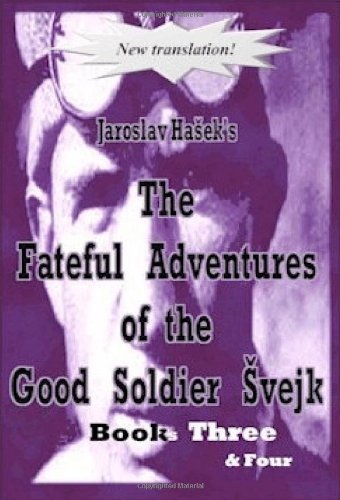
(This is the last volume of the The Fateful Adventures Of ...)
This is the last volume of the The Fateful Adventures Of The Good Soldier Svejk During The World War containing Book Three and Book Four. Jaroslav Hasek planned to write six books but passed away before completing Book Four. That is why the book is considered unfinished. Yet, it can be argued the author, under pressure from his deteriorating health, indeed completed his thoughts and "closed the books" on the book that made him famous quite well. The Good Soldier vejk, is a truly great satire (perhaps the greatest of them all) on the most central feature of social life in the past century and a half (at least) in most modern industrialized countries--the ubiquitous presence of huge, labyrinthine bureaucratic structures ostensibly set in place to make modern society more efficient, equal, and fair, but, in fact, reducing life for those who have to deal with them to what often amounts to an incomprehensible and out-of-control game whose major players never tire of announcing in noble-sounding prose and stirring poetry the importance of the structure and its alleged purpose but who, in their daily practice, show no signs of any significant humanity in dealing with subordinates or those whom the bureaucracy is supposed to serve. That target is something we all understand (because we have to deal with it, no matter where we live), and thus the impact of this satire extends well beyond the particular social and political realities of the world it depicts. - Ian Johnston, Malaspina University-College, Nanaimo, BC.
http://www.amazon.com/gp/product/1438916779/?tag=2022091-20

(Jaroslav Haek's black satire, the inspiration for such w...)
Jaroslav Haek's black satire, the inspiration for such works as Joseph Heller's Catch-22 Good-natured and garrulous, vejk becomes the Austro-Hungarian army's most loyal Czech soldier when he is called up on the outbreak of the First World War - although his bumbling attempts to get to the front serve only to prevent him from reaching it. Playing cards, getting drunk and becoming a general nuisance, the resourceful vejk uses all his natural cunning and genial subterfuge to deal with the doctors, police, clergy and officers who chivvy him towards battle. The story of a 'little man' caught in a vast bureaucratic machine, The Good Soldier vejk combines dazzling wordplay and piercing satire to create a hilariously subversive depiction of the futility of war. Cecil Parrott's vibrant, unabridged and unbowdlerized translation is accompanied by an introduction discussing Haek's turbulent life as an anarchist, communist and vagranty, and the Everyman character of vejk. This edition also includes a guide to Czech names, maps and original illustrations by Josef Ladas. For more than seventy years, Penguin has been the leading publisher of classic literature in the English-speaking world. With more than 1,700 titles, Penguin Classics represents a global bookshelf of the best works throughout history and across genres and disciplines. Readers trust the series to provide authoritative texts enhanced by introductions and notes by distinguished scholars and contemporary authors, as well as up-to-date translations by award-winning translators.
http://www.amazon.com/gp/product/0140449914/?tag=2022091-20
Jaroslav Hasek was born April 24, 1883, in Prague.
At the age of 15 he dropped out of high school, but then graduated from business school.
Before embarking on a career as a writer and journalist he was a bank clerk in 1903. Then he started writing for various newspapers and, using different pseudonyms, even carried on humorous polemics with himself.
During World War I Hasek served in the Austrian army but deserted to the Russians.
After the revolution of 1917 he joined the Bolshevik Party in Russia and served for two years in Siberia as a Soviet commissar.
He returned to Prague in 1920 to publish "The Good Soldier Schweik". Besides The Good Soldier Schweik, Hasek published a number of stories, mostly satirical treatments of the Czech bourgeoisie.
(Jaroslav Haek's black satire, the inspiration for such w...)
( Jaroslav Haek is a Czech writer most famous for his wi...)
(This is the last volume of the The Fateful Adventures Of ...)
(The Good Soldier Svejk is the abbreviated title of an unf...)

