

Background
Pfeffer, Jeffrey was born on July 23, 1946 in St. Louis. Son of Newton Stuart and Shirlee (Krisman) Pfeffer.

(Explores why - despite long-standing evidence that a comm...)
Explores why - despite long-standing evidence that a committed work force is essential for success - firms continue to attach little importance to their workers. The answer resides in a complex web of factors based on perception, history, legislation, and practice that continues to dominate management thought and action.
http://www.amazon.com/gp/product/087584717X/?tag=2022091-20

http://www.amazon.com/gp/product/0875848419/?tag=2022091-20

http://www.amazon.com/gp/product/B01FIWKXI8/?tag=2022091-20

http://www.amazon.com/gp/product/B01K2JDVX6/?tag=2022091-20

http://www.amazon.com/gp/product/0273018515/?tag=2022091-20

http://www.amazon.com/gp/product/B01K2QCVFI/?tag=2022091-20

http://www.amazon.com/gp/product/B01NH00AJE/?tag=2022091-20
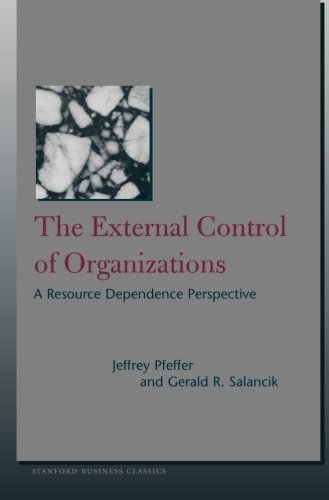
(Among the most widely cited books in the social sciences,...)
Among the most widely cited books in the social sciences, The External Control of Organizations has long been required reading for any student of organization studies. The book, reissued on its 25th anniversary as part of the Stanford Business Classics series, includes a new preface written by Jeffrey Pfeffer, which examines the legacy of this influential work in current research and its relationship to other theories. The External Control of Organizations explores how external constraints affect organizations and provides insights for designing and managing organizations to mitigate these constraints. All organizations are dependent on the environment for their survival. As the authors contend, "it is the fact of the organization's dependence on the environment that makes the external constraint and control of organizational behavior both possible and almost inevitable." Organizations can either try to change their environments through political means or form interorganizational relationships to control or absorb uncertainty. This seminal book established the resource dependence approach that has informed so many other important organization theories.
http://www.amazon.com/gp/product/080474789X/?tag=2022091-20

(Book by Pfeffer, Jeffrey)
Book by Pfeffer, Jeffrey
http://www.amazon.com/gp/product/0882954539/?tag=2022091-20

(Will be shipped from US. Used books may not include compa...)
Will be shipped from US. Used books may not include companion materials, may have some shelf wear, may contain highlighting/notes, may not include CDs or access codes. 100% money back guarantee.
http://www.amazon.com/gp/product/B019L5K4TG/?tag=2022091-20

(This text explores why, despite long-standing evidence in...)
This text explores why, despite long-standing evidence indicating that a committed work-force is essential for success, firms continue to attach little importance to their workers. The answer, argues the author, resides in a complex web of factors based on perception, history, legislation and practice that continues to dominate management thought and action. He investigates each of these factors to get to the root of the problem. The work begins by examining why certain long-discredited perceptions of human behaviour persist in organizations. It then recounts the history of legislation and labour relations and their legacy of distrust and confrontation. Finally, it explores various aspects of the manager/employee relationship and highlights how it has been undermined. However, some organizations have been able to overcome these problems. Indeed, the five common stocks with the highest returns between 1972 and 1992 - Southwest Airlines, Wal-Mart, Tyson Foods, Circuit City and Plenum Publishing - were in industries that shared virtually none of the characteristics traditionally associated with strategic success. What each of these firms did share was the ability to produce sustainable competitive advantage through its use of managing people. The work documents how they, and others, resisted traditional management pitfalls, and offers frameworks for implementing these changes in any industry.
http://www.amazon.com/gp/product/0875844138/?tag=2022091-20

(In New Directions for Organization Theory, Jeffrey Pfeffe...)
In New Directions for Organization Theory, Jeffrey Pfeffer offers a comprehensive analysis and overview of the field of organization theory and its research literature. This work traces the evolution of organization studies, particularly its more recent history, and highlights the principle concepts and controversies characterizing the study of organizations. Pfeffer argues that the world of organizations has changed in several important ways, including the increasing externalization of employment and the growing use of contingent workers; the changing size distribution of organizations, with a larger proportion of smaller organizations; the increasing influence of external capital markets on organizational decision-making and a concomitant decrease in managerial autonomy; and increasing salary inequality within organizations in the US compared both to the past and to other industrialized nations. These changes and their public policy implications make it especially important to understand organizations as social entities. But Pfeffer questions whether the research literature of organization studies has either addressed these changes and their causes or made much of a contribution to the discussion of public policy. New Directions for Organization Theory provides a clear, accessible summary of the current state of organization studies, skillfully synthesizing diverse research and presenting it in an orderly, insightful manner. It offers suggestions for the development of the field, including a call to focus more on issues of design and to use the ability to understand real phenomena to help distinguish among theoretical approaches. A major scholar in the field of organization theory, Jeffrey Pfeffer offers a perspective on its current state that will be of interest and value to scholars and graduate students interested in organizations.
http://www.amazon.com/gp/product/0195114345/?tag=2022091-20

( Although much as been written about how to make better ...)
Although much as been written about how to make better decisions, a decision by itself changes nothing. The big problem facing managers and their organizations today is one of implementation--how to get things done in a timely and effective way. Problems of implementation are really issues of how to influence behavior, change the course of events, overcome resistance, and get people to do things they would not otherwise do. In a word, power. Managing With Power provides an in-depth look at the role of power and influence in organizations. Pfeffer shows convincingly that its effective use is an essential component of strong leadership. With vivid examples, he makes a compelling case for the necessity of power in mobilizing the political support and resources to get things done in any organization. He provides an intriguing look at the personal attributes—such as flexibility, stamina, and a high tolerance for conflict—and the structural factors—such as control of resources, access to information, and formal authority—that can help managers advance organizational goals and achieve individual success.
http://www.amazon.com/gp/product/0875844405/?tag=2022091-20
Pfeffer, Jeffrey was born on July 23, 1946 in St. Louis. Son of Newton Stuart and Shirlee (Krisman) Pfeffer.
Bachelor of Science, Master of Science, Carnegie Mellon U., 1968; Doctor of Philosophy, Stanford University, 1972.
Member technical staff, Research Analysis Corporation, McLean, Virginia, 1968-1969;
assistant professor, University of Illinois, Champaign, 1971-1973;
from assistant professor to associate professor, University of California, Berkeley, 1973-1979;
professor, Graduate School Business, Stanford University, California, since 1979. Visiting professor Harvard University School Business, Boston, 1981-1982. Director, member compensation committee Portola Packaging, Inc., Resumix, Inc.
Director SonoSight, Inc.
(This text explores why, despite long-standing evidence in...)
(In New Directions for Organization Theory, Jeffrey Pfeffe...)
(Among the most widely cited books in the social sciences,...)
(Explores why - despite long-standing evidence that a comm...)
( Although much as been written about how to make better ...)
(Book by Pfeffer, Jeffrey)
(Will be shipped from US. Used books may not include compa...)
Fellow Academy Management (Board of Governors 1984-1986, New Concept award 1979, Richard D. Irwin award for scholarly contributions to management 1989). Member American Sociological Association, Industrial Rels. Research Association.
Married Kathleen Frances Fowler, July 23, 1986.
