

Background
Pollitt, Jerome Jordan was born on November 26, 1934 in Fair Lawn, New Jersey, United States. Son of John Kendall and Doris B. (Jordan) Pollitt.

(This book is a companion volume to Professor Pollitt's Th...)
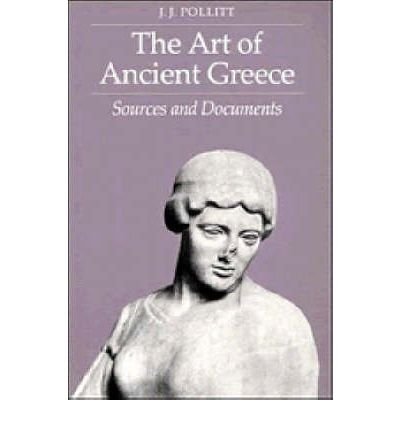
This book is a companion volume to Professor Pollitt's The Art of Rome: Sources and Documents (CUP, 1983). An authoritative and reliable sourcebook, The Art of Ancient Greece contains a comprehensive collection in translation of ancient literary evidence relating to Greek sculpture, painting, architecture, and the decorative arts. The material is presented in a way which makes this important evidence available to students who are not specialists in the Classical languages or Classical archaeology. Accompanying the author's translations of a wide selection of Greek and Latin texts is an accessible, substantial bibliography, as well as an introduction, and explanatory commentary.
http://www.amazon.com/gp/product/0521273668/?tag=2022091-20

http://www.amazon.com/gp/product/B002C5JLMO/?tag=2022091-20

http://www.amazon.com/gp/product/B010BERM1E/?tag=2022091-20
http://www.amazon.com/gp/product/B010BERPB6/?tag=2022091-20

(An account of the development of Greek art in the Classic...)
An account of the development of Greek art in the Classical period (about 480-320 BC) which places particular emphasis on the meaning and content of Greek sculpture, architecture and painting. Professor Pollitt reminds us that the visual arts in Greece, as elsewhere, were primarily vehicles of expression. He does not ignore formal development but always relates this to social and cultural history, which it reflected and from which it grew. While his subject is art, he refers frequently to the literature and philosophy of the period which were shaped by the same influences.
http://www.amazon.com/gp/product/0521096626/?tag=2022091-20

(Art & Experience in Classical Greece by Pollitt,Jerome Jo...)
Art & Experience in Classical Greece by Pollitt,Jerome Jordan. 1972 Paperback
http://www.amazon.com/gp/product/B0040HL7LU/?tag=2022091-20

http://www.amazon.com/gp/product/0300017375/?tag=2022091-20

http://www.amazon.com/gp/product/B010BERWHI/?tag=2022091-20

http://www.amazon.com/gp/product/B01181WDUO/?tag=2022091-20

(This 1986 book is an interpretative history of Greek art ...)
This 1986 book is an interpretative history of Greek art during the Hellenistic period.
http://www.amazon.com/gp/product/B00FDV7IBU/?tag=2022091-20

http://www.amazon.com/gp/product/B00ZM39VL4/?tag=2022091-20

http://www.amazon.com/gp/product/B01181FLLW/?tag=2022091-20

http://www.amazon.com/gp/product/B010EWPRPQ/?tag=2022091-20

('The best reason to study Hellenistic art is for its own ...)
'The best reason to study Hellenistic art is for its own sake' writes Professor Pollitt in the Preface to Art in the Hellenistic Age. 'But', he continues, 'I would suggest that there is an additional quality that should make the art of the Hellenistic age of particular interest to modern audiences: the fact that in background and content it was the product of an age in many ways similar to our own ... The result of the historical conditions (of the age) was an art which, like much modern art, was heterogenous, often cosmopolitan, increasingly individualistic, and frequently elite in its appeal'. This 1986 book is an interpretative history of Greek art during the Hellenistic period - i.e. from the death of Alexander the Great in 323 BC, to the establishment of the Roman Empire at the end of the first century BC - which also explores ways in which that art is an expression of the cultural experience and aspirations of the Hellenistic age.
http://www.amazon.com/gp/product/0521276721/?tag=2022091-20

(A collection of ancient literary evidence relating to Gre...)
A collection of ancient literary evidence relating to Greek sculpture, painting, architecture, and the decorative arts.
http://www.amazon.com/gp/product/B008H02AEE/?tag=2022091-20

http://www.amazon.com/gp/product/B01071R9Z0/?tag=2022091-20

( What did the ancient Greeks think about their own art? ...)
What did the ancient Greeks think about their own art? J.J. Pollitt attempts to answer this question by studying the critical terminology of the ancient Greeks—the terms they used to describe and evaluate sculpture, painting, and architecture. Although Greeks and Romans with a wide variety of backgrounds and interests—including artists, philosophers, rhetoricians, historians, and guidebook writers—wrote about art in antiquity, very few of their works have survived. Mr. Pollitt has therefore had to draw largely on works of authors who, while discussing some other subject, make passing references to art for the purpose of analogy or illustration. By carefully assembling and organizing these fragments, he presents a coherent view of art criticism in ancient Greece. This study is divided into two parts. The first part provides a general history of Greek art criticism and its sources. The second is an extensive glossary which collects, translates, and analyzes passages from Greek and Latin authors in which important critical terms are used. The book can therefore be used by art historians and classicists as both a scholarly text and an important work of reference.
http://www.amazon.com/gp/product/0300015976/?tag=2022091-20
Pollitt, Jerome Jordan was born on November 26, 1934 in Fair Lawn, New Jersey, United States. Son of John Kendall and Doris B. (Jordan) Pollitt.
Bachelor of Arts, Yale University, 1957; Doctor of Philosophy, Columbia University, 1963.
Instructor history of art, Yale University, New Haven, 1962-1964; assistant professor, Yale University, 1964-1968; associate professor, Yale University, 1969-1973; professor, Yale University, since 1973; department chairman classics, Yale University, 1975-1977; department chairman history of art, Yale University, 1981-1984; dean, Yale University, 1986-1991.
(An account of the development of Greek art in the Classic...)
(An account of the development of Greek art in the Classic...)
('The best reason to study Hellenistic art is for its own ...)
(A collection of ancient literary evidence relating to Gre...)
(This book is a companion volume to Professor Pollitt's Th...)
(This 1986 book is an interpretative history of Greek art ...)
(Art & Experience in Classical Greece by Pollitt,Jerome Jo...)
( What did the ancient Greeks think about their own art? ...)
(Book by Jerome Jordan Pollitt)
Member Archaeol. Institute American, College Art Association.
Married Susan Baker Matheson, February 10, 1977.
