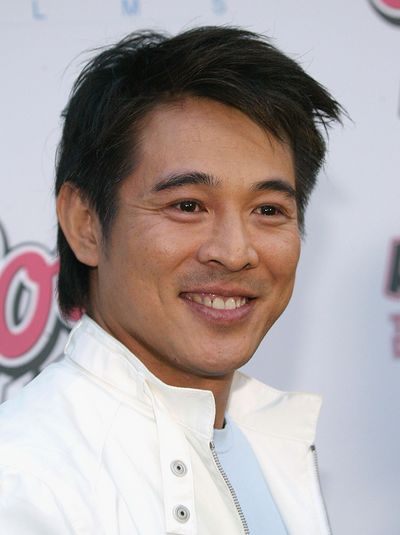
Jet Li (born Li Lianjie) is a Singaporean actor, martial artist, film producer, director, and philanthropist. A four-time national wushu champion, he became a leading figure in Chinese and Hong Kong martial arts cinema before building an international film career. He founded One Foundation and co-founded Taiji Zen.
Background
Ethnicity:
Han Chinese; his ancestral home is Shenyang, Liaoning, China.
Li was born in Beijing on April 26, 1963, the youngest of four children, with two brothers and two sisters. His ancestral home is Shenyang in Liaoning. His father died when Li was two, and the family lived in poverty.
Education
At eight, Li's wushu ability was noticed during a summer course at the Beijing Sports and Exercise School, now Beijing Sport University. He trained at Beijing Shichahai Sports School under coaches Wu Bin and Li Junfeng. Wu supported the young athlete's development and, when Li's family could not afford meat, bought food to improve Li's nutrition.
Li's training took place within China's organized sports system, where specialist schools prepared athletes for competition. At eleven, he joined the 1974 China national wushu team and toured the United States, Mexico City, and Hong Kong. During the United States visit, the team performed in Hawaii, San Francisco, New York, and Washington, D.C.; President Richard Nixon asked Li whether he would become his personal bodyguard. Li replied that he wanted to defend the Chinese people rather than one individual.
Li's wushu practice included changquan and fanziquan, as well as baguazhang, taijiquan, xingyiquan, zuiquan, yingzhaoquan, and tanglangquan. He also trained in weapons forms including gunshu, daoshu, jianshu, and sanjiegun. His first national all-around championship, won at twelve against competitors in their twenties, attracted attention. He later recalled that he was still shorter than the other medalists while standing on the highest step of the podium.
Li joined the newly formed Beijing Wushu Team in November 1974 and became national all-around champion four times between 1975 and 1979. His first-place finishes helped establish his reputation as a wushu athlete. A knee injury ended his competitive career in 1979, after which he served for several years as an assistant coach of the team.
His athletic reputation opened a path into film. In 1982, while he was in the Philippines, a publicity company created the screen name Jet Li because it considered his given name difficult to pronounce, comparing the rapid rise of his career to an aircraft taking off. The name also echoed the nickname Jet, given to him as a student for his speed and grace in training. He made his feature-film debut in Shaolin Temple (1982), which broke Chinese box-office records, with reported sales of about 500 million tickets and gross receipts of CN¥161,578,014. Kids From Shaolin (1984) reportedly sold about 490 million tickets and was China's highest-grossing film that year. The Shaolin films helped renew international attention to the Shaolin Temple at Dengfeng.
Li made his directorial debut with Born to Defence (1988). In the 1990s, his collaborations with director Tsui Hark helped bring wushu to the fore in Hong Kong action cinema, while his wuxia roles drew a wider international audience for the genre. In Once Upon a Time in China (1991–1993), he portrayed the folk hero Wong Fei-hung. Other prominent films from this period included Swordsman II (1992), Fong Sai-yuk (1993), Tai Chi Master (1993), and Fist of Legend (1994), a remake of Bruce Lee's Fist of Fury. He then took on gun-fu action roles in High Risk (1995), Black Mask (1996), and Hitman (1998).
In High Risk, Li played a captain disillusioned after crime lords murdered his wife, who joins forces with a sell-out actor played by Jacky Cheung. The film's setting and Chinese title recalled Die Hard. After director Wong Jing's difficult experience making City Hunter with Jackie Chan, Cheung's character became a satire of Chan; Li later publicly apologized to Chan for taking part in the film. In 2011 Li returned to Chinese-Hong Kong cinema in The Sorcerer and the White Snake and Tsui Hark's Flying Swords of Dragon Gate. He also prepared a tai chi film inspired by Yang Luchan, visiting Yang's former home for research; the project was announced for a possible 2012 release, with Li slated to portray Yang and co-produce with Chen Kuo-Fu.
Li made his international film debut as a villain in Lethal Weapon 4 (1998). Producer Joel Silver promised him the lead in Romeo Must Die (2000), in which Li played Chinese mafia hitman Wah Sing Ku opposite Aaliyah. The film became a box-office hit, and Li's performance was praised despite his limited English at the time. He declined Chow Yun-fat's role in Crouching Tiger, Hidden Dragon (2000), having promised his wife he would not work during her pregnancy. He also turned down Seraph in The Matrix trilogy because he felt the role did not require his particular skills and that the films did not need his name to succeed. He was cast as Kato during development of The Green Hornet in 2000, but the role went to Jay Chou when the film was released in 2011.
In 2001, Li appeared in The One, his first film with Jason Statham, and Kiss of the Dragon opposite Bridget Fonda. That year he agreed to produce and star in an action film with Jackie Chan, but the proposed collaboration did not proceed then. Zhang Yimou's Hero (2002) achieved critical and commercial success and became the highest-grossing motion picture in Chinese film history at the time of its release. Li reunited with Silver for Cradle 2 the Grave (2003), alongside DMX and Mark Dacascos. In 2004, he contributed his likeness, voice, and motion-capture performance to the video game Jet Li: Rise to Honor.
In Unleashed (2005), also released as Danny the Dog, Li played an adult with the mentality of a child who had been raised like an animal. The film used his martial arts skills in a somber story featuring Bob Hoskins and Morgan Freeman. In Fearless (2006), he portrayed the real-life martial arts figure Huo Yuanjia, founder of the Chin Woo Athletic Association, remembered for public challenges involving foreign fighters in the final years of the Qing dynasty. Li had earlier played Huo's fictional student Chen Zhen in Fist of Legend. Fearless opened in Hong Kong on January 26, 2006, and in the United States on September 22, where it placed second in its opening weekend. Li called it the conclusion of his life as a martial arts star, while saying he would continue acting in other kinds of films, including action and martial arts stories with religious and philosophical themes.
War (2007) reunited Li with Statham and action choreographer Corey Yuen. It earned about US$23 million at the American box office and nearly US$52 million in video rentals. Most of Li's American and Western releases—including Kiss of the Dragon, The One, Unleashed, and Cradle 2 the Grave—had more modest theatrical results than his largest international successes; Romeo Must Die and the worldwide release of Hero were exceptions. The Chinese Wushu Association appointed Li Image Ambassador of Wushu at the 2007 World Wushu Championships in Beijing. Later that year, he appeared with Andy Lau and Takeshi Kaneshiro in the Chinese-Hong Kong period drama The Warlords, which emphasized dramatic performance over martial arts and earned him the Hong Kong Film Award for Best Actor.
Li and Jackie Chan made their first joint screen appearance in The Forbidden Kingdom, filmed from May 2007 and released on April 18, 2008. The film drew on the Monkey King legend from Journey to the West and achieved critical and commercial success. Li also played the villainous Emperor Han in The Mummy: Tomb of the Dragon Emperor. In 2009 he launched Wuji, a fitness program combining martial arts, yoga, and Pilates; Adidas released a special clothing line bearing the initials JL. After a year away from filmmaking, he returned in The Expendables (2010) as mercenary Yin Yang, alongside an ensemble cast including Sylvester Stallone, Statham, Dolph Lundgren, Mickey Rourke, Eric Roberts, Steve Austin, Terry Crews, and Randy Couture. He reprised the role in The Expendables 2 (2012) and The Expendables 3 (2014), and worked with Statham in five films overall: The One, War, and the first three Expendables films. Vin Diesel initially announced Li for XXX: Return of Xander Cage, but Donnie Yen replaced him. Li played the Emperor of China in the 2020 live-action Mulan. In 2026, he returned to the screen in Yuen Woo-ping's Blades of the Guardians, which became the highest-grossing wuxia film worldwide.
Li founded One Foundation in 2007. Registered in 2011 as China's first private charitable fundraising organization, it supports disaster relief, mental-health awareness, and suicide prevention. Li has participated in recovery efforts following seven disasters, including the 2008 Sichuan earthquake and Typhoon Morakot in Taiwan. After the 2013 Lushan earthquake in Ya'an, Sichuan, he and other entertainment figures appealed for donations of money and supplies; actor Wu Jing volunteered with the foundation. In 2009, Li said grassroots nongovernmental organizations could respond flexibly to needs government relief might overlook, while remaining smaller and more independent than government efforts.
Li has served as a philanthropic ambassador of the Red Cross Society of China since January 2006. He donated 500,000 yuan, reported at the time as US$62,500, from Fearless box-office revenue to the Red Cross's Psychological Sunshine Project, which promotes mental health. In September 2010, the International Federation of Red Cross and Red Crescent Societies appointed him its first goodwill ambassador. That month he said Bill Gates had invited him to meet Gates and Warren Buffett before a dinner to discuss charitable work.
Li topped Forbes's list of China's richest stars in 2004 and was named by Time among the 100 most influential people in 2010. In 2023, he was inducted into the Martial Arts History Museum Hall of Fame. By August 2010, Lethal Weapon 4 was his highest-grossing film in the United States, with more than US$130 million, followed by The Expendables with more than US$103 million. Hero was among the most successful foreign-language films in the United States, while Fearless ranked seventh among foreign-language films there. Fist of Legend received a 100% Rotten Tomatoes score in the comparison cited, while The One received 13%.
Won the national all-around wushu championship four times between 1975 and 1979, including a first-place title at twelve against adult competitors.
Founded One Foundation in 2007; registered in 2011 as China's first private charitable fundraising organization, it supports disaster relief, mental-health awareness, and suicide prevention.
Co-founded Taiji Zen, an online health program combining tai chi and meditation.
Named one of Time magazine's 100 most influential people in 2010.
Topped Forbes's list of China's richest stars in 2004.
Inducted into the Martial Arts History Museum Hall of Fame in 2023.
Works
film
Tai Chi
(Proposed feature about tai chi master Yang Luchan; Li res...)
2012
Hero
(Zhang Yimou's martial arts film became a major commercial...)
(Li contributed his likeness, voice, and motion-capture pe...)
2004
Religion
Li became a Tibetan Buddhist in 1998 while promoting Lethal Weapon 4 in Taiwan. His teacher is Lho Kunsang, of the Drikung Kagyu lineage of the Kagyu school. Tibetan Buddhism combines Buddhist teachings with traditions developed in Tibet; Kagyu is one of its major schools.
Li has said that religious philosophy can help people face the difficulties of everyday life. His reflections connect Buddhist thought with compassion and inner harmony, and with his view that fame is beyond his control.
Views
Li has said that Hero conveys that one person's suffering cannot outweigh the suffering of a nation, Unleashed argues that violence is not a solution, and Fearless presents the self as a person's greatest enemy. He has described a smile as the greatest weapon and love as the greatest power. He considers inner harmony, rather than strength or speed, the essence of martial arts.
Li has criticized modern wushu competitions for privileging form and uniformity over individuality. He argues that restrictive rules can make competitors move like machines, and would prefer wushu to be treated as an art in which practitioners develop distinctive styles rather than a race to identify the fastest athlete. He believes wushu is not primarily a means of self-defense and advocates peaceful solutions to conflict, including calling the police rather than trying to play the hero. He has stressed the difference between cinematic action and real violence, observing that a firearm can defeat years of martial arts training in an instant.
Quotations:
“I don't want to protect any individual. When I grow up, I want to defend my one billion Chinese countrymen!”; “A gun outdoes years of martial arts training in a split second.”
Membership
Li has undertaken humanitarian roles with the Red Cross Society of China and the International Federation of Red Cross and Red Crescent Societies. These organizations coordinate humanitarian assistance and disaster response; his participation has included fundraising, disaster recovery, and public advocacy.
Philanthropic ambassador.
Red Cross Society of China
,
China
January, 2006
Appointed the organization's first goodwill ambassador.
International Federation of Red Cross and Red Crescent Societies
September, 2010
Personality
Li has said he is unconcerned with fame because he considers it outside his control. He has described himself as active in his free time and said that he does not become bored.
He has emphasized restraint in martial arts and said he has never used his skills in a real-life fight and does not wish to do so. He regards martial arts as incompatible with bullying or using force to intimidate others.
Physical Characteristics:
Li suffered a knee injury that ended his competitive wushu career. In 2013, he said he had hyperthyroidism and had been dealing with the condition for three years. In 2016, he said he had recovered.
Quotes from others about the person
A commentator on Li's performance in Romeo Must Die praised his control of the force behind his punches and kicks, calling him an archetype of power. Martial arts choreographer Yuen Woo-ping likewise praised Li's control, saying that although he had once used too much force, he remained the best.
Interests
Li rides a bicycle, reads, and meditates in his free time. He collects rare Tibetan beads. He co-founded Taiji Zen, a health program combining tai chi and meditation, and launched the Wuji fitness program, which combines martial arts, yoga, and Pilates.
Sport & Clubs
Wushu, badminton, table tennis, and volleyball.
Connections
Li married fellow Beijing Wushu Team member and Kids From Shaolin co-star Huang Qiuyan in 1987. They had two daughters, Si and Taimi, and divorced in 1990. He met actress Nina Li Chi while filming Dragon Fight (1989), and married her on September 19, 1999, at his villa in Arcadia, California. He owned the villa from 1998 to 2004. They have two daughters, Jane, born in 2000, and Jada, born in 2002.
Li obtained United States citizenship in 1997 and renounced it in April 2009. One Foundation executive chairperson Amy Zhou Weiyan confirmed in July 2009 that he had become a Singaporean citizen; Li confirmed his Singaporean citizenship in 2011. He has said that Singapore's education system was one consideration because of his daughters.
During the 2004 Indian Ocean earthquake and tsunami, Li was in the Maldives with Jane, then four, Jada, then one, and their nanny. A piece of floating furniture caused a minor foot injury as he helped guide Jane and the nanny, who was carrying Jada, to safety. They had been by the pool, slightly above the beach, when the wave came ashore.
former wife:
Huang Qiuyan
A fellow Beijing Wushu Team member and co-star in Kids From Shaolin; mother of Si and Taimi.
Wife:
Nina Li Chi
Actress, born Li Zhi; mother of Jane and Jada.
Daughter:
Si
Daughter:
Taimi
Daughter:
Jane
Born in 2000.
Daughter:
Jada
Born in 2002.
References
Celebrity in China
Book by Louise Edwards, published by Hong Kong University Press; includes biographical material about Li.
中国电影年鉴
China Film Yearbook, published by China Film Press.
1985
HOME — Jet Li
Li's official biography covers his childhood training, youth championship, national titles from 1975 to 1979, and appointment as a wushu ambassador.
Won 15 gold medals and one silver medal in Chinese wushu championships; the totals are recorded in his biographical data.
Won 15 gold medals and one silver medal in Chinese wushu championships; the totals are recorded in his biographical data.
Hong Kong Film Award for Best Actor,
Hong Kong
Recognized Li's dramatic performance in The Warlords (2007).
Recognized Li's dramatic performance in The Warlords (2007).
Visionary Award,
United States
Presented by East West Players in 2002 for artists whose work raises the visibility of the Asian Pacific American community through theatre, film, and television. Li delivered his acceptance speech in Mandarin.
Presented by East West Players in 2002 for artists whose work raises the visibility of the Asian Pacific American community through theatre, film, and television. Li delivered his acceptance speech in Mandarin.