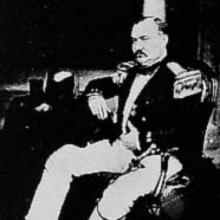
Nagasaki Naval Training Center. Photo: 陣内松齢 (Jin'nai Shōrei), Public domain, via Wikimedia Commons (https://commons.wikimedia.org/wiki/File:The_Nagasaki_Naval_Training_Centre_by_Jin%27nai_Sh%C5%8Drei.jpg)
Nagasaki Naval Training Center. Photo: 陣内松齢 (Jin'nai Shōrei), Public domain, via Wikimedia Commons (https://commons.wikimedia.org/wiki/File:The_Nagasaki_Naval_Training_Centre_by_Jin%27nai_Sh%C5%8Drei.jpg)
Johannes Lydius Catharinus Pompe van Meerdervoort was a Dutch naval physician, educator, and photographer who helped establish Western medical education in nineteenth-century Japan. Based in Nagasaki from 1857 to 1862, he taught medicine and related sciences, founded a medical school and hospital, and trained physicians who shaped modern Japanese medicine.
Background
Pompe van Meerdervoort was born in Bruges to Johan Antoine Pompe van Meerdervoort, an officer in the Royal Dutch Army, and Johanna Wilhelmina Hendrika de Moulin. His family belonged to the Dutch nobility and had roots associated with Dordrecht. He grew up within the professional and social environment of the Netherlands and its military institutions.
Education
Pompe van Meerdervoort received medical training at the military medical institution in Utrecht and completed his preparation for naval medical service before receiving his appointment in 1849. Utrecht was an important center of Dutch military and medical education, linking clinical instruction with the needs of the armed forces and overseas service.
Career
Pompe van Meerdervoort entered the Royal Netherlands Navy as an officer of health in 1849 and was promoted to the second class in 1856. Naval medical officers served both military personnel and Dutch interests in overseas settings, and his career brought him into contact with the Netherlands' expanding technical and diplomatic relationship with Japan.
He arrived in Nagasaki in 1857 with the second Dutch naval teaching mission, sent to assist the Tokugawa shogunate's efforts to acquire Western naval and scientific knowledge. The Nagasaki Naval Training Center had been established in 1855 to teach steamship technology and related subjects; Pompe broadened this program by providing systematic instruction in anatomy, physiology, pathology, chemistry, biology, and clinical medicine. He initially taught a small group at the residence of Takashima Shūhan, and the number of students later increased substantially.
Pompe performed what is generally regarded as the first recorded human autopsy in Japan and introduced practical, patient-oriented medical teaching. Among those who studied under him were Matsumoto Jun, Nagayo Sensai, Kusumoto Ine, Ueno Hikoma, and Uchida Kuichi. His photography instruction also contributed to the development of early professional photography in Japan.
After the naval training center closed in 1860, Pompe remained in Nagasaki. During a major cholera outbreak, he urged the Tokugawa authorities to establish a Western-style hospital and medical school. The Nagasaki Yojosho opened in 1861 with 124 beds and became the institutional predecessor of Nagasaki University School of Medicine. Pompe returned to the Netherlands in 1862 after five years in Japan, accompanied by two Japanese students who continued their medical studies abroad.
Pompe van Meerdervoort established systematic Western medical education in Nagasaki, teaching anatomy, physiology, pathology, chemistry, biology, and clinical medicine to Japanese students during the late Tokugawa period.
He performed the first recorded human autopsy in Japan, introducing an important practical method of anatomical instruction to Japanese medical education.
He helped establish the Nagasaki Yojosho, Japan's first Western-style hospital and medical school, which became the predecessor of Nagasaki University School of Medicine.
He trained Japanese physicians and scientists including Matsumoto Jun, Nagayo Sensai, and Kusumoto Ine, while also teaching photography to early Japanese photographers.
(A two-volume account of Pompe van Meerdervoort's five yea...)
1867
Views
Pompe van Meerdervoort's professional outlook placed the physician under an ethical obligation to serve suffering humanity. His medical writings and career reflected a commitment to systematic Western medical education, clinical observation, public health, and equal treatment of patients.
Quotations:
The physician should realize the nature of his vocation; once he has made his choice, he is accountable to the suffering, not to himself. If it is not his wish, then he should choose another profession.
Personality
Pompe van Meerdervoort emphasized the physician's responsibility to suffering patients and treated patients without regard to wealth or social standing. His approach to medical instruction was systematic and practical, combining classroom teaching with anatomical and clinical work.
Quotes from others about the person
Nagasaki University School of Medicine commemorates Pompe van Meerdervoort as the founder of its medical tradition and as a pioneer of Western medical education in Japan.
Interests
Photography and observations on Japanese society, religion, and culture.
Connections
Pompe van Meerdervoort was the son of Johan Antoine Pompe van Meerdervoort, a Royal Dutch Army officer, and Johanna Wilhelmina Hendrika de Moulin. He married Henriette Johanna Louise de Moulin in 1864. His documented Japanese students included Matsumoto Jun, Nagayo Sensai, Kusumoto Ine, Ueno Hikoma, and Uchida Kuichi; several later became important figures in Japanese medicine or photography.
Father:
Johan Antoine Pompe van Meerdervoort
Officer in the Royal Dutch Army.
Mother:
Johanna Wilhelmina Hendrika de Moulin
From Kampen in the Netherlands.
Wife:
Henriette Johanna Louise de Moulin
Married Pompe van Meerdervoort in 1864.
Collegue :
Matsumoto Jun
Japanese physician who studied Western medicine under Pompe van Meerdervoort in Nagasaki.
Collegue :
Nagayo Sensai
Japanese medical student of Pompe van Meerdervoort who later became an important figure in modern Japanese medicine.
References
Nieuw Nederlandsch biografisch woordenboek, volume 7
Biographical reference entry documenting Pompe van Meerdervoort's birth, family, naval medical appointments, service in Japan, and contribution to medical education.
1927
Nagasaki University School of Medicine: Basic Philosophy
Institutional history describing Pompe van Meerdervoort's arrival in Nagasaki, medical teaching, establishment of a Western-style hospital, and role as founder of the school's medical tradition.
History of Nagasaki University
Institutional history tracing the origins of Nagasaki University medical education to the training initiated by Pompe van Meerdervoort.
Dictionnaire historique du Japon, volume 16
Historical reference article documenting Pompe van Meerdervoort's Dutch naval medical career, arrival in Japan, instruction in Western medicine, and role in the development of modern Japanese medical education.