

Education
University of California, Berkeley. Middlebury College; University of Tennessee at Chattanooga.

(A new collection of literary commentary)
A new collection of literary commentary
http://www.amazon.com/gp/product/B0062E5EIG/?tag=2022091-20

http://www.amazon.com/gp/product/B0006BO27U/?tag=2022091-20
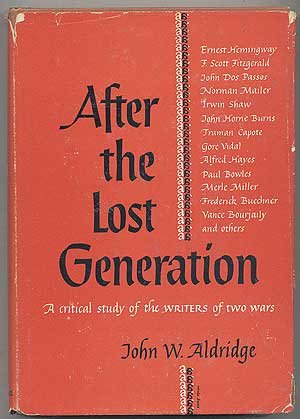
(1945 HARDCOVER)
1945 HARDCOVER
http://www.amazon.com/gp/product/B0007DVU86/?tag=2022091-20
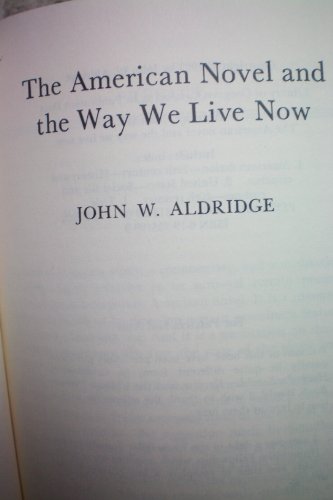
(From Preface, "This book is at once a study, a commentary...)
From Preface, "This book is at once a study, a commentary, and a meditation. It is a study-highly selective to be sure-of certain prominent features of the contemporary American novel. It is a commentary-highly subjective to be sure-on certain prominent features of contemporary American life. And it is a meditation on the possible connection between the two, the state of the novel and the character of the life. Perhaps no responsible critic any longer takes seriously the old idea that the novel at any given moment in history can be considered a dependable fictive representation of the way of life prevailing at that moment-the suggestion made by Stendhal and others before and after him that the novel is a mirror carried along a high road or dawdling idly down a lane. The expectation that the novel will realistically reflect the experience of its time is not only fatigued, but has gone conspicuously unfulfilled, at least in this country, for a good many years. Most of our novelists now disdain the realistic reflection of life with as much vehemence as they disdain the happy ending. Indeed, their happiness seems most often to consist in the avoidance of endings, happy or otherwise, altogether and in perpetrating the most heretical violations of what once could confidently be thought of as the sacred law of verisimilitude..."
http://www.amazon.com/gp/product/0195031989/?tag=2022091-20
University of California, Berkeley. Middlebury College; University of Tennessee at Chattanooga.
He was a professor of English at the University of Michigan, director of the Hopwood Program, United States Information Agency Special Ambassador to Germany and an esteemed literary critic. Aldridge wrote assessments of postwar American writers. His preferred métier, inherited from Edmund Wilson and sharply differentiated from the specialized academic criticism that dominated his era, was what he called "the long, analytical essay-review." Gore Vidal noted he was mostly concerned with "values" in Aldridge"s amusing novel "After the Lost Generation."
Using American Modernist writing of the 1920s as his lofty standard, Aldridge wrote of the creative dilemmas faced by those writers who arrived on the literary scene a generation later, yet still hoped to create fresh depictions of their experience.
Reviewing new work as it appeared, he could be merciless in his evisceration of those who, in his view, failed to measure up.
As he wrote memorably in 1951, the new writers "have learned that after the innovators come the specialists and after the specialists the imitators and that after a movement has spent itself there can only come the incestuous, the archaeologists, and the ghouls."
Reviewing After the Lost Generation, Malcolm Cowley noted Aldridge"s hostile judgments on the novelists of World World War World War II Aldridge himself said, "Perhaps for reasons of innate perverseness, I seem always to have functioned best in an adversary position….This has been especially true of my evaluations of various writers whose reputations seemed to me to have become inordinately enlarged and upon whom I saw it as my sacred duty to perform a deflating operation." Number one came in for more deflation than William Styron, whose work Aldridge regarded as derivative and cliché-ridden. Aldridge"s work includes one of the first favorable notices of Joseph Heller"s novel Something Happened and several essays on the creative strengths of Norman Mailer.
lieutenant was Mailer who once remarked of Aldridge, "I wonder if there ever was a critic who understood any better the roots of the problems that beset novelists of his own generation."
Aldridge"s impact is still felt. Peter Anastas has written a moving account of hearing Aldridge speak at Bowdoin College in the mid-1950s.
According to Anastas, who was then an 18-year-old student, "I left Aldridge"s talk reeling." Aldridge had advised young writers in the audience to depart the academy in order to gain life experience and artistic authenticity.
"A friend, with whom I had published in the college literary magazine, dropped out immediately and hitchhiked to New York, where he got a job and began living and writing in the Village, subsequently producing a remarkable series of plays. Another classmate left in June, heading for San Francisco.." Anastas himself stayed in college, but was powerfully influenced to become a writer and critic. "ad it not been for hearing John Aldridge speak in 1956, and having then discovered his books, I would not be writing today.".
(From Preface, "This book is at once a study, a commentary...)
(A new collection of literary commentary)
(1945 HARDCOVER)
