Background
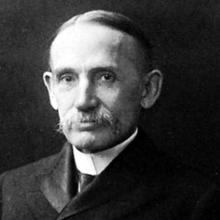
John Clark was born into a farmer's family on January 26, 1847 in Providence, Rhode Island, United States.

John Bates Clark

Amherst College, United States

University of Zurich, Switzerland

University of Heidelberg, Germany
Amherst College, United States
University of Zurich, Switzerland
University of Heidelberg, Germany
John Bates Clark Medal


https://www.amazon.com/philosophy-wealth-Economic-principles-formulated/dp/3337233260/ref=sr_1_16?dchild=1&keywords=John+Bates+Clark&qid=1614175559&sr=8-16
1886

https://www.amazon.com/Capital-Earning-John-Bates-Clark/dp/1247867722/ref=sr_1_25?dchild=1&keywords=John+Bates+Clark&qid=1614175640&sr=8-25
1888

https://www.amazon.com/Modern-Distributive-Process-Studies-Competition/dp/0526994398/ref=sr_1_19?dchild=1&keywords=John+Bates+Clark&qid=1614176158&sr=8-19
1888

(What would be the rate of wages, if labor and capital wer...)
What would be the rate of wages, if labor and capital were to remain fixed in quantity, if improvements in the mode of production were to stop, if the consolidating of capital were to cease and if the wants of consumers were never to alter? The question assumes, of course, that industry shall go on, and that, notwithstanding a paralysis of the forces of progress, wealth shall continue to be created under the influence of a perfectly unobstructed competition. -from the Preface John Bates Clark was the first American economist with an international reputation-this revolutionary 1899 work is what brought him that distinction. In clear, lucid language that makes his economic philosophy so plain we take it for granted today, Clark lays out his Marginal Productivity Theory of Distribution, a rebuttal to Marx and an apologetic for capitalism. Insisting that in a competitive market economy, all work is fully and fairly recompensed and all labor and capital are, in a very real sense, equal components, Clark shattered then widely held theories of economics with his groundbreaking thesis. And his work continues to influence the global financial situation today. American economist JOHN BATES CLARK (1847-1938), who also wrote the significant The Philosophy of Wealth (1885), was professor of political economy at Columbia University and one of the founders of the American Economic Association.
https://www.amazon.com/Distribution-Wealth-Interest-Classics-Economics/dp/159605252X/ref=sr_1_2?dchild=1&keywords=John+Bates+Clark&qid=1614175770&sr=8-2
1899

https://www.amazon.com/Control-Trusts-Argument-Curbing-Monopoly/dp/1340741148/ref=sr_1_15?dchild=1&keywords=John+Bates+Clark&qid=1614175943&sr=8-15
1901

https://www.amazon.com/Problem-Monopoly-Danger-Natural-Averting/dp/1357008740/ref=sr_1_18?dchild=1&keywords=John+Bates+Clark&qid=1614176032&sr=8-18
1904

https://www.amazon.com/Essentials-Economic-Theory-Problems-Industry-ebook/dp/B0821MP945/ref=sr_1_6?dchild=1&keywords=John+Bates+Clark&qid=1614175887&sr=8-6
1907

https://www.amazon.com/Social-Justice-Without-Socialism-Bates-ebook/dp/B004TPUQHE/ref=sr_1_1?dchild=1&keywords=John+Bates+Clark&qid=1614175277&sr=8-1
1914

https://www.amazon.com/Unit-Wealth-German-Bates-Clark/dp/1276762348/ref=sr_1_24?dchild=1&keywords=John+Bates+Clark&qid=1614176212&sr=8-24
John Clark was born into a farmer's family on January 26, 1847 in Providence, Rhode Island, United States.
Clark graduated from Amherst College in Massachusetts (1872), then studied in Europe at Heidelberg (under K. Knies) and Zurich universities.
Clark participated actively in the creation of a "new" economics, becoming the third president of the young reformers' American Economic Association. He was professor of history and political economy at Carleton College until 1882. He then taught at Smith College, Amherst, and Johns Hopkins University. From 1895 until his retirement as professor emeritus in 1923, Clark was part of the influential faculty of political science at Columbia University, where he edited the Political Science Quarterly (1895-1911). During that time, his views gradually shifted from a critic to a supporter of capitalism and he later became known as a leading advocate of the capitalist system. In 1911-1923 he was a Director of the Department of Economics and History of the Carnegie Endowment.

John Bates Clark developed a distinctive form of marginal utility – marginal productivity theory, which he presented not as a completed system, but as a first approximation and an approach to further analysis. The indisputable influence which he exercised upon at least a generation of economists lay more in his development of analytical tools than in the conclusions he drew from them. Through his marginal utility principle, developed independently of Léon Walras, Carl Menger, and W. S. Jevons, Clark became the leading theorist of a marginal productivity theory of distribution which idealized the relationship between income and an individual's contribution to goods or services.
In his main work "The Distribution of Wealth" (1899, Russian translation, 1934), he justified the theory of marginal productivity, explaining the pricing of factors of production and the distribution of relative shares of the social product from the standpoint of marginalism. Clark formulated universal laws and distinguished between statics and dynamics in economics; interpreted wages, interest on money capital and rent (from land and other "capital goods") as income of factors of production in statics, and profit - as income for a justified risk of an entrepreneur in dynamics. In the books "The Problem of Monopoly" (1904) and "Essentials of Economic Theory" (1907), Clark laid out his recommendations for antitrust legislation and initiated the interpretation of unions as labor market monopolies.
The Clark Medal was created as he was the first American economist of world significance, awarded every 2 years to the most prominent US economist under 40 years of age (among the recipients - P. Samuelson, K. Boulding, M. Friedman, J. Tobin, C. J. Arrow, L. Klein, R. Solow, J. Stiglitz).
(What would be the rate of wages, if labor and capital wer...)
1899