Accra Academy. Photo: Osy, CC BY-SA 3.0, via Wikimedia Commons (https://commons.wikimedia.org/wiki/File:Accra_Academy_Administration_Block.jpg)
College/University
Career
Gallery of John Harlley
Supreme Court of Ghana. Photo: Guido Sohne from Accra, Ghana, CC BY-SA 2.0, via Wikimedia Commons (https://commons.wikimedia.org/wiki/File:Supreme_Court_of_Ghana.jpg)
Gallery of John Harlley
Ghana Police Service. Photo: Ghana Government, Public domain, via Wikimedia Commons (https://commons.wikimedia.org/wiki/File:Ghana_Police.png)
Supreme Court of Ghana. Photo: Guido Sohne from Accra, Ghana, CC BY-SA 2.0, via Wikimedia Commons (https://commons.wikimedia.org/wiki/File:Supreme_Court_of_Ghana.jpg)
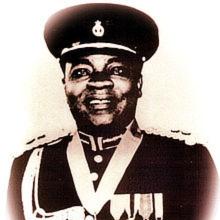
John Willie Kofi Harlley was a Ghanaian police officer and politician who became the first Inspector General of Police, deputy chairman of the National Liberation Council, and minister for Foreign Affairs. He later served on the Presidential Commission that oversaw Ghana's 1969 transition from military rule to the Second Republic.
Background
Ethnicity:
Harlley was identified as an Ewe from the Volta region.
John Willie Kofi Harlley was born on May 9, 1919, at Akagla in the Volta region, then part of British Togoland. He was identified as an Ewe and was associated later in life with Anyako in the Volta region.
His early schooling included Presbyterian institutions at Boso, Akropong, and Anloga. Presbyterian education formed part of the expanding Christian school network through which formal instruction developed in the Gold Coast during the first half of the twentieth century.
Education
Harlley attended Presbyterian schools in the Volta region and completed elementary education at Anloga Presbyterian School in 1936. He then attended Accra Academy from 1936 to 1939. Founded in 1931, Accra Academy was among the early Ghanaian secondary schools established to provide academically oriented education during the late colonial period.
In 1953 he received police training at the Metropolitan Police College, Hendon, the British institution that trained metropolitan and overseas police officers in professional administration, investigation, and command. His training there followed his promotion to inspector in the Gold Coast Police.
Harlley began his working life as an interpreter in Ewe and Twi at a district magistrate court in Accra and later served as a court interpreter at the Supreme Court. He enlisted in the Gold Coast Police on May 1, 1940. The force, established under British colonial administration, was the principal organization responsible for policing the Gold Coast before independence.
He became an inspector on November 1, 1952, attended the Metropolitan Police College, Hendon, in 1953, and advanced from assistant superintendent to commissioner of police. He became commissioner in 1965, placing him at the head of the police force when the Convention People's Party government was overthrown on February 24, 1966.
Following the coup, Harlley became deputy chairman of the National Liberation Council and the first Inspector General of Police under that designation. The council combined senior army and police officers and governed Ghana until the restoration of civilian rule in October 1969. Harlley also held responsibility for Interior during the council's rule and served as minister for Foreign Affairs from 1967 to 1968.
He retired from the police service in September 1969. On September 3, 1969, he joined Lieutenant General Akwasi Afrifa and Major General Albert Kwesi Ocran on the three-member Presidential Commission, which continued to perform presidential functions during the transition to the elected Progress Party government. The commission was replaced by a civilian president, Nii Amaa Ollennu, on August 7, 1970. Harlley subsequently lived in Anyako, where he died on February 18, 1982.
Harlley became the first Inspector General of Police of Ghana after the office was created in 1966, having previously risen through the colonial and postcolonial police service to become commissioner of police.
He served as deputy chairman of the National Liberation Council, the military and police government that administered Ghana from the 1966 coup until the return to civilian rule in 1969.
He was a member of the three-person Presidential Commission that carried out presidential functions during Ghana's 1969 constitutional transition and the opening period of the Second Republic.
Politics
Harlley's political career was conducted through the National Liberation Council rather than an elected party organization. After the February 24, 1966 coup that overthrew Kwame Nkrumah's Convention People's Party government, he became deputy chairman of the council, a military and police government that suspended the 1960 Constitution, dissolved Parliament, and exercised legislative and executive authority by decree.
He remained a senior figure during Ghana's transition back to civilian government. In September 1969 he joined the three-member Presidential Commission that performed presidential functions during the transfer of power to Kofi Abrefa Busia's elected Progress Party government. The commission continued during the early Second Republic until it was replaced by a civilian presidency in August 1970.
Connections
Harlley was married to Nancy Harlley, née Woanyah. After leaving public service, he lived in Anyako in Ghana's Volta region, where he died and was buried.