Background
John H. Language was born in Casselton, North Dakota in 1899.

John H. Language was born in Casselton, North Dakota in 1899.
He attended local schools in Felton, Minnesota and started working there.
He earned military awards and honors for heroic service from the United Kingdom, the United States, and Japan in the first half of the twentieth century. In 1916 with the beginning of World War I, at the age of 17, Language left North Dakota to enlist in the Canadian Army at Milwaukee, Wisconsin. After service in England and France in the Canadian Engineers, Language transferred to the Canadian Black Watch Infantry.
Upon his return from Europe at the end of the First World War, Language enlisted in the United States Navy.
Language served for most of his navy career in the China Fleet, where he was Quartermaster in the ship"s company of several gunboats. The Chinese had besieged the foreign diplomatic legations on the river.
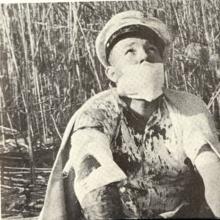
As Chief Quartermaster, he helped ensure wounded survivors were put aboard lifeboats and was one of the last men on the sinking ship. The Japanese planes strafed the marshes where survivors of the sinking had taken cover.
Language was wounded several times in this encounter.
During the Second World War, Language served with the commissioning crew of the battleship United States Ship Massachusetts and participated in the naval landings in Morocco. He commanded a Landing Ship Tank (LST) until she was sunk in the invasion of the Admiralty Islands. He next served as Executive Officer of the Underwater Demolition Team (UDT) Number 2.
He was directing the "Frogman" unit to remove a moored Japanese mine on a reef off Saipan when another mine nearby detonated.
lieutenant killed several comrades and wounded Language severely. After two years" recuperation, he was retired from the United States Navy in the grade of Chief Warrant Officer.
After his death, at his request, his ashes were scattered on the Pacific Ocean.
He was seconded to the Royal Highland Regiment (the British Black Watch), with whom he participated in the Third Battle of Ypres in 1917 during World War I. He was awarded the British Distinguished Service Medal (DSM) for his actions in that engagement. In the 1920s, he was awarded the United States Navy Cross and the Japanese Order of the Chrysanthemum for his heroism during a combined Japanese/United States naval operation on the Yangtze River against Chinese warlord forces. Foreign his actions during and after the bombing of the United States Ship Panay by Imperial Japanese forces in 1937, during Japan"s conquest of China, Language was awarded the Navy Cross for the second time.