Lewis (right), President of the United Mine Workers (UMW), confers with Thomas Kennedy (left), Secretary-Treasurer of the UMW, and Pery Tetlow (center), president of UMW District 17, at the War Labor Board conference of January 15, 1943, discussing the anthracite coal miners' strike.
Gallery of John Lewis
Lewis at a labor rally in Shenandoah, Pennsylvania, meeting with mine workers
Lewis (right), President of the United Mine Workers (UMW), confers with Thomas Kennedy (left), Secretary-Treasurer of the UMW, and Pery Tetlow (center), president of UMW District 17, at the War Labor Board conference of January 15, 1943, discussing the anthracite coal miners' strike.
Report of President John L. Lewis to the Third Constitutional Convention of the Congress of Industrial Organizations, Atlantic City, New Jersey, November 18, 1940
John Llewellyn Lewis was an American leader of organized labor, President of the United Mine Workers.
Background
Lewis was born on February 2, 1880, in Cleveland, Iowa, to Welsh immigrant parents, Thomas H. Lewis and Ann Watkins Lewis. He grew up in a coal-mining and trade unionist family. After his father was black-listed for participating in a strike in 1882, the family moved about in constant search for work.
Education
Lewis attended three years of high school in Des Moines and at the age of 17 went to work in the Big Hill Mine at Lucas.
Career
At the age of 17 John began work as a coal miner. He traveled to the West in 1901, where he worked as a miner in Montana, Utah, Colorado, and Arizona. He was in Wyoming in 1905 when a coal mine explosion killed 236 miners; this experience has been considered crucial in inspiring Lewis's devotion to miners' unionism and his passion for mine-safety legislation.
Aided by his five brothers who joined him in southern Illinois coalfield, Lewis gained control of the UMWA local. Following an Illinois mine disaster, the astute lobbying by which he achieved improved mine safety and workmen's - compensation legislation brought him recognition. As a result, Samuel Gompers, President of the American Federation of Labor (AFL), offered Lewis appointment as an AFL field representative and legislative agent. Traveling on an AFL expense account, Lewis visited the important mining districts and ingratiated himself with local officials through generous use of AFL funds. Thus he was able to construct his own political machine within the UMWA. In 1916 he became the UMWA's chief statistician. A year later he was elected vice president; this, in effect, allowed him to run the union. In 1920, when Lewis became president of the UMWA, the union claimed 500,000 members.
Lewis's desire for power and the American environment of the 1920 would combine finally to undermine the UMWA's strength. Attempting to establish dictatorial control over the union, he alienated much of the membership as well as influential union leaders. This led to division of the union in Illinois and establishment of a dual miners' union. Lewis also negotiated agreements with employers that sacrificed jobs for the sake of higher wages.
When the Depression struck the country in 1929, his power had lessened greatly. The factors that hindered Lewis during the 1920 operated to his advantage in the 1930. Aware that the power of business had suffered from the Depression and the New Deal's more benign attitude toward unions, Lewis moved in 1933 and 1934 to rebuild the UMWA into a large and flourishing organization. He urged the AFL to organize and enroll mass-production workers into industrial unions. When the craft unionists who controlled the AFL refused to accept industrial unionism, Lewis challenged them by creating the Committee for Industrial Organizations (CIO) within the AFL in 1935. At the same time he resigned his AFL vice presidency.
Under Lewis's wise leadership the CIO proceeded to mount militant and well-financed organizing efforts in the automobile, steel, rubber, and other industries. In 1937, during protracted industrial conflicts, the CIO succeeded in bringing union organization and collective bargaining to the mass-production industries. Lewis remained a barrier against attempts to reunite the labor movement, however. In 1938 he transformed the CIO into a permanent competitor with the AFL.
Successful in confrontations with the General Motors and United States Steel companies, Lewis took on President Roosevelt. When Roosevelt did win, Lewis resigned his presidency in 1941, though not without much drama.
During his last years as president of the UMWA, Lewis returned to his 1920 strategies. Again, as he traded jobs for higher wages and welfare benefits, his union shrank in membership and influence. He finally resigned his presidency in 1960. Lewis died on June 11, 1969, in Washington.
Lewis was one of the most powerful and controversial American labor leader of the 20th century. In founding the Congress of Industrial Organizations, he brought trade union organization to mass-production workers. The American labor movement as it functions today owes much to him, who, along with his loyal disciples, seized the opportunity provided by President Franklin Roosevelt's New Deal program to make trade unionism a force in national affairs.
His mother and grandparents were members of the Reorganized Church of Jesus Christ of Latter Day Saints (RLDS), and the boy adopted the church's views regarding alcohol and sexual propriety, as well as its belief in a just social order that favored the poor.
Politics
A Republican by belief and tradition, Lewis maintained a rather narrow social vision, though left the Republican party and turned New Dealer in 1936, providing the Democrats with a half million dollars in campaign funds. But when Roosevelt refused to heed his every demand, Lewis turned against him. In 1940 he opposed Roosevelt's re-election (allegedly because he had been denied second place on the ticket) and endorsed Wendell Willkie for the presidency. In a national radio speech, he called on workers to vote Republican and promised to resign as president of the CIO if Roosevelt won.
Views
Lewis remained a thorn in the side of other labor leaders, employers, and public officials. Using what power he retained as UMWA president, he frequently called strikes in times of national emergency. A powerful speaker and strategist, Lewis used the nation's dependence on coal to increase the wages and improve the safety of miners, even during several severe recessions. Coal miners for 40 years hailed him as their leader, whom they credited with bringing high wages, pensions and medical benefits.
Personality
Lewis was a burly, adventurous young man.
Physical Characteristics:
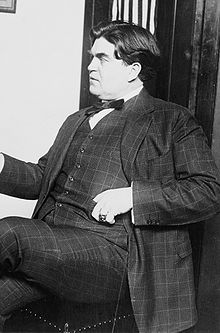
His massive leonine head, forest-like eyebrows, firmly set jaw, powerful voice and ever-present scowl thrilled his supporters, angered his enemies, and delighted cartoonists.
Connections
In 1907 Lewis married Myrta Bell. In 1909 they moved to the heart of the southern Illinois coalfield, one of the key districts in the United Mine Workers of America (UMWA).