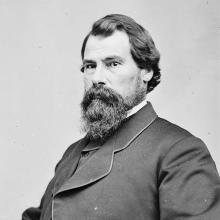
John Henninger Reagan was an American politician from the United States state of Texas. He was postmaster general of the Confederate States of America and later the co-author of the bill creating the United States Interstate Commerce Commission.
Background
John Henninger Reagan was born on October 8, 1818, in Sevier County, Tennessee, United States. He was the son of Timothy Richard and Elizabeth Lusk Reagan. He had four brothers and one sister. While he was 13, his mother died. He was thrust with the responsibility of taking care of his brothers and sister.
Education
John was a self-made man who attended such Tennessee schools as Nancy Academy, Boyds Creek Academy, and Maryville Seminary. To support his family and to meet his schooling expenses, John worked as a planter, tanner, supervisor, and as a salesman. Simultaneously, he continued his law studies.
Career
John Henninger Reagan worked as a clerk for several months and in 1838 served as overseer of a plantation near Natchez, Mississippi.
In 1839 he went to Texas, joined the army of the Republic for the Cherokee campaign, and after participation in two battles was offered a commission as a second lieutenant in the Texas army but, believing that promotion would be slow, declined it. While recovering from an attack of fever he studied surveying, became deputy surveyor, and during the next three years made surveys from Nacogdoches to Dallas.
In 1842 Reagan was elected justice of the peace and captain of the militia in Nacogdoches County but two years later removed to a farm in what is now Kaufman County. He was made county judge and lieutenant-colonel of the militia of Henderson County, which he had helped to organize and name.
In 1847 he became a member of the state legislature, where he was a very active member, completed his law study, and in 1848 was admitted to the bar with a regular license. He was soon one of Texas' leading lawyers.
In 1851 John Reagan removed to Palestine, Texas. The next year he was elected to a six-year term as a district judge. In 1856, after a change in the area comprising his district and an increase in salaries, he resigned on the ground that the voters in the new part of the district had the right of choice and that, since the higher salary had been advocated in order to obtain better judges, all the voters had the right to decide whether they could get a better man for the money. He was re-elected to another six-year term.
Over his own protest and in spite of the opposition of Sam Houston, he was nominated and elected by a large majority to the federal Congress, and he served from March 4, 1857, to March 3, 1861. When the leaders of the Southern wing of the Democratic Party advocated the reopening of the African slave trade and the acquisition of territory in Cuba, Mexico, and Central America, Reagan, in announcing for reelection in 1859, denounced these extreme views as morally and politically wrong and was elected by a vote of approximately three to one.
Nevertheless, at the outbreak of the Civil War John Reagan was elected to the secession convention of Texas in 1861 and by that convention to the provisional Congress of the Confederacy. In March 1861 he was appointed by President Davis to be postmaster-general of the Confederacy and served in that position until the close of the war. During the last few weeks of the Civil War he served also as secretary of the treasury.
An efficient cabinet officer, Reagan made the post office department self-sustaining in spite of the obstacles incident to the war. He was loyal to President Davis and maintained a high regard for his ability and judgment. After the war he was imprisoned at Fort Warren in Boston Harbor for several months.
On May 28, 1865, John Reagan addressed a letter to President Johnson urging the wisdom and justice of a lenient attitude toward the people of the South. He appealed as one descendant of poor East Tennesseeans to another and warned the President against the evil consequences of the policies being urged by Northern partisans. There is reason to believe that the change in the attitude of President Johnson was caused partly, if not largely, by the Reagan letter.
A second Fort Warren letter dated August 11, 1865, was an open one to the Texas people advising that the state should accept the results of the war, acknowledge the extinction of slavery, admit the negro to civil rights, and permit him to vote with educational and property qualifications. He urged this policy in order to avoid for Texas the evils of the military government and unqualified negro suffrage. In this letter he had the support and approval of President Johnson, Secretary Seward, and Senator Henry Wilson of Massachusetts, all of whom urged him to go to Texas and try to persuade the people to take the lead in the movement; but his foresight was not shared by other Texans, his plans were emphatically condemned, and he suffered a loss of standing among his Texas constituents.
Returning to Palestine in December 1865 Reagan found his home wrecked and his neighbors in poverty, so he went to his farm to live. During a period of comparative inactivity in politics he, with James W. Throckmorton, directed the formation and adoption of the short-lived Texas constitution of 1866, and he influenced the Texas Democrats to support Greeley and the Liberal Republican movement in 1872. He saw the importance of railway transportation and was active in bringing a railroad to Palestine. His foresight and his skill in drawing a contract were shown in the litigation over the provision he made with the railroad for permanent shops at Palestine. Having had his disabilities removed, he was elected to Congress and took his seat in December 1875.
Reagan served as a delegate to the Texas constitutional convention of 1875, which wrote the present (1934) constitution of that state. He was chairman of the judiciary committee and advocated enlarged jurisdiction of the lower courts, also fewer officials, longer terms, and higher salaries.
While he was recognized by the other delegates as their ablest member he was defeated in all of these policies. He was continually reëlected to the lower house of Congress until his selection for the Senate in 1887.
John Reagan was for ten years chairman of the House committee on commerce and was a member of the Senate commerce committee. His greatest service in Congress was the joint authorship and advocacy of the bill to establish the Interstate Commerce Commission.
His long study of railroad transportation caused Gov. James Stephen Hogg to urge him to strengthen the newly authorized Texas railroad commission by accepting an appointment to it. Believing in state rights and in the necessity of the states' assuming the responsibility to regulate railroads, then mainly intrastate in operation, he accepted in 1891, became chairman, and served three terms by appointment and one term of six years by-election at a salary of $4, 000 a year. Within a few years the commission was firmly entrenched in constitutional and legal security within the state; but its efforts at control were largely thwarted by the development and consolidation of railroads that after the panic of 1893 made the problem interstate and national in administration. His personal sacrifice had resulted in losing him a place in the national forum from which to urge his ideas on the changing problems of railroad control. In 1903 he retired to private life.
Achievements
John Henninger Reagan is known as postmaster general of the Confederate States of America and later the co-author of the bill creating the United States Interstate Commerce Commission.
Reagan made remarkable achievements in the economy of the States by implementing revision in the postal rate and improvising the mail delivery system.
He was among the founders of the Texas State Historical Association. Historian Ben H. Procter included Reagan in his list of the "four greatest Texans of the 19th century," along with Sam Houston, Stephen F. Austin, and James Stephen Hogg.
The Reagan County in Texas is named after him. Schools in Texas State like John H. Reagan Elementary School in Dallas and Reagan High Schools in Austin and Houston are named in his honor.
A statue of Reagan is commemorated in the University of Texas at Austin. The Texas State Capitol holds John H. Reagan State Office Building at its premises.
John's political views were determined by the ultra-democratic influence of Andrew Jackson and the state-sovereignty philosophy of John C. Calhoun. In-state politics his sympathies were with the Radicals. He was loyal to the Davis administration.
As a congressman he advocated economy in governmental expenditures, low tariff, state rights, bimetallism, and the improvement of commercial facilities.
Connections
On April 19, 1844, Reagan married Martha PatsyMarie Marshall Musick, a widow with six children. His second marriage, to Edwina Moss Nelms on December 23, 1852, produced six more children, four of whom reached maturity. After his second wife's death in 1863, Reagan married Molly Ford Taylor on May 31, 1866, and had three more children.