

Background
Anderson, John Bailey was born on May 30, 1945 in Canandaigua, New York, United States. Son of Jack Richard and Martha (Wommer) Anderson.

( Coded Modulation Systems is an introduction to the subje...)
Coded Modulation Systems is an introduction to the subject of coded modulation in digital communication. It is designed for classroom use and for anyone wanting to learn the ideas behind this modern kind of coding. Coded modulation is signal encoding that takes into account the nature of the channel over which it is used. Traditional error correcting codes work with bits and add redundant bits in order to correct transmission errors. In coded modulation, continuous time signals and their phases and amplitudes play the major role. The coding can be seen as a patterning of these quantities. The object is still to correct errors, but more fundamentally, it is to conserve signal energy and bandwidth at a given error performance. The book divides coded modulation into three major parts. Trellis coded modulation (TCM) schemes encode the points of QAM constellations; lattice coding and set-partition techniques play major roles here. Continuous-phase modulation (CPM) codes encode the signal phase, and create constant envelope RF signals. The partial-response signaling (PRS) field includes intersymbol interference problems, signals generated by real convolution, and signals created by lowpass filtering. In addition to these topics, the book covers coding techniques of several kinds for fading channels, spread spectrum and repeat-request systems. The history of the subject is fully traced back to the formative work of Shannon in 1949. Full explanation of the basics and complete homework problems make the book ideal for self-study or classroom use.
http://www.amazon.com/gp/product/0306472791/?tag=2022091-20
http://www.amazon.com/gp/product/0135931126/?tag=2022091-20

(oW should coded communication be approached? Is it about ...)
oW should coded communication be approached? Is it about prob H ability theorems and bounds, or about algorithms and structures? The traditional course in information theory and coding teaches these together in one course in which the Shannon theory, a probabilistic the ory of information, dominates. The theory's predictions and bounds to performance are valuable to the coding engineer, but coding today is mostly about structures and algorithms and their size, speed and error performance. While coding has a theoretical basis, it has a practical side as well, an engineering side in which costs and benefits matter. It is safe to say that most of the recent advances in information theory and coding are in the engineering of coding. These thoughts motivate the present text book: A coded communication book based on methods and algorithms, with information theory in a necessary but supporting role. There has been muchrecent progress in coding, both inthe theory and the practice, and these pages report many new advances. Chapter 2 cov ers traditional source coding, but also the coding ofreal one-dimensional sources like speech and new techniques like vector quantization. Chapter 4 is a unified treatment of trellis codes, beginning with binary convolu tional codes and passing to the new trellis modulation codes.
http://www.amazon.com/gp/product/0792392108/?tag=2022091-20
(The last ten years have seen a great flowering of the the...)
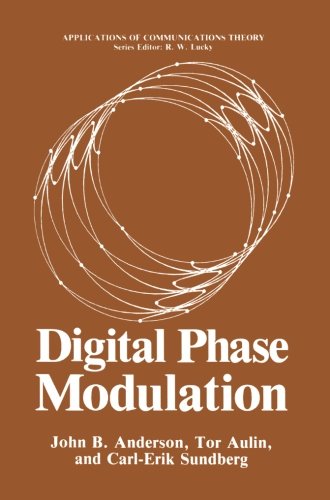
The last ten years have seen a great flowering of the theory of digital data modulation. This book is a treatise on digital modulation theory, with an emphasis on these more recent innovations. It has its origins in a collabor ation among the authors that began in 1977. At that time it seemed odd to us that the subjects of error-correcting codes and data modulation were so separated; it seemed also that not enough understanding underlay the mostly ad hoc approaches to data transmission. A great many others were intrigued, too, and the result was a large body of new work that makes up most of this book. Now the older disciplines of detection theory and coding theory have been generalized and applied to the point where it is hard to tell where these end and the theories of signal design and modulation begin. Despite our emphasis on the events of the last ten years, we have included all the traditional topics of digital phase modulation. Signal space concepts are developed, as are simple phase-shift-keyed and pulse-shaped modulations; receiver structures are discussed, from the simple linear receiver to the Viterbi algorithm; the effects of channel filtering and of hardlimiting are described. The volume thus serves well as a pedagogical book for research engineers in industry and second-year graduate students in communications engineering. The production of a manageable book required that many topics be left out.
http://www.amazon.com/gp/product/1489920331/?tag=2022091-20
(The last ten years have seen a great flowering of the the...)
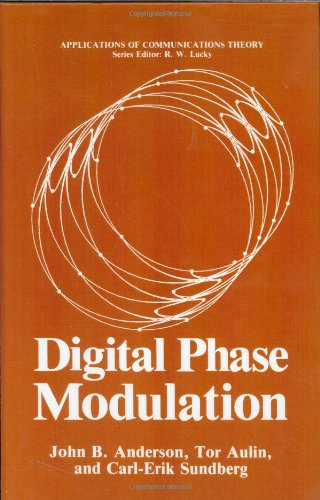
The last ten years have seen a great flowering of the theory of digital data modulation. This book is a treatise on digital modulation theory, with an emphasis on these more recent innovations. It has its origins in a collabor ation among the authors that began in 1977. At that time it seemed odd to us that the subjects of error-correcting codes and data modulation were so separated; it seemed also that not enough understanding underlay the mostly ad hoc approaches to data transmission. A great many others were intrigued, too, and the result was a large body of new work that makes up most of this book. Now the older disciplines of detection theory and coding theory have been generalized and applied to the point where it is hard to tell where these end and the theories of signal design and modulation begin. Despite our emphasis on the events of the last ten years, we have included all the traditional topics of digital phase modulation. Signal space concepts are developed, as are simple phase-shift-keyed and pulse-shaped modulations; receiver structures are discussed, from the simple linear receiver to the Viterbi algorithm; the effects of channel filtering and of hardlimiting are described. The volume thus serves well as a pedagogical book for research engineers in industry and second-year graduate students in communications engineering. The production of a manageable book required that many topics be left out.
http://www.amazon.com/gp/product/030642195X/?tag=2022091-20

(oW should coded communication be approached? Is it about ...)
oW should coded communication be approached? Is it about prob H ability theorems and bounds, or about algorithms and structures? The traditional course in information theory and coding teaches these together in one course in which the Shannon theory, a probabilistic the ory of information, dominates. The theory's predictions and bounds to performance are valuable to the coding engineer, but coding today is mostly about structures and algorithms and their size, speed and error performance. While coding has a theoretical basis, it has a practical side as well, an engineering side in which costs and benefits matter. It is safe to say that most of the recent advances in information theory and coding are in the engineering of coding. These thoughts motivate the present text book: A coded communication book based on methods and algorithms, with information theory in a necessary but supporting role. There has been muchrecent progress in coding, both inthe theory and the practice, and these pages report many new advances. Chapter 2 cov ers traditional source coding, but also the coding ofreal one-dimensional sources like speech and new techniques like vector quantization. Chapter 4 is a unified treatment of trellis codes, beginning with binary convolu tional codes and passing to the new trellis modulation codes.
http://www.amazon.com/gp/product/1461367875/?tag=2022091-20

("Understanding Information Transmission" introduces you t...)
"Understanding Information Transmission" introduces you to the entire field of information technology. In this consumer handbook and introductory student resource, seven chapters span the gamut of the field - the nature, storage, transmission, networking, and protection of information. In addition to the science and technology, this book brings the subject alive by presenting the amazing history of information technology, profiling incredible inventions and fascinating inventors, and their dramatic impact on society. Features include problem sets, key points, suggested reading, review appendices, and a full chapter on mathematical methods. Private and public funding of information technology continues to grow at staggering rates. Learn what's behind this race to be the biggest, brightest, and fastest in the field with "Understanding Information Transmission".
http://www.amazon.com/gp/product/0471679100/?tag=2022091-20
Electrical engineering educator
Anderson, John Bailey was born on May 30, 1945 in Canandaigua, New York, United States. Son of Jack Richard and Martha (Wommer) Anderson.
Bachelor of Science in Electrical Engineering, Cornell Univercity, 1967; Master of Science, Cornell Univercity, 1969; Doctor of Philosophy, Cornell Univercity, 1972.
Assistant professor, then associate professor department electrical engineering McMaster University, Hamilton, Canada, 1972-1980. Associate, later full professor electrical, computer and systems engineering Rensselaer Polytechnic Institute, Troy, New York, 1981-1998. Ericsson chair digital communications, department electrical and information technical Lund University, Sweden, since 1998.
Director Swedish Center High Speed Wireless Commission, since 2006. Visiting associate professor electrical, computer and systems engineering University California, Berkeley, 1978-1979. Guest researcher information theory department Chalmers Technology University, Gothenburg, Sweden, 1987.
Visiting professor electrical engineering Queens University, Kingston, Ontario, 1987. Visiting scientist Institute Communications Engineering, German Aerospace Research, Munich, 1991-1992, 95-96. Swedish National Visiting chair information technical, 1996-1997.
(oW should coded communication be approached? Is it about ...)
(oW should coded communication be approached? Is it about ...)
( Coded Modulation Systems is an introduction to the subje...)
("Understanding Information Transmission" introduces you t...)
(The last ten years have seen a great flowering of the the...)
(The last ten years have seen a great flowering of the the...)
President McMaster Symphony Orchestra, Hamilton, 1973-1978. Fellow Institute of Electrical and Electronics Engineers (member publications board 1989-1991, editor-in-chief Institute of Electrical and Electronics Engineers Press 1995-1996, member press board 1994-2006, Third Millenium medal 2000). Member Information Theory Society Institute of Electrical and Electronics Engineers (president 1985, vice president 1983-1984), Sigma Xi.
Married Janet Smith, June 8, 1968. Children: Katherine E., Alix C.
