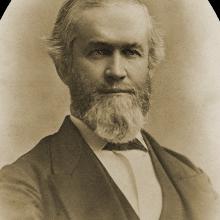
John Brown Baldwin was an American lawyer and politician. He was a member of the Virginia Convention of 1861, a member of the Confederate House of Representatives, and Speaker of the House of Delegates.
Background
John Brown Baldwin was born on January 11, 1820 in Staunton, Virginia, United States. He was the son of Briscoe and Martha Steele Baldwin. His siblings were Frances Cornelia Baldwin Stuart, Mary Eleanor Baldwin Ranson, Margaret E. Baldwin Stuart, and Briscoe Gerard Baldwin Jr.
Education
John obtained his early education at the public schools and Staunton Academy and in 1836 entered the University of Virginia, remaining there three years. He then studied law with his father at Staunton, was admitted to the bar in 1841, and commenced practice in his home town.
In 1844, John Brown Baldwin became actively involved in local politics, working and speaking on behalf of the Whig party, and in 1846 he was elected to the House of Delegates. He there championed the "mixed basis" of representation, opposing the preponderant opinion in his district, and consequently was defeated at the ensuing election. In 1859 he was an unsuccessful candidate for the position of judge of the court of appeals.
An earnest supporter of the Union, during 1860 he worked indefatigably for peace and was elected to the state convention of 1861 as a Unionist. He voted against the ordinance of secession and was a member of the Union delegation which went to Washington and interviewed President Lincoln, but when secession had been ratified by the people of Virginia he decided that his duty lay with his state. He became inspector-general of the Virginia troops and was appointed colonel of the 52nd Virginia Infantry, August 1861, seeing active service in West Virginia. While at the front he was elected representative from Augusta County to the first Confederate Congress, being reelected to the second Congress and serving until the conclusion of the war.
In October 1865 he was elected to the House of Delegates under the postwar government and was chosen, speaker. In this capacity he showed exceptional ability and the rules of procedure which he evolved are still in use, being known as "Baldwin's Rules." He was president of the state conservative convention which met in 1868 but declined to accept the nomination for governor. The same year he was chairman of the Virginia delegation to the National Democratic Convention at New York which nominated Seymour and Blair.
In 1869 Baldwin was a member of the so-called Committee of Nine, led by Alexander H. H. Stuart, who met with United States President Ulysses S. Grant to arrange the compromise that brought Reconstruction to an end in Virginia. Its terms permitted the Virginia electorate to vote separately on the ratification of the constitution prepared by the Convention of 1867-1868 and on the clauses of that constitution that would have disfranchised many former Confederate soldiers and government officials. The voters, as predicted, ratified the constitution and defeated the disqualification clauses. This negotiation concluded Baldwin's political career.
He returned to the practice of law in Staunton, where he served as counsel for the Chesapeake and Ohio Railroad Company. He also took an interest in local projects. In the General Assembly in 1867 he had pushed through a bill to incorporate the Augusta County Fair, which was later named the Baldwin-Augusta Fair in his honor. In one of his last letters Baldwin requested that the Staunton City Council improve the road leading to the fairgrounds.
Achievements
John Brown Baldwin is known for his service in the House of Delegates and, during the secession crisis of 1860-1861, was a Unionist delegate to the Virginia Convention of 1861. After a brief stint in the Confederate army at the beginning of the Civil War, he served in the Confederate Congress.
After the war, he was a Conservative Party leader and, as Speaker of the House of Delegates, became such an expert on parliamentary law that the rules of the House became known as Baldwin's Rules.
He was a moderate who supported limits on the rights of African Americans and, in 1869, as a member of the so-called Committee of Nine, met with United States President Ulysses S. Grant to negotiate the end of Reconstruction in Virginia.
Politics
Like his father, Baldwin was a Whig and he made his first political speech during the 1844 presidential campaign. Baldwin was also one of the strongest critics of Confederate president Jefferson Davis.
Baldwin became a staunch Unionist, as a delegate to the secession convention, voted against leaving the Union, even meeting privately with United States president Abraham Lincoln in an attempt to find a compromise.
Baldwin became a leader of the Conservative Party in Virginia and was chairman of the party's May 1868 state convention, which almost nominated him for governor in spite of his public announcement that he would decline the nomination. Two months later he headed the Conservative Party's delegation to the Democratic National Convention.
Views
Baldwin supported changes that would allow for partial amendment of the new constitution and link apportionment in the General Assembly directly to population and wealth. His belief that seats in the proposed convention (not actually held for five more years) should be distributed based on the system of representation than in effect, and that the different sections of the state would have to compromise by basing apportionment on the value of the taxable property as well as the white population, alienated his constituents, many of whom opposed measures that limit their political clout by including the value of slaves in decisions about apportionment.
Personality
John was a man of imposing physique and blunt manners, a man of strong opinions, with the ability to clothe them inappropriately forceful language.
Connections
John was married on September 20, 1842, to Susan Madison Peyton, daughter of John Howe Peyton, a prominent Staunton lawyer.