

Background
Findlay, John Niemeyer was born on November 25, 1903 in Pretoria, South Africa. Came to the United States, 1966. Son of John Judson L. and Elizabeth (Niemeyer) Findlay.
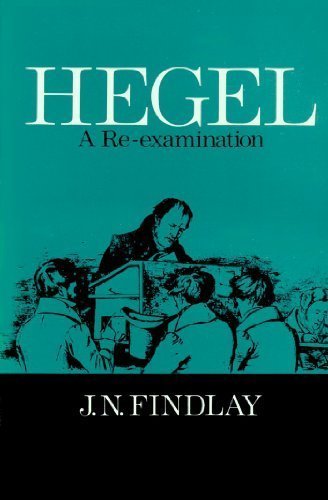
(Provides an account of Hegel's philosophical doctrines an...)
Provides an account of Hegel's philosophical doctrines and guides the reader through the intricacies of his principal writings. Particular emphasis is placed on The Phenomenology of Spirit and on the three parts of the Encyclopaedia of the Philosophical Sciences.
http://www.amazon.com/gp/product/0195198794/?tag=2022091-20
(First published in 2002. Routledge is an imprint of Taylo...)
First published in 2002. Routledge is an imprint of Taylor & Francis, an informa company.
http://www.amazon.com/gp/product/1138870919/?tag=2022091-20
http://www.amazon.com/gp/product/B003T1QFKG/?tag=2022091-20
http://www.amazon.com/gp/product/B001IETI96/?tag=2022091-20
(First published in 2002. Routledge is an imprint of Taylo...)
First published in 2002. Routledge is an imprint of Taylor & Francis, an informa company.
http://www.amazon.com/gp/product/0415295785/?tag=2022091-20
http://www.amazon.com/gp/product/0391005693/?tag=2022091-20
http://www.amazon.com/gp/product/0855271973/?tag=2022091-20
( First published in 1966, The Discipline of the Cave is ...)
First published in 1966, The Discipline of the Cave is the first series of a course of Gifford lectures on philosophical issues.. J N Findlay’s lectures use the image of the Cave to show how familiarity is full of restrictions, and involves puzzles and discrepancies unable to be resolved or removed. Such philosophical perplexities may be a result of the misunderstanding and abuse of ordinary ways of thinking and speaking. They may also be a way of ‘drawing us towards being’, providing proof of the absurdity of ordinary thought, speech and experience unless modified and added to in ways which may point beyond it. What may be called a mystical and otherworldly element may need to be introduced into or rendered explicit in all our experience in order to give a viable sense to the most commonplace human utterances and activities.
http://www.amazon.com/gp/product/0041110013/?tag=2022091-20
http://www.amazon.com/gp/product/B0000CMV1L/?tag=2022091-20
( First published in 1967, The Transcendence of the Cave ...)
First published in 1967, The Transcendence of the Cave is the second in a series of Gifford Lectures on philosophical issues, and continues the themes of the first series entitled The Discipline of the Cave. In the opening chapters, J N Findlay sketches an ontology, an axiology and a theology which are ‘phenomenological’ in the sense of Husserl, as they attempt to show that a ‘firmament’ of logical and other values emerges out of the contingencies of first order liking and interest. The synthesis of these values in an object having many paradoxical, mystical-religious properties is also a necessary outcome of this ‘logic’. In the later chapters, the author attempts to construct an orderly picture of other worldly experiences and their objects based solely on the premise that these experiences must be such as to resolve the many philosophical surds that plague us in this life.
http://www.amazon.com/gp/product/0415685419/?tag=2022091-20
http://www.amazon.com/gp/product/B007BNXK88/?tag=2022091-20

http://www.amazon.com/gp/product/B011825HHO/?tag=2022091-20
http://www.amazon.com/gp/product/B000Z4QBEA/?tag=2022091-20
( First published in 1967, The Transcendence of the Cave ...)
First published in 1967, The Transcendence of the Cave is the second in a series of Gifford Lectures on philosophical issues, and continues the themes of the first series entitled The Discipline of the Cave. In the opening chapters, J N Findlay sketches an ontology, an axiology and a theology which are ‘phenomenological’ in the sense of Husserl, as they attempt to show that a ‘firmament’ of logical and other values emerges out of the contingencies of first order liking and interest. The synthesis of these values in an object having many paradoxical, mystical-religious properties is also a necessary outcome of this ‘logic’. In the later chapters, the author attempts to construct an orderly picture of other worldly experiences and their objects based solely on the premise that these experiences must be such as to resolve the many philosophical surds that plague us in this life.
http://www.amazon.com/gp/product/0415685419/?tag=2022091-20
http://www.amazon.com/gp/product/B007BNXK88/?tag=2022091-20
http://www.amazon.com/gp/product/B011825HHO/?tag=2022091-20
(Book by Findlay, J. N)
Book by Findlay, J. N
http://www.amazon.com/gp/product/039100073X/?tag=2022091-20
(Book by Findlay, J. N)
Book by Findlay, J. N
http://www.amazon.com/gp/product/0812907485/?tag=2022091-20
(This book is an attempt to conduct a comprehensive examin...)
This book is an attempt to conduct a comprehensive examination of Kant's metaphysic of Transcendental Idealism, which is everywhere presupposed by his critical theory of knowledge, his theory of the moral and the aesthetic judgement, and his rational approach to religion. It will attempt to show that this metaphysic is profoundly coherent, despite frequent inconsistencies of expression, and that it throws an indispensable light on his critical enquiries. Kant conceives of knowledge in especially narrow terms, and there is nothing absurd in the view that thinkables must, in his sense, extend far more widely than knowables. Kant also goes further than most who have thought in his fashion in holding that, not only the qualities of the senses, but also the space and time in which we place them, have non-sensuous, non-spatial, and non-temporal foundations in relations among thinkables that transcend empirical knowledge. This contention also reposes on important arguments, and can be given a sense that will render it interesting and consistent. The book explores this sense, and connects it with the thought of Kant's immediate predecessors in the great German scholastic movement that began with Leibniz: this scholasticism, it will be held, is throughout preserved as the unspoken background of Kant's critical developments, whose great innovation really consisted in pushing it out of the region of the knowable, into the region of what is permissively or, in some cases, obligatorily, thinkable.
http://www.amazon.com/gp/product/0198246382/?tag=2022091-20

http://www.amazon.com/gp/product/B011DAJ7ZO/?tag=2022091-20
(Plato s Parmenides and Its Heritage presents in two volum...)
Plato s Parmenides and Its Heritage presents in two volumes ground-breaking results in the history of interpretation of Plato s Parmenides, the culmination of six years of international collaboration by the SBL Annual Meeting seminar, Rethinking Plato s Parmenides and Its Platonic, Gnostic and Patristic Reception (2001 2007). The theme of Volume 1 is the dissolution of firm boundaries for thinking about the tradition of Parmenides interpretation from the Old Academy through Middle Platonism and Gnosticism. The volume suggests a radically different interpretation of the history of thought from Plato to Proclus than is customary by arguing against Proclus s generally accepted view that there was no metaphysical interpretation of the Parmenides before Plotinus in the third century C.E. Instead, this volume traces such metaphysical interpretations, first, to Speusippus and the early Platonic Academy; second, to the Platonism of the first and second centuries C.E. in figures like Moderatus and Numenius; third, to the emergence of an exegetical tradition that read Aristotle s categories in relation to the Parmenides; and, fourth, to important Middle Platonic figures and texts. The contributors to Volume 1 are Kevin Corrigan, Gerald Bechtle, Luc Brisson, John Dillon, Thomas Szlezák, Zlatko Ple e, Noel Hubler, John D. Turner, Johanna Brankaer, Volker Henning Drecoll, and Alain Lernould.
http://www.amazon.com/gp/product/1589834496/?tag=2022091-20
http://www.amazon.com/gp/product/9004233237/?tag=2022091-20
( Professor Findlay in this book, originally published in...)
Professor Findlay in this book, originally published in 1961, set out to justify, and to some extent carry out, a ‘material value-ethic’, ie. A systematic setting forth of the ends of rational action. The book is in the tradition of Moore, Rashfall, Ross, Scheler and Hartmann though it avoids altogether dogmatic intuitive methods. It argues that an organised framework of ends of action follows from the attitude underlying our moral pronouncements, and that this framework, while allowing personal elaboration, is not a matter for individual decision. The relations connecting our fundamental value-judgements with one another, and the frames of mind behind them, are not rigorously deductive but are sufficiently compelling to be called logical. Something of a ‘transcendental deduction’ of a well-ordered family for our basic heads of valuation is both possible and necessary. The work is further critical of the notion of obligation which has been extended far beyond legal contracts and understandings. The book also contains a chapter on religion.
http://www.amazon.com/gp/product/1138825638/?tag=2022091-20
http://www.amazon.com/gp/product/085527543X/?tag=2022091-20
Findlay, John Niemeyer was born on November 25, 1903 in Pretoria, South Africa. Came to the United States, 1966. Son of John Judson L. and Elizabeth (Niemeyer) Findlay.
Bachelor, Transvaal University College, 1922. Master of Arts, Transvaal University College, 1924. Bachelor, Balliol Colonel Oxford University, England, 1926.
Master of Arts, Balliol Colonel Oxford University, 1930. Doctor of Philosophy, University Graz, Austria, 1933.
Professor philosophy, U. Otago, New Zealand, 1934-1944;professor philosophy, U. Natal, South Africa., 1946-1948;professor philosophy, King's College, Newcastle-upon-Tyne, England, 1948-1951;professor philosophy, King's College, U. London, 1951-1966;professor philosophy, University Texas, 1966-1967;Clark professor moral philosophy and metaphysics, Yale University, 1967-1972;U. professor, Bowne professor philosophy, Boston University, 1972-1987. Gifford lecturer U. St. Andrews (Scotland), 1964-1966.
(Plato s Parmenides and Its Heritage presents in two volum...)
(This book is an attempt to conduct a comprehensive examin...)
( First published in 1967, The Transcendence of the Cave ...)
( First published in 1967, The Transcendence of the Cave ...)
( Professor Findlay in this book, originally published in...)
( First published in 1966, The Discipline of the Cave is ...)
(Provides an account of Hegel's philosophical doctrines an...)
(Philosophy, European Studies)
(Ethical Studies, Philosophy)
(First published in 2002. Routledge is an imprint of Taylo...)
(First published in 2002. Routledge is an imprint of Taylo...)
(Book by Findlay, J. N)
(Book by Findlay, J. N)
(1970, 94pp)
Author: Meinong's Theory of Objects and Values, second edition, 1963, Hegel: A Re-Examination, 1958, Values and Intentions, 1961, Language, Mind and Value, 1963, The Discipline of the Cave, 1966, The Transcendence of the Cave, 1967, Axiological Ethics, 1970, Ascent to the Absolute, 1970, Plato: The Written and Unwrittn Doctrines, 1974, Plato and Platonism, 1978, Kant and the Transcendental Object, 1981, Wittenstein: A Critique, 1984, Studies in the Philosophy of J.N. Findlay, 1985. Translator Logische Untersuchungen (Husserl).
Fellow British Academy, American Academy Arts and Sciences. Member Aristotelian Society (vice president 1956-1987).
Married Aileen May Davidson, August 15, 1941. Children: Paul H.D., Rachel Clare.
