

Background
Burke, John Patrick was born on October 16, 1953 in Los Angeles, California, United States. Son of Donald Edward and Eleanor Sutherland Burke.
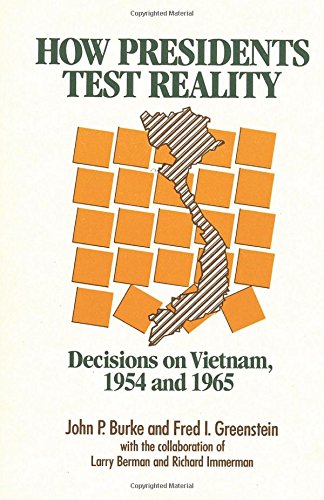
( Just as famines and plagues can provide opportunities f...)
Just as famines and plagues can provide opportunities for medical research, the unhappy course of United States relations with Vietnam is a prime source of evidence for students of American political institutions. How Presidents Test Reality draws on the record of American decision making about Vietnam to explore the capacity of top government executives and their advisers to engage in effective reality testing. Authors Burke and Greenstein compare the Vietnam decisions of two presidents whose leadership styles and advisory systems diverged as sharply as any in the modern presidency. Faced with a common challenge--an incipient Communist take-over of Vietnam--presidents Eisenhower and Johnson engaged in intense debates with their aides and associates, some of whom favored intervention and some of whom opposed it. In the Dien Bien Phu Crisis of 1954, Eisenhower decided not to enter the conflict; in 1965, when it became evident that the regime in South Vietnam could not hold out much longer, Johnson intervened. How Presidents Test Reality uses declassified records and interviews with participants to assess the adequacy of each president's use of advice and information. This important book advances our historical understanding of the American involvement in Vietnam and illuminates the preconditions of effective presidential leadership in the modern world. "An exceptionally thoughtful exercise in what 'contemporary history' ought to be. Illuminates the past in a way that suggests how we might deal with the present and the future." --John Lewis Gaddis "Burke and Greenstein have written what amounts to an owner's manual for operating the National Security Council....This is a book Reagan's people could have used and George Bush ought to read." --Bob Schieffer, The Washington Monthly
http://www.amazon.com/gp/product/0871541769/?tag=2022091-20

(Book by Burke, John P., Greenstein, Fred I.)
Book by Burke, John P., Greenstein, Fred I.
http://www.amazon.com/gp/product/0871541750/?tag=2022091-20

( When Franklin Roosevelt decided his administration need...)
When Franklin Roosevelt decided his administration needed a large executive staff, he instituted dramatic and lasting changes in the federal bureaucracy and in the very nature of the presidency. Today, no president can govern without an enormous White House staff. Yet analysts have disagreed about whether the key to a president's success lies in his ability to understand and adapt to the constraints of this bureaucracy or in his ability to control and even transform it to suit his needs. In The Institutional Presidency John Burke argues that both skills are crucial. Burke examines how the White House staff system―larger and more powerful than ever―interacts with a particular president's management ability and style. Beginning with the institutional presidency that emerged during the Roosevelt administration, this new edition includes a revised chapter on the Bush administration and a new chapter on Bill Clinton.
http://www.amazon.com/gp/product/0801865018/?tag=2022091-20

http://www.amazon.com/gp/product/B01FJ0SFAC/?tag=2022091-20

(Brand New. In Stock. Will be shipped from US. Excellent C...)
Brand New. In Stock. Will be shipped from US. Excellent Customer Service.
http://www.amazon.com/gp/product/B01FIYVQO6/?tag=2022091-20

http://www.amazon.com/gp/product/B01JXS376I/?tag=2022091-20

(Book by Burke, Professor John P.)
Book by Burke, Professor John P.
http://www.amazon.com/gp/product/0801830095/?tag=2022091-20

(A civil servant in the Pentagon blows the whistle on the ...)
A civil servant in the Pentagon blows the whistle on the Defense Department by leaking to the press stories of gross overspending. A high-level official in the Environmental Protection Agency publicly reports irregularities in the handling of toxic waste cleanup and the agency's head is forced to resign. The Energy Department fines oil companies for overcharging consumers; does an official overstep his bounds in ordering that the money be distributed to help the poor and elderly pay their heating bills? How much do bureaucrats know? And how much should they tell? In "Bureaucratic Responsibility", John Burke moves from case study to theory to explore what is perhaps the most basic problem confronting modern democracy: How are we to make those bureaucracies upon which government relies both accountable and responsive? Responsibility, Burke contends, must not be primarily to the formally defined terms and obligations of a particular office, but to the institutions of American democracy and the public consent. "Bureaucratic Responsibility" is a provocative combination of descriptive analysis, political theory, and prescriptive speculation-- and makes a timely case for a more responsible bureaucracy.
http://www.amazon.com/gp/product/0801836549/?tag=2022091-20
Burke, John Patrick was born on October 16, 1953 in Los Angeles, California, United States. Son of Donald Edward and Eleanor Sutherland Burke.
AB, Stanford University, 1975; Master of Arts, Princeton University, 1979; Doctor of Philosophy, Princeton University, 1982.
Assistant professor, U. Vermont, Burlington, 1984-1988; associate professor, U. Vermont, Burlington, since 1988; department chairman political science, U. Vermont, Burlington, since 1991.
( Just as famines and plagues can provide opportunities f...)
( When Franklin Roosevelt decided his administration need...)
(A civil servant in the Pentagon blows the whistle on the ...)
(Book by Burke, Professor John P.)
(Book by Burke, John P., Greenstein, Fred I.)
(Brand New. In Stock. Will be shipped from US. Excellent C...)
Member Phi Beta Kappa.
