Background
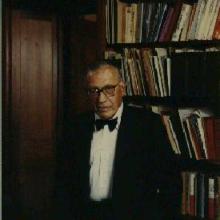
Dunlop, John Thomas was born on July 5, 1914 in Placerville, California, United States. Son of John W. and Antonia (Forni) Dunlop.


(In this revised edition, John T. Dunlop updates his gener...)
In this revised edition, John T. Dunlop updates his general theory of industrial relations, describing it as a set of tools for practitioners that can be used to develop new industrial relations systems or to reform existing ones. He also discusses the transformation of the industrial relations systems of the former Soviet Union. Since the initial publication of this work in 1958, a substantial literature has grown up around Dunlop's theory, which provides a framework for analyzing and interpreting the vast and growing body of information about labour relations. This book is the inaugural volume in a new series, Harvard Business School Press Classics, which will bring back into print works widely recognized as having significant impact on management practice and research.
http://www.amazon.com/gp/product/0875843344/?tag=2022091-20

( John Dunlop is one of the world's outstanding figures i...)
John Dunlop is one of the world's outstanding figures in the theory and practice of industrial relations. In this book he advocates a better means to resolve disputes. He stresses that each side must work out its own internal accommodation as a necessary prerequisite to across-the-table resolution.
http://www.amazon.com/gp/product/0865691231/?tag=2022091-20

http://www.amazon.com/gp/product/B007FRHQYO/?tag=2022091-20

(Book by Dunlop, John T.)
Book by Dunlop, John T.
http://www.amazon.com/gp/product/0669211435/?tag=2022091-20

(A Guide for Policy and Practice This book offers a road...)
A Guide for Policy and Practice This book offers a road map to dramatically reduce workplace conflict and legal costs. ADR is a revolutionary trAnd that offers the potential for resolving disputes in a fair and reasonable manner, at tremAndous savings to everyone involved. On behalf of consumers, businesses, and ordinary Americans trapped in a liability logjam, bravo Dunlop and Zack! --Jerry J. Jasinowski, president, National Association of Manufacturers For many employers and employees alike, alternative dispute resolution (ADR) offers clear advantage over recourse to a legal system compromised by staggering case loads, Andless appeals, and high litigation costs. Indeed, ADR may prove the best hope for the equitable, affordable, and expeditious adjudication of employment dispute claims. Now, two of the people most responsible for the adoption of due process arbitration standards--standards that finally gave ADR real teeth--take a comprehensive look at due process arbitration in practice and offer policy guidelines, as well as an action plan for establishing mediation and arbitration as the cornerstones of any dispute resolution system.
http://www.amazon.com/gp/product/0787908479/?tag=2022091-20

http://www.amazon.com/gp/product/B0000CHTLO/?tag=2022091-20

http://www.amazon.com/gp/product/B010BG5SPO/?tag=2022091-20

(The apparel and textile industries have always been at th...)
The apparel and textile industries have always been at the mercy of rapidly changing styles and fickle customers who want the latest designs while they are still in fashion. The result for these businesses, often forced to forecast sales and order from suppliers with scant information about volatile demand, is a history of stock shortages, high inventories, and costly markdowns. But, as the authors explain in A Stitch in Time, technological advances in the 1980s paved the way for a new concept in retailing--lean retailing. Pioneered by companies like WAL-MART, lean retailing has reshaped the way that products are ordered, virtually eliminating delays from distribution center to sales rack by drawing on sales data captured electronically at the checkout counter. Armed with up-to-the-minute data about colors, sizes, styles, and geographic sales, apparel and textile companies now must be able to respond rapidly to real-time orders efficiently based on new approaches to distributing merchandise, forecasting, planning, organizing production, and managing supplier relations. A Stitch in Time shows that even in the face of burgeoning product proliferation, companies that successfully adapt to the world of lean retailing can reduce inventory risk, reduce costs, and increase profitability while improving their responsiveness to the ever-changing tastes of customers. Based on the success of these practices in the apparel industry, lean retailing practices are propagating through a growing number of consumer product industries. A richly detailed and resonant account, A Stitch in Time brilliantly captures both the history and future of the retail-apparel-textile channel and offers bold insights on the changes and challenges facing retailers and manufacturers in all segments of our rapidly changing economy.
http://www.amazon.com/gp/product/0195126157/?tag=2022091-20

http://www.amazon.com/gp/product/B004XIMSBO/?tag=2022091-20

(Irwin Series In Economics.)
Irwin Series In Economics.
http://www.amazon.com/gp/product/1258233304/?tag=2022091-20
economist and industrial relations expert
Dunlop, John Thomas was born on July 5, 1914 in Placerville, California, United States. Son of John W. and Antonia (Forni) Dunlop.
Bachelor of Arts, Doctor of Philosophy University California Berkeley, 1935. Honorary Doctor of Laws University Chicago, 1968, Temple University 1975, Boston College, 1975, University Akron, 1975, University Pennsylvania, 1976, Babson College, 1977, Loyola University, 1978, Villanova University, 1983.
Acting instructor Stanford University, 1936-1937. Instructor Harvard University, 1938-1945, associate professor economics, 1945-1950, professor economics, 1950-1985, Lamont University professor, 1970-1985, dean faculty arts and science, 1970-1973. Served as vice chairman Boston Regional War Labor Board, 1944-1945.
Chairman National Joint Board for Settlement of Jurisdictional Disputes in building and construction industry, 1948-1957. Consultant Office Economic Stabilization, 1945-1947, National Labor Relations Board, 1948-1952, Atomic Energy Labor Panel, 1948-1953. Member board inquiry Bituminous Coal Industry, 1950.
Public member Electricity Supply Board, 1950-1952. Member Emergency Boards 109, 130, 167. Member Presidential R.R. Commission, 1960-1962, Missile Sites Labor Commission, 1961-1967, President's Equal Employment Opportunity Commission, 1964-1965.
Impartial chairman Construction Industry Joint Conference, 1959-1968. Director Cost of Living Council, 1973-1974. Secretary, United States Department Labor, 1975-1976.
Chairman Massachusetts joint committee Municipal Police and Fire, 1977-2003. Chairman Pay Advisory Committee, 1979-1980, Social Security Council, 1989-1991. Chairman Future Worker/Management Relations Committee, 1993-1995, Massachusetts Blue Ribbon Commission on Older Workers, 1997-2000, Att.
General international advisory committee, 1997-2000, Foster G. McGaw prize committee, 1986-2003.
(The apparel and textile industries have always been at th...)
(A Guide for Policy and Practice This book offers a road...)
( John Dunlop is one of the world's outstanding figures i...)
(In this revised edition, John T. Dunlop updates his gener...)
(Irwin Series In Economics.)
(Book by Dunlop, John T.)
I started my professional career with an intellectual interest in the determination of wages
and prices, in labour economics and industrial organisation. The War Labor Board (1943-1947) in World World War II and the Korean war period dispute settlement and stabilisation agencies (1950-1953) provided extensive experience in wage-setting, labour-management dispute resolution and responsibility for decision-making. These perspectives were reinforced by further university and public responsibilities as well as continuing as a labour-management arbitrator in many industries.
These experiences were to influence the choice of research and writing, notions of relevance in economics as well as views on the relations between economic analysis and public policy. Living at the margin of a large number of organisations — labour unions, business organisations, government agencies, university administrations at national and local levels — provided an opportunity to introduce many generations of Doctor of Philosophy students and junior faculty to data and materials not otherwise available. A number of the volumes of such research appear in the Wertheim.
Atomic Energy Labor Relations Panel 1948-1953. Secretary Labor"s Advisory Committee on Labor-Management Relations in Atomic Energy Installations 1954-1957. Kaiser Steelworkers’ Commission 1960-1968, Presidential Railroad Commission 1960-1962, Missiles Sites Labor Commission 1961-1967.
President's National Commission, on Productivity 1970-1973.
Construction Industry Collective Bargaining Commission 1969-1971. 1973-1974; American Academy, of Arts and Sciences, American Philosophical Society, Institute of Medicine.
Married Dorothy Webb, July 6, 1937. Children: John Barrett, Beverly Claire, Thomas Frederick.