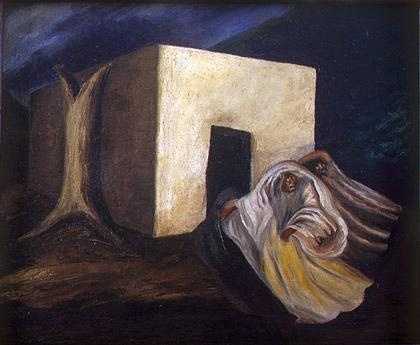
Orozco began night classes in drawing at the Academy of San Carlos. After a break in his studies there, he returned to the Academy in 1905 with an intention to become a competent painter.
Orozco began night classes in drawing at the Academy of San Carlos. After a break in his studies there, he returned to the Academy in 1905 with an intention to become a competent painter.
José Clemente Orozco was a Mexican painter, and one of the most well-known adherents of the Mexican Mural Renaissance. The painter’s skeptical attitude, as well as his interest in pre-Columbian art, played an important role in both his palette and subject matter.
Background
Orozco was born in Ciudad Guzmán, Mexico, on November 23, 1883. He was raised in Zapotlán el Grande, a small city in the region of Jalisco. He was the son of Ireneo, a businessman, and Rosa de Flores Orozco, a homemaker and amateur singer. His parents were both natives of Jalisco and also descendants of early Spanish settlers.
Education
José Orozco first became interested in art in 1890, when his family moved to Mexico City. He started to study painting attending José Guadalupe Posada's workshop, Mexico’s first great printmaker. Orozco began night classes in drawing at the Academy of San Carlos. At the end of the 1890s, he obeyed his father’s wishes and studied to become an agronomist, attending the School of Agriculture between 1897 and 1899. Later he continued his education as an architectural draftsman. However, at the age of 17, he lost his left hand in a laboratory accident. So he abandoned his architectural studies.
Orozco returned to the Academy of San Carlos in 1905 with an intention to become a competent painter. One of his teachers at the Academy was Gerardo Murillo, a radical artist. He convinced painters to resist the cultural domination of Europe and to cultivate Mexican traits in their work. Influenced by Doctor Atl, Orozco began to explore Mexican themes and to draw more directly from scenes of daily life.
Orozco served as a caricaturist for an opposition newspaper, often focusing on the lives of destitute members of society. When civil war broke out in Mexico in 1914, Orozco became a supporter of the forces of General Venustiano Carranza. During this time he worked as a satiric artist on the revolutionary paper La vanguardia (The Vanguard).
In 1915 he had his first solo exhibit of paintings and drawings in Mexico City. In 1917 the negative reaction of critics and moralists to the exhibition of his House of Tears paintings forced Orozco to leave Mexico for the United States. There he lived for several years in San Francisco and New York City. When he returned to Mexico in 1920, he found that the new government of President Álvaro Obregón wanted to sponsor his work.
In 1922, José Orozco began creating murals. Along with his colleagues David Alfaro Siqueiros, Diego Rivera, and others, Orozco was commissioned to paint murals on the walls of the National Preparatory School in Mexico City between 1923 and 1927. It was the time when the Mexican muralist movement appeared. Orozco painted such murals as The Elements, Man in Battle Against Nature, Christ Destroys His Cross, Destruction of the Old Order, Omniscience, and many more. However, the artist was dissatisfied with his early murals, and destroyed many of them.
In 1927, after years of working as an artist in Mexico, Orozco left his family and went to the United States, where he stayed until 1934. Even after the fall of the stock market in 1929, his works were still in demand. His first mural in the United States was created for Pomona College in Claremont, California, in 1930. He also produced massive works for the New School for Social Research, Dartmouth College and the Museum of Modern Art. One of his most renowned murals is The Epic of American Civilization, housed in Dartmouth College in New Hampshire. It took him two years to complete the work, which consisted of 24 panels and was nearly 3,200 square feet.
In the year 1932, the painter made a brief trip to Europe, where he studied the art of England, France, Spain, and Italy. He was impressed with the paintings of Pablo Picasso as well as the Byzantine mosaics of Rome and Ravenna.
Orozco returned to Mexico in 1934, where he painted the mural Catharsis for the Palace of Fine Arts in Mexico City (1934). In 1940 José Orozco was asked by The Museum of Modern Art in New York to create the piece for its exhibition Twenty Centuries of Mexican Art. Between 1942 and 1944 Orozco painted for the Hospital de Jesús in Mexico City. In 1947, the American author John Steinbeck asked Orozco to illustrate his book The Pearl. A year later, Orozco was asked to paint his only outdoor mural, Allegory of the Nation, at Mexico’s National Teachers College. The work was later photographed and featured in Life magazine. Orozco's 1948 "Juárez Reborn" huge portrait-mural was one of his last works.
José Orozco was one of the most esteemed among the Mexican Muralists, alongside Diego Rivera and David Alfaro Siqueiros. Orozco became a national hero in his later years, honoured as the leader among those who raised Mexican art to a position of international celebrity.
In 1946 he was awarded the National Prize in the Arts and Sciences, and that same year a great retrospective exhibition of his works was presented in the Palace of Fine Arts. In 1947 the president of Mexico awarded Orozco the Federal Quinquennial Prize, which recognized him as the outstanding Mexican figure in the arts and sciences of the preceding five years. The artists inspired by José Orozco range from the Mexican painter, sculptor and poet, Gustavo Arias Murueta, to Joan Mitchell, Eleanor Coen, Rico Lubrun, and Luis Nishizawa.
Today, his works are held in the collections of the Museum of Modern Art in New York, the Art Institute of Chicago, and the National Gallery of Art in Washington, D.C.
Modern Migration of the Spirit - The Epic of American Civilization
Soldiers
Catharsis
La Acechanza
Dive Bomber and Tank
Zapatista's Marching
Ceiling mural of Hospicio Cabanas
The great mexican revolutionary law and the freedom of slaves
Prometheanist
The Subway
La Conquete
Departure of Quetzalcoatl - The Epic of American Civilization
Farewell
Winter
Zapata
Father Hidalgo
Wheel
Ceiling of Colegio de San Ildefonso
Revolutionaries on the march
Youth
Gods of the Modern World - The Epic of American Civilization
Reaching out
Advance
The Clowns of War Arguing in Hell
The Rich People
Prometheus
Combat
El Brujo (The Sorcerer)
The Franciscans
Entrance of Colegio de San Ildefonso
Omnisciencia
Cortés and La Malinche
Man of Fire
Mexican soldiers
Politics
José Orozco was known for being a politically committed artist. He promoted the political causes of peasants and workers.
Views
Quotations:
"Painting in its higher form and painting as a minor folk art differ essentially in this: the former has invariable universal traditions from which no one can separate himself, the latter has purely local tradition."
"All praise to the masters indeed, but we too could produce a Kant or a Hugo."
"Errors and exaggerations do not matter. What matters is boldness in thinking with a strong-pitched voice, in speaking out about things as one feels them in the moment of speaking; in having the temerity to proclaim what one believes to be true without fear of the consequences. If one were to await the possession of the absolute truth, one must be either a fool or a mute. If the creative impulse were muted, the world would then be stayed on its march."
"Art is Knowledge at the service of emotion."
"In every painting, as in any other work of art, there is always an IDEA, never a STORY. The idea is the point of departure, the first cause of the plastic construction, and it is always present all the time as energy creating matter. The stories and other literary associations exist only in the mind of the spectator, the painting acting as the stimulus."
"We could raise prodigious cities and create nations, and explore the universe."
"What is important is not so much what people see in the gallery or the museum, but what people see after looking at these things, how they confront reality again. Really great art regenerates the perception of reality; the reality becomes richer, better or not, just different."
Personality
José Clemente Orozco was an introverted and pessimistic person.
Connections
José Orozco married Margarita Valladares in 1923. The couple produced three children. Around 1943, Orozco met Gloria Campobello, the prima ballerina for the Mexico City Ballet. Within three years, he left his wife to live with Gloria in New York City. The affair, however, ended very quickly. In 1946, Campobello left him, and Orozco eventually returned to Mexico to live alone.
Jose Clemente Orozco
Published by The Delphic Studios New York , 1932, 1932. The book contains 12 pages text, photographic frontispiece, hundreds of monochrome illustrations.
1932
Jose Clemente Orozco in the United States, 1927-1934
All of Orozco's North American work is presented here, with discussions on his life and influences as well as his place among the other Mexican artists and his impact on the exuberant art of the 1960s and 1970s.
2002
Jose Clemente Orozco: Mexican Artist (Hispanic Biographies)
Discusses the life and times of Jose Clemente Orozco, who has been called "the most original and powerful mural painter" in Mexico despite having been badly injured in an explosion as a teenager.