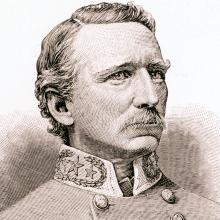
Joseph Brevard Kershaw was an American jurist. He served as a member of the State Senate from 1852 to 1856 and as a judge of the Circuit Court from 1877 to 1893. During his service in the United States Army, he rose to the rank of the Major General.
Background
Joseph Brevard Kershaw was born on January 5, 1822 at Camden, South Carolina, United States. He was the son of Colonel John Kershaw and of Harriette Du Bose, of distinguished ancestry. His grandfather, Joseph Kershaw, who emigrated from England in 1748, became prominent in the affairs of his state and took an active part in the War of the Revolution. His father, several times mayor of Camden, was a judge of the County of Kershaw, a member of the South Carolina House of Representatives, and a member of Congress for one term.
Education
Joseph attended the Cokesbury Conference School in Abbeville, South Carolina. He studied law in the office of Honorary John M. De Saussure and was admitted to the bar in the year 1843.
Career
Joseph Brevard Kershaw entered the Mexican War as a lieutenant in the Palmetto Regiment of his state on February 6, 1843, but after seeing considerable field service, he was forced by a protracted illness to return to his home the following June, when he resigned from the army and resumed the practice of law.
He was elected to the state legislature in 1852 and again in 1854. In 1860 he was a member of the secession convention which met at Charleston, and in April 1861 he entered the Confederate army as colonel, 2nd South Carolina Volunteers, which regiment he had recruited. His command was at Morris Island during the bombardment of Fort Sumter and formed a part of Bonham's brigade in the first battle of Bull Run. He was commissioned brigadier-general, February 13, 1862, and thereafter his command became well known as "Kershaw's Brigade" of McLaws' division, Longstreet's corps, Army of Northern Virginia. His brigade distinguished itself at the Battle of Fredericksburg, where it held the sunken road below Marye's Heights, at Chancellorsville, and at Gettysburg, where he led the attack of Longstreet's corps and lost over half his command. Transferred westward, his brigade took part at Chickamauga in the famous charge which crushed the Federal right-wing and in all the engagements of the Tennessee campaign. Rejoining the Army of Northern Virginia and promoted major-general, May 18, 1864, he commanded a division of Longstreet's corps in the battles of the Wilderness, Spotsylvania, Cold Harbor, and Petersburg. At Sailor's Creek, his division was a part of Ewell's corps which surrendered April 6, 1865. Kershaw was confined for several months as a prisoner of war at Fort Warren, Boston.
After his release, Kershaw resumed the practice of law in Camden and entered politics. He became a member of the state Senate in 1865 and for one year as its president. In 1870, as a member of the Union Reform party convention, he prepared the resolutions recognizing the Reconstruction Act. In 1877 he was elected judge of the fifth circuit court of his state, which office he held until failing health required his retirement sixteen years later. When he left the bench, in 1893, he was made postmaster of Camden, but he died the following year.
Kershaw was prominent in Masonry and at one time was grand master of the state of South Carolina. He prepared for Battles and Leaders of the Civil War "Kershaw's Brigade at Fredericksburg" and "Kershaw's Brigade at Gettysburg."
Achievements
Joseph Brevard Kershaw rendered valuable and dangerous services through military campaigns as a Confederate soldier in the American Civil War. He took a prominent part in the Peninsular campaign, and in the battles of Second Bull Run, South Mountain, and Antietam.
He also served as a Judge, elected to the State Senate in 1865, and chosen President of the Senate.