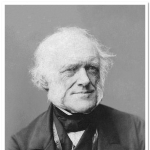
Joseph Leidy was an American paleontologist, parasitologist, geologist, and anatomist. He was one of the most distinguished and versatile scientists in the United States, who made important contributions to the fields of comparative anatomy, parasitology, and paleontology.
Background
Leidy was born on September 9, 1823, in Philadelphia, Pennsylvania, the third of four children of Philip and Catherine Mellick. Both his parents were of German ancestry: his father, a grandson of John Jacob Leydig who came to Pennsylvania from Wittenberg in 1729; his mother, a member of a family long settled in New Jersey. She died when Joseph was but a year and a half old, and he was brought up by her sister Christiana, his stepmother.
Education
Leidy was sent to a private classical academy kept by a Methodist clergyman, but did not distinguish himself in his studies, preferring to wander along the banks of the Wissahickon or the Schuylkill collecting plants and minerals. A talent for drawing evinced in his early teens led his father, a prosperous hatmaker, to take the boy from school at sixteen with a view to making a sign-painter of him. Joseph's scientific predilections, however, together with his stepmother's faith and ambition, at length turned him to the study of medicine and anatomy, and in 1844 he took the degree of M. D. at the University of Pennsylvania with a thesis on "The Comparative Anatomy of the Eye of Vertebrated Animals."
After serving a short time as assistant in the chemical laboratory of the University Leidy entered upon the practice of medicine, but two years later abandoned practice for teaching, and was elected demonstrator of anatomy at the Franklin Medical College. In 1848 he visited Europe in company with Dr. W. E. Horner of the University, and after his return began, in 1849, to give a course of lectures on physiology in the Medical Institute. With Prof. George B. Wood he visited Europe again in 1850 to collect specimens for use in Dr. Wood's courses, and upon returning, resumed his lectures at the Institute.
When ill health compelled Dr. Horner to retire from teaching, Leidy, who had been serving as his prosector, was appointed his substitute, and upon Horner's death in 1853, his successor in the chair of anatomy at the University of Pennsylvania. This position he continued to hold until his death, thirty-eight years later. In 1861 he published his famous work in the field of human anatomy, Elementary Treatise on Human Anatomy (1861, 2nd edition 1889).
During the Civil War he served as surgeon in the Satterlee United States Army General Hospital, and in this Distinguished capacity performed some sixty autopsies reported in the Medical and Surgical History of the War of the Rebellion (1870 - 1888). From 1870 to 1885 he was professor of natural history at Swarthmore College, and after 1884, in addition to being professor of anatomy, he was director of the department of biology at the University of Pennsylvania. Distinguished as he was as an anatomist, he was scarcely less so in other fields of science.
His initial publications, including papers on new species of fossil shells and the anatomy of the snail, appearing in 1845 when he was in his twenty-second year, brought him election to the Boston Society of Natural History and the Academy of Natural Sciences of Philadelphia, with the second of which he was ever after closely identified. His first noteworthy contribution to vertebrate paleontology was his paper "On the Fossil Horse of America" in which it was shown conclusively that the horse had lived and become extinct on the American continent long before its discovery by Columbus. In this line of work Leidy became a pioneer, and before O. C. Marsh and E. D. Cope had begun their work he had shown, through fossil remains, the one-time presence in the western United States of the lion, tiger, camel, horse, rhinoceros, and other vertebrates long since extinct or found only in milder and distant climes. Notable publications on these subjects were The Ancient Fauna of Nebraska and his monograph of 1869, "On the Extinct Mammalia of Dakota and Nebraska", which last is stated by Osborn to be "with the possible exception of Cope's Tertiary Vertebrata, the most important paleontological work which America has produced. "
Leidy was not merely a paleontologist, however; he was a naturalist in the full meaning of the word, and continued the foremost in his line until his death, although he largely discontinued his vertebrate work when the confining duties of the university prevented his participating and competing in a field where Cope and Marsh were rapidly becoming efficient. No subject seemed too large for him to grasp, none too small to excite his interest. The wide range which he covered and his handling of it cannot be better illustrated than by comparing the works mentioned above with his Fresh Water Rhizopods of North America (1879), Monograph XII of the Hayden Survey, in which are shown and described forty-eight quarto plates of microscopic forms, the drawings for which were from his own hand.
Parasitology had been a favorite study of Leidy's from very early in his career and was the subject of many of his most important papers. One of his early discoveries was the identity of a minute parasitic worm in pork with the dangerous Trichina spiralis sometimes occurring in the muscles of the human species. His treatise on intestinal worms, in William Pepper's System of Practical Medicine (vol. II, 1885), was the first comprehensive work of its kind published in America, while his Flora and Fauna within Living Animals is described as epoch-making. He was the first to suggest the probability that certain parasitic forms communicated from the other animals to man might be "one of the previously unrecognized causes of pernicious an'mia".
Although an indefatigable worker, Leidy is stated to have been almost wholly devoid of all ambition but that of the collection of facts. He was not given to theory, and disliked controversy on any subject. "I am too busy to theorize or make money, " he is quoted as saying. The honors which came to him were of a high order. In 1881 he was unanimously elected president of the Academy of Natural Sciences of Philadelphia, an office which he continued to hold until his death. In 1885 he was made president of the Wagner Free Institute of Science.
In 1889, broken in health from constant application, he made his last trip to Europe. Returning, he resumed his teaching and other duties, but his health continued to fail and he died in 1891, at the age of sixty-eight. His bibliography of over six hundred titles is a telling monument to his industry.
Achievements
Leidy was recognized as the foremost American anatomist of his time. His "Elementary Treatise on Human Anatomy" had been characterized as "one of the best works ever offered to the medical profession on the subject". Leidy was also a renowned parasitologist, and determined as early as 1846 that trichinosis was caused by a parasite in undercooked meat. He was also a pioneering protozoologist, publishing "Fresh-water Rhizopods of North America" in 1879 - a masterpiece that is still referenced today.
He received the Walker prize of $1, 000 from the Boston Society of Natural History in 1880, the Lyell medal from the Geological Society of London in 1884, the Cuvier medal from the Institute of France in 1888.
Academy of Natural Sciences of Philadelphia
,
United States
1848
Personality
Leidy was a devoted worker who missed only five days in thirty-eight years as professor of anatomy, and his steadfastness contributed greatly to the strength of the institutions he served.
Quotes from others about the person
"Among zoologists he was the last to treat of the whole animal world from the protozoa to man, rendering in every branch contributions of permanent value"
Connections
In August 1864, Leidy married Anna Harden of Louisville, Kentucky. They had no children, but adopted a little girl, the orphad daughter of one of Leidy's colleagues.
Joseph Leidy: The Last Man Who Knew Everything
Contemporaries of the modest and unassuming scientist Joseph Leidy (1823-1891) revered him as the supreme consultant in questions relating to human anatomy, paleontology, protozoology, parasitology, anthropology, mineralogy, botany, and numerous other scientific fields. Leidy’s achievements and the breadth of his scientific interests and knowledge were astonishing.