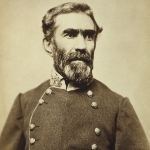
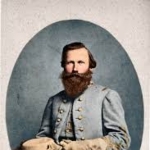
Joseph Wheeler was an American military commander and politician. He served as the commander of the cavalry for the Confederate Army of Tennessee during the Civil War, then went on to a career as a member of Congress from Alabama before returning to the military service during the Spanish-American War.
Background
Joseph Wheeler was born on September 10, 1836, in Augusta, Georgia, United States. His father Joseph Wheeler Sr. was a banker, cotton broker, and real estate speculator before being ruined in the economic depression that followed the Panic of 1837. When his wife Julia Hull died, the elder Wheeler returned home to Connecticut with his children. A few years later, further financial setbacks forced him to move back to Georgia, but his youngest son stayed with relatives in Connecticut to continue his education.
Education
Joseph attended local schools and the Episcopal Academy. He was appointed to the United States Military Academy in 1854. Graduating in 1859 with a fine military and a mediocre academic record, he was brevetted a second lieutenant of dragoons and saw two years' service in the Regular Army, some of which was against Indians in New Mexico.
Joseph Wheeler was commissioned initially a first lieutenant in the Confederate States Army but soon was offered the colonelcy of the 19th Alabama Infantry. He fought through the Shiloh campaign with this regiment, gained recognition as a disciplinarian and a leader, succeeded to the command of an infantry brigade, and on July 18, 1862, was placed in command of the cavalry of the Army of Mississippi. He had now definitely assumed the military role which was to bring him his greatest distinction. In the next two and a half years he rose successively to brigadier-general, major-general, and lieutenant-general in the Confederate service, but in all this time he held one assignment, the leadership of the cavalry in the western theatre of operations.
He covered Bragg's advance into and retreat from Kentucky and took a prominent part in the Murfreesboro and Chickamauga campaigns. After Rosecrans' retirement to Chattanooga, Wheeler executed a masterly raid on the Union communications, which, unlike most Civil War raids, had a material effect on the course of events. His cavalry participated in the siege of Knoxville and then opposed Sherman throughout his long progress through Atlanta to Savannah and finally to Raleigh. In this campaign Wheeler repulsed the attempt of Garrard, Stoneman, and McCook to outflank the Atlanta position, and his troops were practically the only troops opposed to Sherman in the march to the sea. His forces disintegrated at Joseph E. Johnston's surrender, and Wheeler himself was captured near Atlanta. Wheeler was the hero of a spectacular personal encounter with Union cavalry at Duck River, Tennessee, June 27, 1863, was three times wounded in the course of the war, and is said to have participated in two hundred engagements and eight hundred skirmishes in that period.
After the war Wheeler established himself as a commission merchant in New Orleans. In 1868 Wheeler moved to Wheeler, Alabama, and engaged in cotton planting and the practice of law. As the tide of Reconstruction ebbed, he entered politics.
In 1881 he was elected to the Forty-seventh Congress, but as the result of a contest was unseated, June 3, 1882, in favor of W. M. Lowe. Upon the death of Lowe soon afterward, however, he was elected to fill the vacancy and served from January 15 to March 3, 1883. He was re-elected to the Forty-ninth Congress and thereafter served continuously from 1885 to 1900.
Upon the outbreak of the Spanish-American War, Wheeler offered his services to President McKinley and was appointed a major-general of volunteers. The presidential action was recognized and applauded as a significant effort to make the war an instrument to fuse the sections.
Wheeler commanded the cavalry division of Shafter's Santiago expedition, landed at Daiquiri, Cuba, precipitated the engagement at Las Guasimas (June 24, 1898), and despite illness was present at the battle of San Juan Hill (July 1). During the subsequent siege of Santiago, he contributed a disproportionate share of aggressiveness to the American high command. After the surrender of the city and the repatriation of the bulk of the expeditionary force, he commanded the convalescent and demobilization camp at Montauk Point, Long Island. Shortly thereafter he was sent to the Philippines in command of a brigade but soon returned to the United States. On June 16, 1900, he was commissioned a brigadier-general in the Regular Army; he retired on his sixty-fourth birthday, September 10, 1900.
Wheeler was also the author of several books on military history and strategy and civil subjects.
Achievements
Joseph Wheeler is known for having served both as a cavalry general in the Confederate States Army in the 1860s during the American Civil War, and then as a general in the United States Army during both the Spanish-American War and Philippine-American War near the turn of the twentieth century. For much of the Civil War he served as the senior cavalry general in the Army of Tennessee and fought in most of its battles in the Western Theater.
His home was listed in the National Register of Historic Places in 1977 and was donated to the Alabama Historical Commission by his descendants in 1993.
Joe Wheeler State Park, Wheeler Lake and Dam, and the Wheeler National Wildlife Refuge, Joseph Wheeler High School in Marietta, Georgia, and Wheeler County, Georgia are named after him.
Wheeler was a member of the Democratic party. As a representative he was chiefly active in military and fiscal matters. By virtue of long service he became eventually the ranking Democrat on the Ways and Means Committee, and fought strenuously for the low tariff principle. He pushed various pension bills and was instrumental in the congressional rehabilitation of Fitz-John Porter. On the whole, however, his interests were predominantly local, and he devoted the greater part of his energies to the direct service of his constituency. His chief public contribution was his untiring advocacy of reconciliation between North and South. To a host of people he embodied the reintegration of the Confederacy into the Union.
In Alabama, there was attached to the glamor of his Civil War record a high degree of personal popularity, and it was in this period that he built up the local esteem which resulted eventually in his choice by that state as one of its two representatives in Statuary Hall in the Capitol at Washington.
Personality
General Robert E. Lee bracketed Wheeler with J.E.B. Stuart as one of the two outstanding Confederate cavalry leaders. In the breadth of military vision and in the delicacy of touch, Stuart was undoubtedly superior. Nathan Bedford Forrest had a lethal simplicity of action that perhaps surpassed Wheeler at his best, but the latter yielded to none in dogged aggressiveness, in hard-hitting, and in reliability. Loyal to the persons and to the conceptions of his many chiefs, he was ideal and almost invariably appreciated subordinate. Capable opponents, with superior forces of fine cavalry, never succeeded in mastering him. He was beloved and trusted by his men, and despite the fact that excesses were ascribed to his troops in the last days of the Confederacy, he enjoyed general popularity throughout the South.
Connections
On February 8, 1866, Wheeler married Daniella Jones Sherrod, a widow whom he had met while fighting in northern Alabama. The couple had seven children.