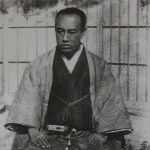
Matsudaira Katamori was a samurai who lived in the last days of the Edo period and the early to mid Meiji period. He was the 9th daimyō of the Aizu han and the Military Commissioner of Kyoto during the Bakumatsu period
Background
The sixth son of Yoshitake Matsudaira, the Lord of Takasu Clan. Was adopted by Katataka, the Lord of Aizu Clan, whom he succeeded in 1852. He was the seventh son of Matsudaira Yoshitatsu, daimyō of Takasu, born by one of Yoshitatsu's concubines, a woman of the Komori family whose name is believed by some scholars to be Komori Chiyo (she was also known by her Buddhist name, Zenkyō-in.)
Education
Katamori, or as he was first known, Keinosuke (銈之丞), had an eventful childhood. Following his adoption, Keinosuke assumed the name "Katamori", which made use of one of the characters from his adoptive father's name. He was presented to the reigning shōgun, Tokugawa Ieyoshi, as well as to Ii Naosuke, four months after his adoption, and at the end of the year was invested with the court title of Wakasa no Kami (若狭守), which was traditionally held by the heir to the house of Aizu.
Interested to further Katamori's education, Katataka then sent his heir to Aizu, where he was educated in the domain school, Nisshinkan.
Career
Following Katataka's death in early 1852, Katamori succeeded to the family headship at age 18. As the 9th daimyō, he was granted the title of Higo no Kami (肥後守), which was traditionally held by the daimyō of Aizu-han. He also received the additional title of Sakonnoe-gon-shōshō (左近衛権少将; Lesser General of the Left Guard) from the Imperial court, and formally sent his thanks to the Emperor later that year. Furthermore, Katamori inherited the family's traditional seat in the tamari no ma chamber, where important matters of state were discussed in conjunction with the Senior Council.
The early years following his appointment were filled with trying times for his leadership of the domain. Just one year later, Commodore Matthew C. Perry led the American East India Squadron into Edo Bay and demanded the opening of Japan to trade. The shogunate mobilized a massive number of men and ships from a broad coalition of feudal domains, and Aizu, being a prominent branch of the Shōgun's house, was no exception. Aizu had already received orders to provide security in the coastal areas of Kazusa and Awa provinces in the months prior to the Perry mission, and when the commodore went ashore to meet with Japanese officials, Aizu was one of the domains which provided patrol boats and coastal security for the event.
In 1862, senior political figures in the Tokugawa shogunate created the post of Kyoto Shugoshoku (Kyoto Military Commissioner), for the purpose of recovering public order in the city, which was under the influence of sonnō-jōi militants. The post of Kyoto Shugoshoku was one that changed much of the dynamic that had theretofore existed in the city. After much deliberation, the choice for the Shugoshoku post came down to two domains: Echizen and Aizu. Of the two, Echizen's Matsudaira Yoshinaga already held high Shogunal office as President of Political Affairs (政治総裁職; seiji sōsai-shoku), so all attention was then turned to Matsudaira Katamori.
News of Katamori's acceptance of the assignment quickly reached Aizu. On September 23, 1862, Katamori was formally summoned to Edo Castle and presented with the assignment. The position was not without its personal incentives: it included an office salary of 50,000 koku a year, a 30,000 ryō loan to cover the expense of traveling to Kyoto, as well as a promotion to senior 4th court rank, lower grade (正四位下; shō-shi'i-ge). Following the assignment, a sweeping program of personnel reassignment took place in the Tokugawa government's Kyoto command structure. Assigned together with Katamori were a group of trusted, powerful daimyō and hatamoto. After a few months of further political difficulty, he left Edo on January 27, 1863 at the head of a thousand-strong Aizu force. Entering Kyoto on February 11, he first headed to Honzen-ji Temple, changing into court clothes, then going to the residence of Imperial regent Konoe Tadahiro and paying his respects. After that, he promptly set up residence in the eastern section of the city, at Konkaikōmyō-ji Temple, in the Kurotani area. Soon after his arrival, Katamori was again formally received by the Court, appearing before regent Konoe together with his senior retainers Ono Gonnojō and Komori Ikkan.
The first difficulty that Katamori faced after taking office was the unfamiliarity of the locals with Aizu and its ability to get the job done. This issue of unfamiliarity and unease began to have some resolution in the early months of 1863, when Katamori was formally received at the Imperial court. Katamori took his role as protector of Kyoto (and the Court) very seriously, and thus played a large role in the coup d'état of September 30 (or the coup d'état of August 18), and the Forbidden Gates Incident (禁門の変, Kinmon no Hen), which both involved clashes between the allied domainal forces under Shogunate command (including Aizu han) against the men of Chōshū han. During the Choshu Expeditions, he also advocated a hard line against the domain. These events lead to increased animosity towards Katamori and the Aizu han within the Chōshū han. Katamori served as shugoshoku from 1862 through 1864; and he served again from 1864 through 1868.
He died on December 5, 1893, and was buried by Shinto rites, receiving the posthumous Shinto name of Masane-reishin (忠誠雲神).
Connections
The young Keinosuke was adopted by Katataka, and married Katataka's daughter Toshihime, in 1856.
Matsudaira Kiyo (松平 喜代), (1844 -1920) was a Japanese woman of the mid to late 19th century. Believed to have been a native of Edo. Kiyo, or as she was also known, Naka (ナカ), was a concubine of Matsudaira Katamori.
Spouse:
Kawamaru Naga
Brother:
Matsudaira Sadaaki
Matsudaira Sadaaki (松平 定敬, January 18, 1847 - July 12, 1908) was a Japanese daimyō of the Bakumatsu period, who was the last ruler of the Kuwana Domain.
Matsudaira Nobunori was adopted from the Mito Tokugawa family. However, Nobunori left the Aizu Matsudaira family soon after the Meiji Restoration, to let Matsudaira Kataharu become the heir of the family.