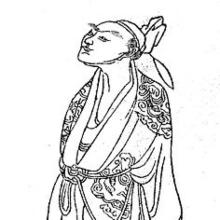
Background
A native of Changgu (昌谷, in modern-day Luoyang, Henan), Li was discouraged by some of his contemporaries from taking the Imperial Examination owing to naming taboo: his father's name happened to sound similar to Jinshi.

李贺
A native of Changgu (昌谷, in modern-day Luoyang, Henan), Li was discouraged by some of his contemporaries from taking the Imperial Examination owing to naming taboo: his father's name happened to sound similar to Jinshi.
However, these qualities lead to a revival of interest in him and his poetry in the twentieth century. Encouraged by Han Yu, who admired his talent, Li took the examination but failed it. Despite his distant royal ancestry (to the Li family who were the ruling dynastic family of the Tang Dynasty), Li He died a low-ranking and poor official, at the age of about 27: various dates are given for him, some more credible than others.
According to Frodsham (1983), "the weight of evidence suggests that he was born in a Horse year, since he wrote no less than twenty-three poems in which the horse stands as a symbol for himself". According to Sinologist Francois Jullien Li He's poetry was readmitted "at the end of the nineteenth century . Known as an eccentric poet, Li was dubbed "Ghost of Poetry" (詩鬼), while Li Bai was called an "Immortal of Poetry" (詩仙) and Du Fu "Sage of Poetry" (詩聖).
Along with Li Bai and Li Shangyin, Li He is one of the "Three Lis" (三李), loved by Mao Zedong, and others. In 1968, Roger Waters of the rock band Pink Floyd borrowed lines from his poetry to create the lyrics for the song "Set the Controls for the Heart of the Sun" from the band's second album A Saucerful of Secrets.
Western notions of romanticism the Chinese to reexamine this poet, allowing the symbolism of his poems to speak at last, freeing his imaginary world from the never-ending quest for insinuations." (Detour and Access, p 73).