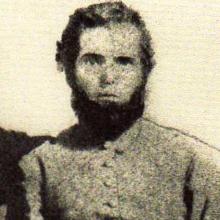
Linton Stephens was an American legislator, jurist. He served in the Confederate States Army during the Civil war.
Background
Linton was born on July 1, 1823, near Crawfordville, Georgia, United States. He was the grandson of Alexander Stephens who emigrated to Pennsylvania from England in 1746, was a captain in the Revolution and removed to Georgia in 1795.
His father, Andrew Baskins Stephens, was a farmer and teacher and his mother, Matilda S. Lindsey Stephens, was the daughter of John Lindsey, a Scotch-Irish Revolutionary soldier of Wilkes County, Georgia.
Linton was the youngest of his father's eight children. Both parents died in 1826, and the boy was reared by his maternal relatives until 1837, when he went to live with his half-brother, Alexander Hamilton Stephens, in Crawfordville.
Education
Having attended the Culloden and Crawfordville academies, Linton entered Franklin College, now a part of the University of Georgia, in 1839 and graduated in 1843. He spent the winter of 1843-1844 in Washington visiting Congress and the Supreme Court. He studied law under Robert Toombs, received the degree of bachelor of laws at the University of Virginia in 1845, and attended Joseph Story's lectures at Harvard for a short time.
Admitted to the bar in 1846, Linton Stephens immediately gained prominence and, as a partner of Richard M. Johnston, was a leader of the bar. An able and fearless speaker, he loved the Union and supported the compromises of 1850.
Representing Hancock County in the Senate, 1853-1855, he introduced the Nebraska resolution opposing the Kansas-Nebraska Bill. As a candidate opposed to the Know-Nothings he was defeated for Congress in 1855 and again in 1857.
A delegate to the Southern Commercial Convention at Montgomery in 1858, he took an extreme position, favoring secession unless Kansas was admitted as a slave state. Governor Brown appointed him to the state supreme court in 1859, and he won recognition as an able jurist. Because of a lack of health, he resigned in 1860.
Stephens supported Douglas in 1860, hoping to defeat Breckinridge in the South and thus avert revolution. A member of the convention of 1861, he voted against secession but, when the war began, raised a company and as lieutenant-colonel of the 15th Georgia Volunteers saw service in Virginia, 1861-1862. Because of the failure of his health, he resigned but was commissioned a colonel in the state cavalry in 1863 and served around Atlanta.
A member of the legislature again in 1863, he opposed conscription and the suspension of the writ of habeas corpus. He introduced the famous resolutions justifying the Confederacy and the peaceful resolutions of 1864.
He also opposed the grant of unconstitutional powers to Governor Brown. After the war, he practiced law and refused to reenter politics.
Linton denounced the Fourteenth and Fifteenth amendments and the Reconstruction acts as nullities, subversive of American liberties. He resisted the Enforcement Act of 1870, was arrested and tried before a federal commission in Macon.
Pleading his own case he denounced the entire Reconstruction program, and the case was dropped. In a famous speech in Atlanta, he bitterly opposed Southern support for Horace Greeley in 1872.
Achievements
Linton Stephens was a distinguished Civil War Confederate Army Officer, served as Lieutenant Colonel and commander of the 15th Georgia Infantry regiment. He also aided his famous brother, Toombs, and Cobb in organizing the Constitutional Union party.
Politics
As a Whig, Stephens was elected to the legislature in 1849 from Taliaferro County and served until his removal to Sparta in 1852. He aided his brother, Toombs, and Cobb in organizing the Constitutional Union party but returned to the Whig party in 1852.
As a Democrat, he attended the Cincinnati convention of 1856 and helped to write the state Democratic platform of 1857.
Personality
Positive, independent, and aggressive, Linton was unbending in his convictions; yet honest and sympathetic, he was loved and esteemed by the people of Georgia. Devoted to his family, his brother, and his friends, he preferred home life to active politics.
Linton was an earnest student, a critic of literature, with a brilliant intellect, a scholar and philosopher rather than a man of action.
Connections
Linton was twice married: first, in January 1852, to Emmeline Thomas Bell, the daughter of James Thomas of Sparta, who bore him three daughters and died in 1857, and, second, in June 1867, to Mary Williams Salter, the daughter of R. H. Salter of Boston, Massachusetts, who also bore him three children.