

Background
Louis St-Laurent was born on 1 February 1882 in Compton, Quebec, a village in the Eastern Townships to Jean-Baptiste-Moïse Saint-Laurent, a French-Canadian, and Mary Anne Broderick, an Irish-Canadian. He grew up fluently bilingual.
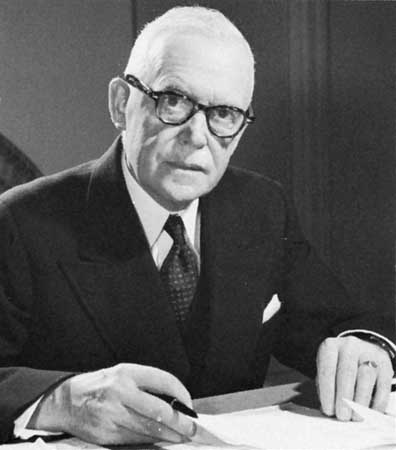
Louis St-Laurent was born on 1 February 1882 in Compton, Quebec, a village in the Eastern Townships to Jean-Baptiste-Moïse Saint-Laurent, a French-Canadian, and Mary Anne Broderick, an Irish-Canadian. He grew up fluently bilingual.
He was educated at St. Charles College, Sherbrooke, and Laval University, Quebec.
He was called to the bar in 1905 and became one of Canada’s leading lawyers, serving two terms as president of the Canadian Bar Association. In 1914 he was appointed professor of law at Laval University. In 1941 he was asked by Prime Minister W. L. Mackenzie King to enter public life.
As a member of the Liberal Party, Saint Laurent was elected to the Canadian House of Commons from Quebec East in 1942 and was reelected in all subsequent elections until his retirement. King appointed him minister of justice and attorney general and later secretary of state for external affairs (acting in 1945, regular 1946). Saint Laurent was deputy chairman of the Canadian delegation to the United Nations Conference on International Organization in San Francisco in 1945 and served as leader of the delegations at the UN General Assembly sessions in London and New York City in 1946–47.
He was persuaded to accept the leadership of the Liberal Party in 1948 and succeeded King as prime minister. Under Saint Laurent’s leadership Newfoundland became a part of the dominion; his government supported UN intervention in Korea (1950–53) and in Suez (1956); and Canada helped to keep India and Pakistan as members of the Commonwealth. He endeavoured to unify and develop the country by equalizing provincial revenues, by expanding social security and university education, and by establishing a council for promoting arts and letters. He led his party to great victories in the general elections of 1949 and 1953, but the Liberals were narrowly defeated in 1957. Although personally reelected, he announced his retirement and was succeeded in 1958 as the leader of the opposition by Lester B. Pearson. He withdrew from public life in 1960 and resumed his law practice. St. Laurent died on July 25, 1973, in Quebec city.
He was the 12th Prime Minister of Canada, from 15 November 1948 to 21 June 1957. He was a Liberal with a strong base in the Catholic francophone community, from which base he had long mobilised support to Prime Minister William Lyon Mackenzie King. His foreign policy initiatives transformed Canada from an isolationist ex-colony with little role in world affairs to an active "middle power". St. Laurent was an enthusiastic proponent of Canada's joining NATO in 1949 to fight Communist totalitarianism, overcoming opposition from some intellectuals, the Labor-Progressive Party, and many French Canadians.
St-Laurent's government was modestly progressive, fiscally conservative and run with business-like efficiency.
Quotes from others about the person
Robertson says, "St Laurent's administrations from 1949 to 1956 probably gave Canada the most consistently good, financially responsible, trouble-free government the country has had in its entire history. "
In 1905 he married Jeanne Renault with whom he had two sons and three daughters.

