(
About Marcus Aurelius Meditations
Meditations is a ser...)
About Marcus Aurelius Meditations
Meditations is a series of personal writings by Marcus Aurelius, Roman Emperor from 161 to 180 AD, recording his private notes to himself and ideas on Stoic philosophy. Marcus Aurelius wrote the 12 books of the Meditations in Koine Greek as a source for his own guidance and self-improvement. It is possible that large portions of the work were written at Sirmium, where he spent much time planning military campaigns from 170 to 180. It is unlikely that Marcus Aurelius ever intended his Meditations to be published and the work has no official title, so "Meditations" is one of several titles commonly assigned to the collection. These writings take the form of quotations varying in length from one sentence to long paragraphs.
About this translation of Marcus Aurelius Meditations
This is the classic and official translation of the Meditations as produced by George Long and originally printed in The Harvard Classics.
What you get when you buy this edition of Meditations
This edition of Meitations is an 80 page long 9x6 trade paperback edition in creme paper and a black glossy cover.
Famous quotes from this edition of Meditations
• Do not act as if thou wert going to live ten thousand years. Death hangs over thee. While thou livest, while it is in thy power, be good.
• Why do you hunger for length of days? The point of life is to follow reason and the divine spirit and to accept whatever nature sends you. To live in this way is not to fear death, but to hold it in contempt. Death is only a thing of terror for those unable to live in the present. Pass on your way, then, with a smiling face, under the smile of him who bids you go.
• Do not then consider life a thing of any value. For look at the immensity of time behind thee, and to the time which is before thee, another boundless space. In this infinity then what is the difference between him who lives three days and him who lives three generations?
• TA cucumber is bitter. Throw it away. There are briars in the road. Turn aside from them. This is enough. Do not add, "And why were such things made in the world?"
• "If thou art pained by any external thing, it is not this that disturbs thee, but thy own judgment about it. And it is in thy power to wipe out this judgment now."
What a reader says about Marcus Aurelius Meditations
We find several recurring themes in The Meditations: develop self-discipline to gain control over judgments and desires; overcoming a fear of death; value an ability to retreat into a rich, interior mental life (one's inner citadel); recognize the world as a manifestation of the divine; live according to reason; avoid luxury and opulence. But generalizations will not approach the richness and wisdom nuggets a reader will find in Marcus's actual words.-Glenn Russel
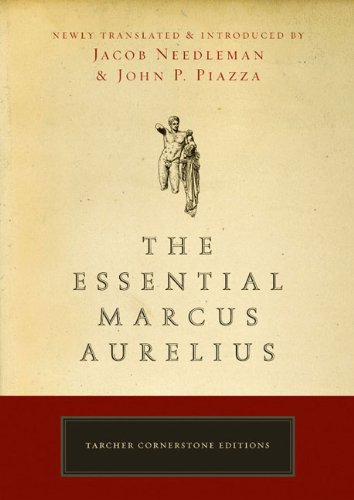
The Essential Marcus Aurelius (Tarcher Cornerstone Editions)
(This inaugural-and all new-Tarcher Cornerstone Edition pr...)
This inaugural-and all new-Tarcher Cornerstone Edition presents a stunningly relevant and reliable translation of the thoughts and aphorisms of the Stoic philosopher and Roman emperor Marcus Aurelius, properly placing the philosopher-king's writings within the vein of the world's great religious and ethical traditions.
The late antique world possessed no voice like that of Roman emperor Marcus Aurelius (121-180 CE). His private meditations on what constitutes a good life have withstood the centuries and reach us today with the same penetrating clarity and shining light as the words of Shakespeare, Emerson, or Thoreau.
In this remarkable new translation, bestselling religious philosopher Jacob Needleman and classics scholar John P. Piazza have retained the depth of Marcus's perspective on life. They have carefully selected and faithfully rendered those passages that clarify Marcus's role as someone who stood within the great religious and ethical traditions that extend throughout every culture in human history. The voice that emerges from their translation is a universal one, equally recognizable to students of Christ, Buddha, the Vedas, the Talmud, and to anyone who sincerely searches for a way of meaning in contemporary life.
(Beautifully formatted and illustrated for digital and pri...)
Beautifully formatted and illustrated for digital and print publication, this collection includes:
12 unique illustrations relevant to the writings and reflections of Marcus Aurelius
New introduction by Pat Flynn on applying Stoic wisdom in the modern age.
The Meditations of Marcus Auerlius: Selections Annotated & Explained (SkyLight Illuminations)
(
The timeless wisdom of an ancient Stoic can become a co...)
The timeless wisdom of an ancient Stoic can become a companion for your own spiritual journey.
Stoicism is often portrayed as a cheerless, stiff-upper-lip philosophy of suffering and doom. Yet as experienced through the thoughtful and penetrating writings of Roman emperor Marcus Aurelius (121180 CE), the Stoic approach to life is surprisingly rich, nuanced, clear-eyed and friendly.
With facing-page commentary that explains the texts for you, Russell McNeil, PhD, guides you through key passages from Aurelius's Meditations, comprised of the emperors collected personal journal entries, to uncover the startlingly modern relevance his words have today. From devotion to family and duty to country, to a near-prophetic view of the natural world that aligns with modern physics, Aureliuss words speak as potently today as they did two millennia ago.
Now you can discover the tenderness, intelligence and honesty of Aureliuss writings with no previous background in philosophy or the classics. This SkyLight Illuminations edition offers insightful and engaging commentary that explains the historical background of Stoicism, as well as the ways this ancient philosophical system can offer psychological and spiritual insight into your contemporary life. You will be encouraged to explore and challenge Aureliuss ideas of what makes a fulfilling life?and in so doing you may discover new ways of perceiving happiness.
The Roman emperor Marcus Aurelius Antoninus was a convinced Stoic philosopher, and at his accession there was widespread rejoicing that at last Plato's dream of a philosopher-king had become reality.
Background
Marcus Aurelius Antoninus was three months old when his father died, and was thereupon adopted by his grandfather.
The moral training which he received from his grandfather and his mother must have been all but perfect.
Education
Marcus Aurelius Antoninus was educated, not at school, but by tutors, Herodes Atticus and M. Cornelius Fronto in the usual curriculum of rhetoric and poetry but at the age of eleven he became acquainted with Diognetus the painter and Stoic philosopher, was fascinated by the philosophy he taught, assumed the dress of his sect, and ultimately abandoned rhetoric and poetry for philosophy and law, having among his teachers of the one Sextus of Chaeronea.
Career
The reign opened with floods on the Tiber and a variety of other natural disasters, but the overshadowing problemwas the Eastern question.
Parthia, the only large, organized power that Rome faced, was always a rival for dominance in Armenia, and now, in 162, Parthia attacked, defeated the Romans in Cappadocia, and overran the rich province of Syria.
Marcus Aurelius, for reasons which still are not entirely clear, remained at Rome and sent Verus to take charge of the war in the East.
But in late 165 a terrible plague broke out among the Roman troops, a plague which they were to carry back with them and which would carry off a quarter or more of the population of the empire.
Rome recalled its armies with Parthia defeated but not conquered.
Nevertheless, Marcus and Verus celebrated a magnificent triumph. The Parthian War had ended none too soon, for the German War, which was to run with only the briefest of intervals for the rest of the reign, had already begun.
Another of those great waves of unrest which occasionally troubled the barbarians beyond the frontier was setting the Germans in motion, and in 167 a group of tribes crossed the Danube, destroyed a Roman army, and actually besieged Aquileia in Italy.
Verus died in early 169, and Marcus was left to face the war alone.
The barbarians were driven back, but still the war dragged on in a mixture of victories and defeats, with Marcus living mainly at the front, sometimes on the Danube, sometimes on the Rhine as the focus of crisis shifted.
Gradually the Romans gained the upper hand, and by 175 we are told that Marcus was intending to annex the lands of the tribes nearest the frontier when he was suddenly forced to call off the war because of the revolt of Avidius Cassius in the East.
After distinguished service in the Parthian War, Avidius Cassius, himself a Syrian, had been made governor of Syria and, with the deepening of the German crisis, had gradually been raised to the position almost of viceroy for the entire East.
Marcus had to break off the war in Germany with less than total victory and hurry eastward. Cassius was murdered after only 3 months, and the immediate danger passed; but Marcus could not avoid showing himself in the East and making a fairly extendedsojourn there.
He exhibited his customary leniency in dealing with Cassius's supporters and returned to Rome in late 176, where he celebrated a splendid triumph with his son Commodus, who was soon given the title Augustus and made an equal sharer of power.
Thus through his own act Marcus Aurelius ended his reign as he had begun it, with a partner his equal in power but not in virtue. In 177 began a serious persecution of the Christians.
Then, too, if his persecution was more severe than those that went before, this was partly because the Christians were more numerous and more visible than before.
The reason for which Marcus Aurelius deservedly is most remembered is the collection of his thoughts or reflections, usually entitled the Meditations.
Since the Meditations were composed in bits, they are best read so; they are to be savored rather than downed at a gulp.
Achievements
Marcus Aurelius Antoninus is considered to be one of the best philosophers.