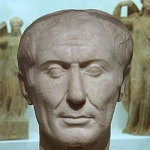
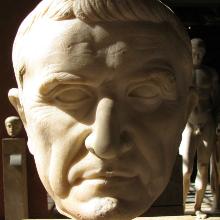
Marcus Licinius Crassus was a Roman politician and general, famous with the cruel repression of Spartacus’s slave revolt in 71 B.C. He became part of the first triumvirate with Caesar and Pompeius.
Background
Crassus was born about 115 B.C. of an ancient and wealthy family in Rome, Roman Republic (nowadays Italy); the second of three sons born to the eminent senator and vir triumphalis Publius Licinius Crassus Dives. His father and brother lost their lives in the "Marian" terror of 87 B.C.
Career
Crassus began his public career as a military commander under Lucius Cornelius Sulla during his civil war. He escaped to Spain and subsequently joined Sulla on the latter's return from the East: indeed Crassus, in command of the right wing, was largely responsible for Sulla's victory over the Marian forces in the decisive Battle of the Colline Gate (82 B.C.). By shrewd speculation on the property of Sulla's victims he increased his already large fortune and became closely associated with the business interests (i.e., the knights) in Rome.
Crassus himself followed a senatorial career. He became praetor (about 73 B.C.) and, taking command against Spartacus' army of rebel slaves, destroyed them in Southern Italy in 71 B.C. Pompey belittled this achievement by claiming that it was only his own destruction of the remnants who had escaped northwards that ended the threat from Spartacus; this claim by Pompey planted ineradicable seeds of suspicion in the mind of Crassus.
Distrusting one another wholeheartedly, Crassus and Pompey thought it prudent to share power: they engineered their election as consuls for 70 B.C., proceeded to undo Sulla's constitution by restoring powers to the tribunes and partial control of the law courts to the knights, and then reverted to private life.
Crassus, suspicious as always of Pompey, opposed the Gabinian and Manilian proposals for giving him extraordinary powers; moreover, while Pompey was in the East (67-63 B.C.), Crassus bought the political support of Julius Caesar and, to strengthen his own position against Pompey's eventual return, attempted various stratagems, all of them calculated to gain him support of some kind, preferably armed.
In 65 B.C., while censor, he advocated the annexation of Egypt and enfranchisement of Transpadane Gaul; in 64 B.C. he supported Catiline's candidacy for the consulship; in 63 B.C. he sponsored a bill for distribution of public land; he was also suspected of complicity in Catiline's conspiracies. Crassus' schemes came to nothing, but his anxieties were relieved when Pompey, on returning to Italy, disbanded his troops (62 B.C.).
Indeed, Crassus soon became closely associated with Pompey, since, when the senate sought to humiliate the latter, Pompey joined Crassus and Caesar (60 B.C.) to form the so-called First Triumvirate, a political coalition which dominated Roman public life for some years.
There was a renewal of tension between Crassus and Pompey in 57 B.C., but the Conference of Luca (56 B.C.) restored harmony and the two men again became consuls together, with prospects of prolonged commands like Caesar's, in 55 B.C. Towards the end of that year Crassus departed with an army to his command in Syria. In 54 B.C. he invaded Parthia. He met disaster in 53 B.C. at Carrhae where he lost his son, his army, and finally his life.
Achievements
Marcus Licinius Crassus played a key role in the transformation of the Roman Republic into the Roman Empire.
Amassing an enormous fortune during his life, Crassus is considered one of the wealthiest man in Roman history.
Crassus is a principal character of several novels, films and ballets.
Politics
In politics Crassus was the spokesman for Roman financial interests. He was one of the members of in the unofficial political alliance known as the First Triumvirate, formed to challenge effectively the power of the Senate. Crassus entered this informal coalition partly to effect passage of laws helpful to his business ventures in Asia.
Personality
Crassus was not known as a mean man, rather, he was known as generous to his friends and his popularity with the people not only came from his offers of free parties and grain but also his polite manner and lack of snobbery. Plutarch says that in Crassus many virtues were obscured by one vice, avarice. His failure was that he had no political goals beyond his own personal advancement or protection.
Crassus was also a good orator, no doubt a skill he honed via his many court cases and helped by his love of philosophy.
Connections
Crassus was married to Tertulla and had two sons, one of whom shared his name and the other - Publius Licinius Crassus - fought with him in Parthia. Marcus Licinius Crassus the younger enjoyed some military success, notably achieving the highest Roman military honour of killing an enemy king.
Father:
Publius Licinius Crassus Dives
He became consul in 97 BC. In his consulship, the senate abolished practice of magic arts and human sacrifice. Between 97-93 BC, he served in Hispania Ulterior as governor and won a battle over the Lusitani, for which he was awarded and honored with a triumph.
He served as a censor in 89 BC. As a censor, he banned foreign wines and unguents. He later became an electorate officer dividing new citizens into voting districts.
Spouse:
Tertulla
She was a daughter of Marcus Terentius Varro Lucullus (c. 116 – soon after 56 B.C.), younger brother of the more famous Lucius Licinius Lucullus and a supporter of Lucius Cornelius Sulla and consul of ancient Rome in 73 B.C. As proconsul of Macedonia in 72 B.C, he defeated the Bessi in Thrace and advanced to the Danube and the west coast of the Black Sea. In addition, he was marginally involved in the Third Servile War (Spartacus' War).
child:
Publius Licinius Crassus
He belonged to the last generation of Roman nobiles who came of age and began a political career before the collapse of the Republic.
child:
Marcus Licinius Crassus
He was a quaestor of the Roman Republic in 54 B.C.