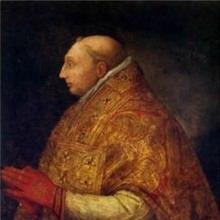
Background
The man who was to become Pope Martin V was born in Genazzano, Italy, on February 20, 1368; the son of Agapito Colonna and Caterina Conti. His name was Oddone Colonna, and he was the only member of that illustrious Roman family ever to be elected to the throne of Peter.
Education
Oddone studied law at the University of Pavia.
Career
Martin was made a cardinal by Innocent VII in 1405 and three years later, at the height of the quarrel between the Avignonese and the Roman claimants to the papal chair, withdrew his obedience from Gregory XII.
Thereupon, in 1409, he participated in the Council of Pisa, which had been convoked in a desperate effort to end the schism. He voted in the election of Alexander V in 1409 and of John XXIII in 1410, hoping in each case, as did all men of goodwill, that the choice of the council would prevail and that the two reigning popes, Benedict XIII and Gregory XII, would accept the conciliar decision that they be deposed. They did not, and another council was convoked, this time at Constance (1414 - 1418).
After a long debate on electoral procedure, 22 cardinals and 30 delegates from the five nations represented chose Oddone Colonna as Pope Martin V. The election took place on November 11, 1417. With the temporary exception of Aragon, all Western Christendom now recognized Martin V as the true and only vicar of Christ.
Before leaving for Rome, Martin made known his hostile feeling toward the possibility of future supremacy of councils over popes, implied during several sessions at Constance. On May 10, 1418, he ordered read in consistory the constitution which prohibited all appeals from the judgment of the pope in matters of faith. Six days later, on May 16, Martin left Constance. His ultimate destination was Rome, but he could not go there at once because the roads were under the control of Braccio da Montone, a mercenary general. He spent some time in Mantua and Florence and arrived at Rome only on September 28, 1420.
He found the city in a shocking condition of decay. Rome and the entire states of the Church had fallen under petty despots in the long absence of firm papal control. Martin V was not the man to permit such conditions to persist. He at once set to work, establishing order and restoring the dilapidated churches, palaces, bridges, and other public structures. For this reconstruction he engaged some famous masters of the Tuscan school, and thus laid the foundation for the Roman Renaissance. However, Martin was constrained to continue the vicious practice of selling Church offices.
The Pope summoned a council to Pavia in April 1423 in obedience to the decree Frequens promulgated at Constance. One of the principal tasks of the Council of Pavia was an undertaking dear to the heart of the Pope: reunion of the Roman and Greek Churches, for which hope had been quickened by some of the sessions of Constance. All efforts failed, however; and when the delegates moved to establish the principle of conciliar superiority to popes, Martin quickly dissolved the council.
It is fair to say that without Martin V's unswerving support of papal supremacy at a time when either road could have been taken, the Roman Church might well have changed from an authoritarian to a democratic institution. In a bull of 1425, the Pope proposed changes in the financing of the Curia, but this effort at reform found little support and died quickly.
It has been said that Martin V was a gentle man, and this judgment seems to be borne out by his many attempts, through correspondence and emissaries, to bring about peace between England and France, engaged at that time in the Hundred Years War. Obedient to the letter if not always to the spirit of Constance, Martin summoned another council, to meet in 1431 at Basel.
On February 20, 1431, shortly before the council was to meet, he died.