

Background
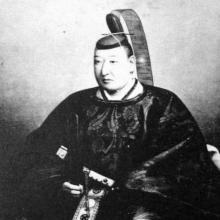
Masahiro Abe was born on 3 December 1819 in Edo, Japan. He was the son of Abe Masakiyo, lord of the domain of Fukuyama in the province of Bingo. His childhood name was Gozo, but he was later known as Kazue; his literary name was Yuken.

阿部正弘
Masahiro Abe was born on 3 December 1819 in Edo, Japan. He was the son of Abe Masakiyo, lord of the domain of Fukuyama in the province of Bingo. His childhood name was Gozo, but he was later known as Kazue; his literary name was Yuken.
In 1836 he succeeded his elder brother Masayasu as lord of the domain, which received a revenue of 100,000 kohi of rice a year. In 1840 he became jisha-bugyo, official in charge of temples and shrines for the shogunate. During his term in office, he succeeded in disciplining Nikkei, a priest of the Chiscn-in, a subtemple of Hokekyo-ji at Nakayama in Shimosa. Nikkei as a man of religion had enjoyed special confidence with the women of the shogun’s private quarters and had taken advantage of this fact to secure improper advantages. Masahiro won widespread renown by having him banished to a distant island, a daring move, since Nikkei’s close connections with the women of the shogun's household had previously protected him from disciplinary measures.
In 1843, at the age of twenty-four, Masahiro became a roju, or councilor of state.
In 1855 he recommended Hotta Masayoshi to the position of roju and stepped down himself. He died in the seventh month of 1857 at the age of thirty-eight.
When Perry arrived in Japan in 1853 and demanded the opening of the country to trade relations, he consulted with the various daimyo and decided to open the country. The following year, he concluded a friendship treaty with the United States and opened the two ports of Shimoda and Hakodate; this was followed by similar treaties with Russia, England, and Holland. At Masahiro’s insistence, however, trade was not at this time permitted at the ports that had been opened. He worked to stabilize the position of the shogunate by emphasizing a policy of cooperation with the daimyo and the imperial court.
In addition to the foregoing, his achievements include the removal of the ban on the construction of large ships; the establishment of a shogunate naval force; the setting up, under the stimulus afforded by a knowledge of Western armed forces, of the Köbujö, a forerunner of the military academy known as the Kobusho; and the spread of a knowledge of Western culture through the creation of the Yogakusho, the forerunner of the Bansho Shirabesho, a shogunate center for Western studies. Such able and progressive officers of the shogunate as Kawaji Toshi- akira, Tsutsui Masanori, Iwase Tadanari, Nagai Naomune, and Egawa Hidetatsu were all promoted to office by him.
He was given the honorary title of Isc-no-kami.
