

Background
Maureen Baker was born on March 9, 1948, in Toronto, Ontario, Canada; the daughter of Albert T. and Irene May Baker.


http://www.amazon.com/gp/product/075533339X/?tag=2022091-20
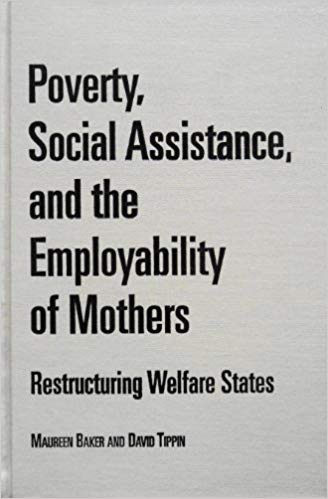
(Why do some welfare states provide income support for mot...)
Why do some welfare states provide income support for mothers to care for their school-aged children at home while others expect them to find employment when their youngest child is six months old? This study, a fundamental contribution to social policy and social welfare theory, compares recent efforts to restructure social programs for low-income mothers in four countries: Canada, Australia, New Zealand, and the United Kingdom. While these countries are sometimes classified as liberal welfare states, this book demonstrates that they vary considerably in terms of benefit development, expectations concerning maternal employment, and restructuring processes. The authors examine changes to income security programs, discuss the social, political and economic conditions affecting these programs, and analyse the discourse promoting reform. Using a feminist and political economy perspective, they conclude that recent, often expensive, efforts to make beneficiaries more employable have not always enabled them to escape welfare or poverty. While full-time employment opportunities are becoming scarcer, governments are requiring beneficiaries to enter the workforce, often with little social support or improvement in income. Regardless of the impact of employability initiatives on poverty levels, the study concludes that these policies are important ideological instruments in tempering demands on contemporary welfare systems. The result is a more residual welfare state, in which social provision is increasingly presented as a meagre last resort.
http://www.amazon.com/gp/product/0802043577/?tag=2022091-20
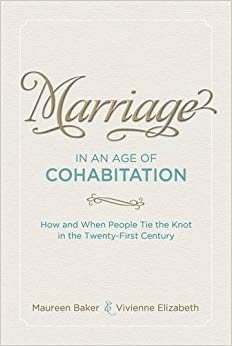
(In the past few decades, legal marriage rates have declin...)
In the past few decades, legal marriage rates have declined in the Western world. Many heterosexual and same-sex couples today are living together or cohabitating for several years before tying the knot. The changing nature of intimate relationships and the very meaning of marriage have resulted in a period of extended intimate partnership that may - or may not - result in marriage. Sociologists Maureen Baker and Vivienne Elizabeth present a cutting-edge discussion of contemporary ideas about marriage and living together. They explore the reasons why certain couples who cohabitate eventually decide to formalize their long-term relationship, and whether formalization actually makes a difference for the couple and those around them. While the decision to marry has evolved from previous generations, so have the practices surrounding wedding rituals. The authors discuss aspects of the wedding industry, examining which traditions couples are retaining and which they are personalizing, such as writing non-patriarchal vows and sharing personal stories about their relationship. The authors also compare the cohabitation and wedding rituals practiced by same-sex and different-sex couples. Baker and Elizabeth draw on a wide range of international studies - from Canada, Australia, New Zealand, the United Kingdom, and the United States - as well as their own research, in which they interviewed marriage celebrants and long-term cohabitants who are heterosexual and gay/lesbian, aged from 28 to 63, and from a variety of social backgrounds. The result is a fascinating, multi-generational study of the lives of couples around the world as they negotiate their relationships in the twenty-first century.
http://www.amazon.com/gp/product/0199002630/?tag=2022091-20
Maureen Baker was born on March 9, 1948, in Toronto, Ontario, Canada; the daughter of Albert T. and Irene May Baker.
Baker earned his Bachelor of Arts degree from the University of Toronto, in 1970. Two years later she obtained Master of Arts degree at that university. Finally, she became Doctor of Philosophy at the University of Alberta, Edmonton, in 1975.
Baker held a position of an assistant professor at the Acadia University, for 2 years from 1974. From 1978 till 1983 she served at the same position, at the University of Toronto. Next year she was appointed as a senior researcher by the Parliament of Canada, staying there until 1990.
From 1990 to 1997, Baker served as a professor of social work at the McGill University.
Since 1998, she moved to the University of Auckland, becoming a holder of the chair in sociology.
(Why do some welfare states provide income support for mot...)
(Designed specifically for sociology of the family courses...)
( Recent years have seen significant changes in the socia...)
( With poverty, unemployment, and one-parent families on ...)
(In the past few decades, legal marriage rates have declin...)
Maureen married John J. J. Archer, but they divorced in 1975. Baker married David John Tippin, in July 1983.
