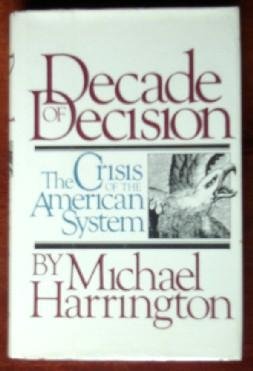
(Harrington's best-known book, an examination of poverty a...)
Harrington's best-known book, an examination of poverty among Americans excluded from postwar affluence. It helped make poverty a central issue of national policy and influenced the War on Poverty.
Michael Harrington was an American socialist writer, political theorist, educator, and activist best known for The Other America: Poverty in the United States (1962). His writing helped place poverty at the center of national policy debate, while his leadership shaped the Socialist Party, Democratic Socialist Organizing Committee, and Democratic Socialists of America.
Background
Harrington was born on February 24, 1928, in St. Louis, Missouri, to Edward Michael Harrington and Catherine Fitzgibbon Harrington. He grew up in an upper-middle-class Irish-Catholic family and received a traditional Catholic upbringing.
His family background combined professional and religious influences. His father was a patent attorney, and his mother had been a schoolteacher before devoting herself to the household. Harrington's early environment gave him access to strong educational opportunities and a Catholic moral vocabulary that remained influential even after he became an atheist.
Education
Harrington attended St. Louis University High School, a Jesuit secondary school, where the intellectual and ethical traditions of Jesuit education shaped his early outlook. He then studied at the College of the Holy Cross and received a Bachelor of Arts degree in 1947.
After Holy Cross, Harrington attended Yale Law School from 1947 to 1948 but did not complete a law degree. He transferred to the University of Chicago, where he received a Master of Arts degree in English literature in 1949. His education combined Catholic intellectual formation, literary study, and the political and social concerns that later informed his writing.
In 1966, Bard College awarded him a Doctor of Humane Letters. By that time Harrington had already developed a public career as a writer, socialist organizer, and commentator on poverty and American political life.
Harrington began his public working life in New York in the early 1950s as an associate editor of The Catholic Worker, the newspaper associated with Dorothy Day's Catholic Worker movement. From 1951 to 1952 he also worked with Saint Joseph's House of Hospitality, a Catholic Worker settlement house serving poor and homeless people. These experiences brought him into direct contact with urban poverty and influenced his transition from Catholic activism toward democratic socialism.
In 1953 he became organization secretary of the Workers Defense League. He later served as a consultant to the Fund for the Republic from 1954 to 1989 and participated in research and public discussion concerning civil liberties, labor, democracy, and social policy. In 1959 he co-edited Labor in a Free Society and wrote widely for political and literary publications.
Harrington became editor of New America from 1961 to 1962. He also organized the March on Conventions Movement in 1960 and helped connect socialist politics with labor and civil-rights activism. His 1962 book The Other America: Poverty in the United States described the living conditions of poor Americans and helped inspire the Kennedy and Johnson administrations' War on Poverty.
He was appointed professor of political science at Queens College of the City University of New York in 1972 and remained associated with the college until his death. He was named a distinguished professor in 1988. Alongside teaching, he wrote, lectured, appeared on radio programs, advised reform movements, and participated in international socialist organizations.
Harrington continued political and intellectual work after being diagnosed with esophageal cancer. He founded the Next America Foundation in 1988 to support research on poverty and completed The Long-Distance Runner: An Autobiography during his illness. He died of cancer at his home in Larchmont, New York, on July 31, 1989, at the age of 61.
He continued public and intellectual work despite the disease until shortly before his death.
The Other America: Poverty in the United States brought the conditions of poor Americans to national attention and helped inspire the federal War on Poverty.
Harrington developed a prominent body of writing on poverty, socialism, labor, religion, democracy, technological change, and American political life.
He helped establish Democratic Socialists of America as a major organization of the American democratic-socialist movement.
He founded the Next America Foundation in 1988 to support research on poverty.
(Protected edition record for Harrington's autobiography.)
Religion
Harrington was raised in Roman Catholicism, received a Jesuit education, and worked in Dorothy Day's Catholic Worker movement before leaving the Church. In adult life he described himself as an atheist and a “pious apostate,” while continuing to treat religious questions as central to moral and political life.
His religious outlook remained shaped by Catholic social ethics, especially concern for poverty, human dignity, solidarity, and the moral obligations of social institutions. In The Politics at God's Funeral, he argued that the decline of religious authority created a crisis of shared values and explored how democratic socialism might preserve ethical commitments associated with Judaism and Christianity in secular form.
Politics
Harrington's political life developed within the American socialist tradition. He joined the Socialist Party and served on its national executive committee from 1960 to 1972, becoming national chairman in 1968. He later chaired the Democratic Socialist Organizing Committee from 1973 to 1982 and helped found Democratic Socialists of America, serving as its co-chairman from 1982 until his death.
Harrington advocated democratic socialism, civil liberties, economic equality, racial equality, feminism, labor rights, and the expansion of democratic control over economic life. He rejected Communist authoritarianism and favored a realignment strategy that sought to build a socialist movement within and alongside the Democratic Party rather than establish an isolated third party.
The Democratic Socialist Organizing Committee and Democratic Socialists of America joined socialist politics with the movements for civil rights, women's equality, labor representation, and peace. Harrington described this orientation as the “left wing of the possible,” emphasizing practical reforms while retaining a long-term goal of democratic social transformation. He also served as honorary president of Socialist International and contributed to the organization's New Declaration of Principles during the 1980s.
Views
Harrington's philosophy centered on democratic socialism as an ethical and political response to poverty, inequality, and the concentration of economic power. He argued that freedom required more than formal political rights and depended on social arrangements that gave people meaningful control over the conditions of their lives.
He rejected both laissez-faire indifference to poverty and authoritarian forms of communism. His preferred alternative combined democratic institutions, economic planning, labor organization, equitable distribution, feminism, racial equality, and popular control of resources and production.
Harrington believed that political action required both moral vision and practical reform. His strategy of socialist realignment sought to make the labor movement and democratic left effective forces within American political life rather than treating socialism as a purely doctrinal or sectarian project.
Quotations:
“To be socialist … is to make an act of faith, of love … toward this land.”
“To be radical is, in the best and only decent sense of the word, patriotic.”
“The left wing of the possible.”
Membership
Harrington served on the boards of the Workers Defense League and the American Civil Liberties Union. He was also associated with the League for Industrial Democracy and international socialist organizations, whose work connected labor rights, democratic participation, civil liberties, and social reform.
His professional and political associations placed him within the institutions through which American socialists, labor activists, civil-liberties advocates, and academics debated poverty, democracy, and economic justice.
Served on the board of directors.
Workers Defense League
,
United States
Served on the board of directors.
American Civil Liberties Union
,
United States
Served as chairman of the board.
League for Industrial Democracy
,
United States
Personality
Harrington was known for combining intellectual seriousness with an informal, energetic, and often humorous manner. He spoke about poverty and socialism in accessible language, translating statistical and economic analysis into moral and human terms.
He maintained a demanding schedule of writing, teaching, lecturing, political organizing, and public commentary. Even while undergoing treatment for cancer, he continued working on books and political projects, reflecting the persistence that characterized the final period of his life.
Physical Characteristics:
Harrington underwent surgery and chemotherapy for cancer of the throat and esophagus during the 1980s.
Quotes from others about the person
Gerald McEntee of the American Federation of State, County and Municipal Employees described Harrington as a writer who translated the dry statistical analysis of poverty into passionate human terms and gave moral and intellectual strength to the idea that government should make the elimination of poverty a primary social goal.
Senator Ted Kennedy said that Harrington had delivered the Sermon on the Mount to America and called him a loyal ally of people engaged in the War on Poverty.
Interests
Writing, lecturing, political discussion, labor organizing, civil-liberties advocacy, and the study of poverty, religion, democracy, and social policy.
Philosophers & Thinkers
Karl Marx
Politicians
Eugene V. Debs; Norman Thomas; Dorothy Day
Writers
Dorothy Day
Connections
Harrington married Stephanie Gervis, a writer associated with The Village Voice, on May 30, 1963. They remained married until his death and had two sons.
His family life continued alongside his political and academic work. Gervis survived him and continued her career as a writer after his death.
Father:
Edward Michael Harrington
Harrington's father was a patent attorney.
Mother:
Catherine Fitzgibbon Harrington
Harrington's mother had been a schoolteacher before devoting herself to the household.
Wife:
Stephanie Gervis
Writer associated with The Village Voice; married Harrington on May 30, 1963.
Awarded for The Other America: Poverty in the United States, which documented poverty in the United States and brought the subject into national public debate.
Awarded for The Other America: Poverty in the United States, which documented poverty in the United States and brought the subject into national public debate.
Sidney Hillman Award,
United States
Recognized Harrington's writing and public work concerning poverty, labor, and social justice.
Recognized Harrington's writing and public work concerning poverty, labor, and social justice.
Riordan Award,
United States
Award from the District of Columbia Newspaper Guild recognizing Harrington's public and journalistic contribution.
Award from the District of Columbia Newspaper Guild recognizing Harrington's public and journalistic contribution.
Eugene V. Debs Award,
United States
Award from the Eugene V. Debs Foundation recognizing Harrington's contribution to democratic socialism and the labor movement.
Award from the Eugene V. Debs Foundation recognizing Harrington's contribution to democratic socialism and the labor movement.