Background
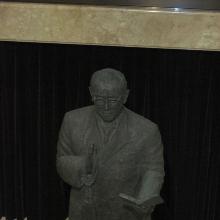
Born in the snow country of northern Japan on November 15, 1906, as Shikazo Niwano, he was the son of Jukichi Niwano, a farmer. He learned the special kind of cooperation that was needed to survive the most severe winter climate in Japan.

( Buddhism for Everyday Life emphasizes the fundamental B...)
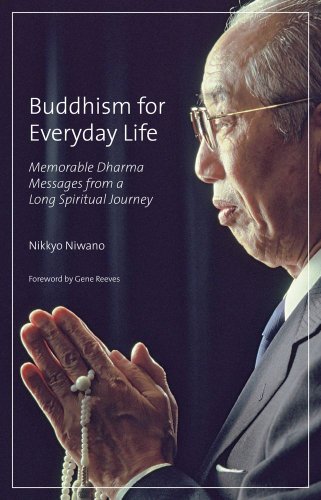
Buddhism for Everyday Life emphasizes the fundamental Buddhist principles that everything is constantly changing and is interdependent. Reverend Nikkyo Niwano teaches that life's impermanence holds the promise of infinite potential, and that the recognition of how all people and all things are interrelated can form the basis of our lasting happiness. Throughout these pages, the sensitivity, consideration, and wisdom of Reverend Niwano cannot fail to inspire.
http://www.amazon.com/gp/product/4333024838/?tag=2022091-20
http://www.amazon.com/gp/product/4333010012/?tag=2022091-20
(Combining time-honored Buddhist teachings and stories wit...)
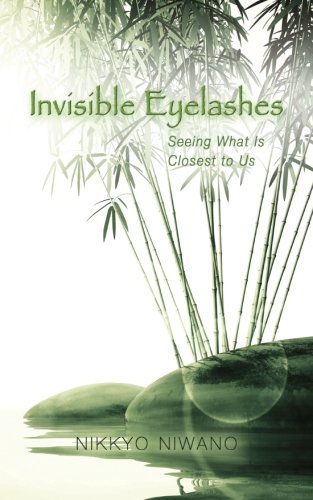
Combining time-honored Buddhist teachings and stories with examples from modern life, Rev. Nikkyo Niwano shows us how we may attain a uniquely Buddhist way of reflecting on our everyday ways of thinking and being. We learn why attitude affects happiness, and how flexibility of mind helps us grow spiritually, making us more productive at work and better able to relate to others. We learn how even desires and self-love can be used to make the world more harmonious. Finally, this prominent Buddhist explains how taking a deep look at what is closest lets us see the way our individual lives fit into the universe.
http://www.amazon.com/gp/product/4333016819/?tag=2022091-20

(Book by Niwano, Nikkyo)
Book by Niwano, Nikkyo
http://www.amazon.com/gp/product/4333003083/?tag=2022091-20
(Book by Niwano, Nikkyo)
Book by Niwano, Nikkyo
http://www.amazon.com/gp/product/4333003369/?tag=2022091-20
( This concise, readily understandable book is designed a...)
This concise, readily understandable book is designed as a guide to one of the supreme scriptures of Mahayana Buddhism: the Threefold Lotus Sutra. The first publication of the complete sutra in English (Kosei, 1975) was widely acclaimed, and an ever-growing audience has been created for what is certainly among the greatest of the world's religious documents. Like the Bible and the Koran, however, the Threefold Lotus Sutra requires explanation by a gifted teacher, and it is for this reason that Niwano has written this guide. Giving careful consideration to the relationships among the thirty-two chapters of the sutra, he not only outlines the contents but also explains the major points.
http://www.amazon.com/gp/product/4333002702/?tag=2022091-20
http://www.amazon.com/gp/product/B0088PJ71C/?tag=2022091-20
( This concise, readily understandable book is designed a...)
This concise, readily understandable book is designed as a guide to one of the supreme scriptures of Mahayana Buddhism: the Threefold Lotus Sutra. With careful consideration of the relationships among the 32 chapters, the author outlines the contents and explains the major points.
http://www.amazon.com/gp/product/433301025X/?tag=2022091-20
Born in the snow country of northern Japan on November 15, 1906, as Shikazo Niwano, he was the son of Jukichi Niwano, a farmer. He learned the special kind of cooperation that was needed to survive the most severe winter climate in Japan.
This was quite an accomplishment for a man who only had a primary school education (but became a lifetime student) and whose sect of Japanese Buddhism was related to Nichiren Buddhism (often noted as the most nationalistic and narrow of Buddhist groups).
At the age of 17 he left home and went to Tokyo, only to arrive there five days before the great earthquake of 1923. He returned home but again went to Tokyo the following year, working first as a gardener and then in a charcoal shop. In 1926 he entered the Japanese navy and served for three years. Upon discharge he returned to the charcoal shop, got married, and began a family. His interest in the owner's practice of fortunetelling led him into esoteric and traditional folk religion. Serious illness of his first children, both daughters, led him to explore folk spirituality — paranormal phenomena such as faith healing, prophecy, and knowledge of personality traits from physical correspondents such as name interpretation. He joined one of the so-called new religions named Reiyukai.
Young Niwano began to neglect both his family and his newly started pickle business for his religious work, so he opened a milk shop in order to have enough time to continue his religious practices. One of his customers was Masa Naganuma, who was ill, and he interested her in faith healing. Internal dissension within Reiyu-kai led Niwano and some 30 others to start their own religious group. On March 5, 1938, Niwano and Masa Naganuma founded Rissho (establishing the teaching of the law in the world) Ko (mutual exchange of thought) Sei (perfection of the personality and the attainment of Buddhahood) Kai (association, society). Niwano changed his first name to Nikkyo and Masa Naganuma to Myoko (she became known as Myoko Sensei, teacher Myoko). Rissho Kosei-kai was classified by the government as a new religion as it brought together folk and Nichiren Buddhist elements. (This misnomer fails to account for religious strains going back centuries in Japan — hardly a new religion. Some scholars have finally noticed this discrepancy. ) Because the militarists believed that Nichiren Buddhism was nationalistic, little pressure was brought to bear on Rissho Kosei-kai during its first years. In August of 1941, however, President Niwano and Myoko Sensei were arrested on charges brought by their former religious group — that they were confusing the local people. Because of the arrests, many ceased their membership. This became known as the "first flight of steps. "
In 1944 Niwano faced a crisis of a personal nature. Myoko Sensei had a revelation for Niwano to live similarly to a Buddhist monk, so he sent his family to the country. She also revealed to him that he was to do no other reading than the Lotus Sutra. He used the next ten years for study and discipline. But in 1954 he brought his family back, choosing a Buddhism of laity rather than that of the clergy. His harder decision was between revelations from mediumship and knowledge from the Lotus Sutra. He finally opted for the latter when there was any discrepancy between the two. Within three years Myoko Sensei died and the use of mediums ended.
In 1956 the "second flight of steps" occurred when more members left after a newspaper attacked the organization, its business practices, and its leadership for a three month period. Even though the criticisms were refuted, nearly 20 percent of the membership had walked away.
With Myoko Naganuma's death in 1957 President Niwano made Shakyamuni Buddha and the Lotus Sutra the central focus of Rissho Kosei-kai. The postwar years saw phenomenal growth. A practice of meeting together in small groups presided over by a leader conversant in the teachings of the Lotus Sutra may have contributed to this growth more than any other factor. The practice was called Hoza.
Receiving advice to avoid controversies with Sokagakkai over what was the true Buddhism, Niwano began to involve Rissho Kosei-kai in sharing Buddhism's compassion for suffering and concern for peace beyond his own country. This came at a time when Japanese were not too welcome in most parts of the world. Through cooperation with the International Association for Religious Freedom (IARF) and with the World Conference on Religion and Peace, Niwano began ten years of work and service that would culminate in the two international awards mentioned earlier. Then in 1981 he was elected president of IARF and brought the first IARF Congress to Asian soil.
Niwano built in Rissho Kosei-kai the most international religious organization in Asia as evidenced by the relief campaigns for Southeast Asia and Africa in the 1980s. His Niwano Peace Foundation gave annual recognition to persons whose activities advanced religion and peace. Another measurement of his influence was his work with the United Nations (UN), the Vatican, and the World Council of Churches; there was growing expertise within Rissho Koseikai (RKK) in international diplomacy. A stream of dignitaries passed through RKK's headquarters to talk with Niwano or the RKK staff. Niwano's efforts for peace and worldwide cooperation made him one of the most active religious leaders in the world.
( This concise, readily understandable book is designed a...)
( This concise, readily understandable book is designed a...)
( Buddhism for Everyday Life emphasizes the fundamental B...)
(Combining time-honored Buddhist teachings and stories wit...)
(Book by Niwano, Nikkyo)
(Book by Niwano, Nikkyo)