

Background
Graebner, Norman Arthur was born on October 19, 1915 in Kingman, Kansas, United States. Son of Rudolph William and Helen (Brauer) Graebner.

(Book by Graebner, Norman A.)
Book by Graebner, Norman A.
http://www.amazon.com/gp/product/0941690407/?tag=2022091-20

(Book by Graebner, Norman A.)
Book by Graebner, Norman A.
http://www.amazon.com/gp/product/088295573X/?tag=2022091-20

http://www.amazon.com/gp/product/0842022325/?tag=2022091-20
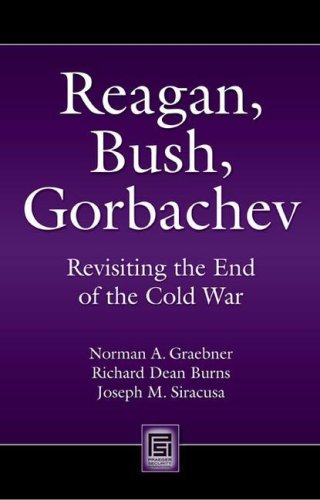
( This work is a contemporary chronicle of the Cold War a...)
This work is a contemporary chronicle of the Cold War and offers an analysis of policy and rhetoric of the United States and Soviet Union during the 1980s. The authors examine the assumptions that drove political decisions and the rhetoric that defined the relationship as the Soviet Union began to implode. This work demonstrates that while the subsequent unraveling of the Soviet empire was an unintended side effect of Mikhail Gorbachev's reforms, termination of the Cold War was not. Ronald Reagan deserves full credit for recognizing Gorbachev's sincerity and his determination to change the direction of Soviet policies. For this, Reagan felt the full wrath of anticommunist hawks for doing business with a communist leader. But it was Gorbachev who concluded the superpowers had become mesmerized by ideological myths which ruled out any meaningful discussions of a possible accommodation of political issues for more than four decades. The evidence is compelling that Gorbachev himself broke the Cold War's ideological straight jacket that had paralyzed Moscow and Washington's ability to resolve their differences. Though politically weakened, Gorbachev conceded nothing to U.S. military superiority. Never did he negotiate from a position of weakness. In doing so, the last Soviet leader faced even greater political and physical risk. Without Gorbachev the end of the Cold War could have played out very differently and perhaps with great danger.
http://www.amazon.com/gp/product/0313352410/?tag=2022091-20

(Book by Graebner, Norman A.)
Book by Graebner, Norman A.
http://www.amazon.com/gp/product/0874360331/?tag=2022091-20

http://www.amazon.com/gp/product/B0007DFERY/?tag=2022091-20
(Chronicles the evolution of the political relationship be...)
Chronicles the evolution of the political relationship between Reagan and Mikhail Gorbachev, and that relationship's role in ending the Cold War.
http://www.amazon.com/gp/product/B00FBBJOCS/?tag=2022091-20

( Freedom! Freedom! The word "rings" with meaning to each...)
Freedom! Freedom! The word "rings" with meaning to each of us! Yet, what does it really mean? Only the tyrant, living in a secure environment and operating above the law, is theoretically free to do as he chooses. For the remainder of society freedom is an elusive condition, circumscribed by a wide spectrum of personal, social, economic, and governmental restraints. Freedom is bounded most fundamentally by the nature of man and the physical universe. Merely to remain alive human beings must accept a myriad of restrictions on individual appetites, actions, and desires. Personal choices are limited by levels of intelligence and the capacity to think. Effective propaganda or advertising can affect the freedom of those unable to analyze or resist it. Poor health and poverty can set serious limits to choice. No less significant are the intellectual and moral limitations which society imposes on those whom it intends to respect and honor. Social customs and mores, and the restraints they impose, set limits of necessity and respectability and thus, for most, the limits of free choice. Freedom is boundless for none. Those are most free who accept personal and social restraints as the necessary price which they and society must pay for minimum of order, decorum, security, and satisfaction. Freedom with restraint for none creates chaos; freedom with restraint for some creates injustice. Thus restraints must be public no less than private, for freedom, in practice, must be limited by regard for the freedom and welfare of others. This book brings together fourteen outstanding and concerned scholars to acquaint readers with the history, nature, and significance of freedom in America since the Declaration of Independence. Its publication should cause the reader to reflect on the meaning of freedom for the future. Following a "stage-setting" introduction, the chapters are organized to cover four essential areas of concern: Foundations of Freedom, Freedom and Governmental Processes, Freedom and the Human Condition, and Freedom and the Physical Environment. As would be expected, various points of view are presented. However, the differences are not over the facts, but over their meanings and their significance for the future. Certainly this is one of the better efforts to capture the meaning of democratic thought in American history.
http://www.amazon.com/gp/product/027101234X/?tag=2022091-20

http://www.amazon.com/gp/product/1930053177/?tag=2022091-20

http://www.amazon.com/gp/product/B010DUS8H8/?tag=2022091-20
Graebner, Norman Arthur was born on October 19, 1915 in Kingman, Kansas, United States. Son of Rudolph William and Helen (Brauer) Graebner.
Bachelor of Science, Milwaukee State Teachers College, 1939. Master of Arts, University Oklahoma, 1940. Doctor of Philosophy, University Chicago, 1949.
Doctor of Letters, Albright College, 1976. Master of Arts, Oxford University, 1978. Doctor of Humane Letters (honorary), University Pittsburgh, 1981.
Doctor of Humane Letters (honorary), Valparaiso University, 1981. Doctor of Humane Letters (honorary), Eastern Illinois University, 1986. Doctor of Humane Letters (honorary), University Wisconsin, Milwaukee, 1997.
Doctor of Humane Letters, Averett University, 2003. Doctor of Pedagogy, Marshall University, 1993.
Assistant professor Oklahoma College for Women, 1942—1943, 1946—1947. From assistant professor to professor Iowa State College, 1948—1956. Professor history University Illinois, Urbana, 1956—1967, chairman department history, 1961—1963.
Edward R. Stettinius professor modern American history University Virginia, 1967—1982, Randolph P. Compton professor, Miller Center Public Affairs, 1982—2010. Visiting professor Stanford University, 1952-1953, summers 1959, 72, University Colorado, summer 1968, Concordia Teachers College, summer 1971, United States Military Academy, West Point, New York, 1981-1982, Beloit College, spring 1987, Virginia Military Institute, fall 1987, College of William and Mary, spring 1988, Marshall University, spring 1989. Commonwealth Fund lecturer University College, London, 1958.
Fulbright lecturer University Queensland, Brisbane, Australia, 1963, University Sydney, Australia, 1983, University Heidelberg, Germany, 1998-1999. Distinguished visiting professor history Pennsylvania State University, 1975-1976. Harmsworth professor American history Oxford University, 1978-1979.
Phi Beta Kappa visiting scholar, 1981-1982. Thomas Jefferson visiting scholar Downing College, Cambridge University, 1985. Distinguished visiting professor National War College, 1994-1995.
(Traditions and Values: American Diplomacy 1790-1865 (Amer...)
( Freedom! Freedom! The word "rings" with meaning to each...)
(This book focuses on American political, diplomatic, and ...)
(As the first of a trilogy of works on American diplomacy,...)
( This work is a contemporary chronicle of the Cold War a...)
(Chronicles the evolution of the political relationship be...)
(A text book on diplomacy and American foreign policy.)
(Format Paperback Subject Literary Collections)
(Book by Graebner, Norman A.)
(Book by Graebner, Norman A.)
(Book by Graebner, Norman A.)
Director bicentennial program Pennsylvania State University, 1975-1976. Served to First lieutenant United States Army, 1943-1946. Member American, Southern history associations, Organisation American Historians, Society American Historians, Society Historians American, Foreign Rels.
(president 1972), American Academy Arts and Sciences, Massachusetts History Society, Phi Beta Kappa.
Married Laura Edna Baum, August 30, 1941. Married Jane Shannon, January 3, 1998 (deceased 2002). Married Mary Moon, July 2, 2004.
