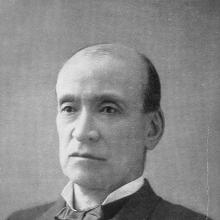
Background
Temple was born near Greeneville, Tennessee, in 1820. He was the son of James and Mary (Craig) Temple, and a descendant of William Temple, a native of England who was living in Goshen, Pa. , in 1721.


(Excerpt from John Sevier: Citizen, Soldier, Legislator, G...)
Excerpt from John Sevier: Citizen, Soldier, Legislator, Governor, Statesman; 1744 1815 Years ago Sevier sat in Knoxville as a memberof the Legislative council for this Territory. Appointed by Washington; we know also that soon after this. For twice six years (two years intervening on account of a constitutional inhihition). He was daily seen on the streets as the chief executive of this young State. We know that he lived around the corner, within sound of my voice that he daily mingled with his fellow citizens most freely. Most unostenta tiously. With that winning grace and open heartedness which captivated all who saw him. We also know that on the lot across the street. Fust opposite to his monument. Then the public square. He denounced General Jackson in the hitterest terms. Accusing him of having stolen and run away with another man's wife. And that the latter in turn denounced him. About the Publisher Forgotten Books publishes hundreds of thousands of rare and classic books. Find more at www.forgottenbooks.com This book is a reproduction of an important historical work. Forgotten Books uses state-of-the-art technology to digitally reconstruct the work, preserving the original format whilst repairing imperfections present in the aged copy. In rare cases, an imperfection in the original, such as a blemish or missing page, may be replicated in our edition. We do, however, repair the vast majority of imperfections successfully; any imperfections that remain are intentionally left to preserve the state of such historical works.
https://www.amazon.com/John-Sevier-Legislator-Governor-Statesman/dp/1332945708?SubscriptionId=AKIAJRRWTH346WSPOAFQ&tag=prabook-20&linkCode=sp1&camp=2025&creative=165953&creativeASIN=1332945708

(Excerpt from An Address Delivered Before the Knoxville In...)
Excerpt from An Address Delivered Before the Knoxville Industrial Association The Immigrant, in selecting a new home, naturally inquires, in refer ence to the point in contemplation, concerning the Climate, the Soil, the Productions, the Schools and Colleges, the state of Society, the Railroads and Markets, the Minerals and Manufactures. About the Publisher Forgotten Books publishes hundreds of thousands of rare and classic books. Find more at www.forgottenbooks.com This book is a reproduction of an important historical work. Forgotten Books uses state-of-the-art technology to digitally reconstruct the work, preserving the original format whilst repairing imperfections present in the aged copy. In rare cases, an imperfection in the original, such as a blemish or missing page, may be replicated in our edition. We do, however, repair the vast majority of imperfections successfully; any imperfections that remain are intentionally left to preserve the state of such historical works.
https://www.amazon.com/Address-Delivered-Knoxville-Industrial-Association/dp/0267852126?SubscriptionId=AKIAJRRWTH346WSPOAFQ&tag=prabook-20&linkCode=sp1&camp=2025&creative=165953&creativeASIN=0267852126

(East Tennessee and the Civil War by Oliver Perry Temple)
East Tennessee and the Civil War by Oliver Perry Temple
https://www.amazon.com/Tennessee-Civil-Oliver-Perry-Temple-ebook/dp/B005WKG8B8?SubscriptionId=AKIAJRRWTH346WSPOAFQ&tag=prabook-20&linkCode=sp1&camp=2025&creative=165953&creativeASIN=B005WKG8B8

(Excerpt from The Covenanter, the Cavalier, and the Purita...)
Excerpt from The Covenanter, the Cavalier, and the Puritan The publication of this little book in its present form is due. To an accidental circumstance. The matter it contains was prepared as a part of a larger and perhaps more important historical work, on which I am now engaged, and which I hope will soon be in print. Happening to show some of the chapters to a friend, in whose judgmenti had great confidence, he said to me: Why not publish these chapters as a separate book? The matter they contain is only remotely related to that of the main book, and the two should not appear to gether. It happened that my own mind was run ning in the same direction, and had nearly arrived at the same conclusion. The publication of this book, in its present form, is, therefore, mainly due to that interview. It is, as it were, a leaf torn from another book. About the Publisher Forgotten Books publishes hundreds of thousands of rare and classic books. Find more at www.forgottenbooks.com This book is a reproduction of an important historical work. Forgotten Books uses state-of-the-art technology to digitally reconstruct the work, preserving the original format whilst repairing imperfections present in the aged copy. In rare cases, an imperfection in the original, such as a blemish or missing page, may be replicated in our edition. We do, however, repair the vast majority of imperfections successfully; any imperfections that remain are intentionally left to preserve the state of such historical works.
https://www.amazon.com/Covenanter-Cavalier-Puritan-Classic-Reprint/dp/1331494338?SubscriptionId=AKIAJRRWTH346WSPOAFQ&tag=prabook-20&linkCode=sp1&camp=2025&creative=165953&creativeASIN=1331494338

( This work has been selected by scholars as being cultur...)
This work has been selected by scholars as being culturally important, and is part of the knowledge base of civilization as we know it. This work was reproduced from the original artifact, and remains as true to the original work as possible. Therefore, you will see the original copyright references, library stamps (as most of these works have been housed in our most important libraries around the world), and other notations in the work. This work is in the public domain in the United States of America, and possibly other nations. Within the United States, you may freely copy and distribute this work, as no entity (individual or corporate) has a copyright on the body of the work. As a reproduction of a historical artifact, this work may contain missing or blurred pages, poor pictures, errant marks, etc. Scholars believe, and we concur, that this work is important enough to be preserved, reproduced, and made generally available to the public. We appreciate your support of the preservation process, and thank you for being an important part of keeping this knowledge alive and relevant.
https://www.amazon.com/Notable-Tennessee-1833-1875-Contemporaries/dp/1296377539?SubscriptionId=AKIAJRRWTH346WSPOAFQ&tag=prabook-20&linkCode=sp1&camp=2025&creative=165953&creativeASIN=1296377539
Temple was born near Greeneville, Tennessee, in 1820. He was the son of James and Mary (Craig) Temple, and a descendant of William Temple, a native of England who was living in Goshen, Pa. , in 1721.
While a student at Greeneville College in 1838 Oliver volunteered as a soldier to aid regulars under Gen. Winfield Scott in his work of pacifying the Cherokee Indians then being moved beyond the Mississippi. In 1841 he entered Washington College, Washington County, Tenn. , and was graduated with the class of 1844.
He entered the field of politics, delivering speeches throughout his congressional district in behalf of Henry Clay, candidate for the presidency. Subsequently he read law in Greeneville under Robert J. McKinney, and in 1846 was admitted to the bar. In July of the following year he was the Whig candidate for Congress against Andrew Johnson, and in a campaign of three weeks, by dexterous attacks on his opponent's record he cut Johnson's usual majority of about 1500 to 314 votes.
In 1848 Temple removed to Knoxville, where he practised law in partnership with leaders of the East Tennessee bar. He was appointed in 1850 one of the commissioners to negotiate with the Indian tribes of Texas, New Mexico, and Arizona.
He took a leading part in the Southern Commercial Convention held in Knoxville in 1856, as proponent and advocate of resolutions against the reëstablishment of the slave trade. In 1860 he was a delegate to the National Union Convention, held at Baltimore, and aided in the nomination of John Bell as candidate for the presidency; subsequently, as a Bell and Everett elector, he canvassed his congressional district. In November of the same year he made the first speech in Tennessee, after Lincoln's election, in behalf of the Union, and in December he planned a meeting of East Tennessee Unionists at Knoxville to consolidate the sentiment of that section against secession.
The following year he stumped East Tennessee for the Union cause, and took a leading part in the Greeneville Convention of June 17, 1861, which declared for a separation of East Tennessee from the state of Tennessee. In July 1866, he was appointed one of the chancellors of Tennessee by Gov. W. G. Brownlow, and continued as such until September 1878. He then returned to the bar but after 1881 devoted his attention to his large estate. When more than seventy-five years old he turned to authorship. His first production was The Covenanter, the Cavalier and the Puritan (1897). This was followed by East Tennessee and the Civil War (1899), and Notable Men of Tennessee, published in 1912, after his death. He wrote in a vigorous and interesting, though not graceful style, and drew copiously from his own rich store of reminiscences.
His contribution to the progress of transportation and agriculture in East Tennessee was considerable. He was one of the originators of the Knoxville & Ohio Railroad; a director of the East Tennessee & Georgia Railroad Company, and president of the first macadam turnpike company in his section of the state. Before the Civil War he was a member of the state board of agriculture, and in 1872 he was the prime mover in the organization of the East Tennessee Farmers' Convention. For many years he was active as a trustee of the University of Tennessee, and for a period served as chairman of the board. His work for the institution was directed principally toward the development of the agricultural department.
After the war, Temple promoted agricultural and industrial development in East Tennessee, most notably by assisting in the development of the Rugby Colony, and in later years wrote several books on the history of East Tennessee. After his death the Farmers' Convention built Temple Hall on the experimental farm of the University, in his honor.
(Excerpt from An Address Delivered Before the Knoxville In...)
(Excerpt from John Sevier: Citizen, Soldier, Legislator, G...)
( This work has been selected by scholars as being cultur...)
(Excerpt from The Covenanter, the Cavalier, and the Purita...)
(East Tennessee and the Civil War by Oliver Perry Temple)
Temple married Scotia Caledonia Hume in 1851. Their only child, Mary Boyce Temple (1856–1929), compiled and published Notable Men of Tennessee, a collection of biographies her father had written about various Civil War-era figures.